
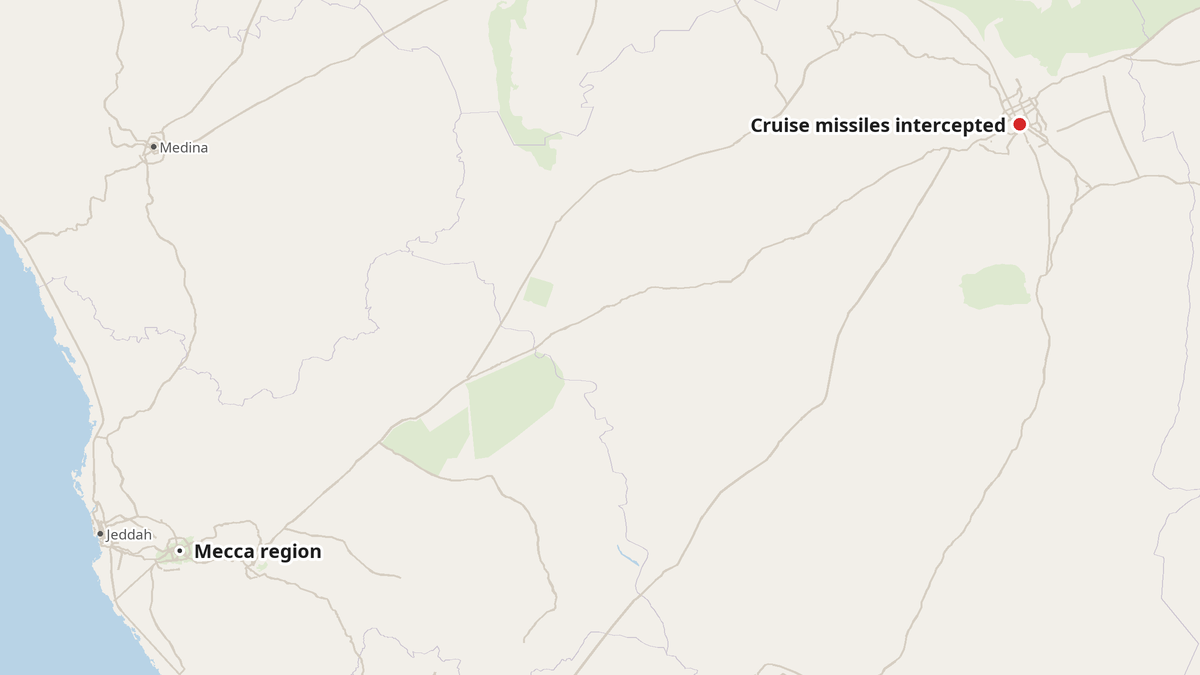
Debris from two Houthi ballistic missiles fell in the Mecca region on Wednesday, November 11, after Saudi air defenses intercepted and destroyed them, Saudi Arabia's civil defense said. Saudi state television placed the fallout in Sabuhah village, about 35 km (22 miles) northeast of the Grand Mosque, and in Wadi al-Maghmas, about 21 km east of it. Islam's holiest city sat inside the strike zone of an Iran-aligned militia.
The Saudi-led coalition said earlier that it had intercepted three cruise missiles launched toward Riyadh, plus drones aimed at Mecca and the kingdom's southern regions. A drone was also intercepted and destroyed in the Eastern Province overnight, according to Ynet, citing Saudi reports. Civil Defence teams responded to the falling debris, and authorities said they acted immediately to protect lives and property.
"This hostile targeting of civilian objects constitutes a flagrant violation of international humanitarian law and reflects the dangerous hostile approach pursued by the Houthi militia," Saudi Arabia's civil defense said early Thursday.
The Houthi Denial
The Houthis rejected the Saudi account. A spokesperson dismissed what he called Saudi "lies" that the group had launched a drone toward Mecca. He said a drone was fired at a pumping station in Yanbu on the Red Sea, and that three cruise missiles targeted Riyadh's King Khalid International Airport. The group has repeatedly denied targeting Mecca and Medina, saying its operations are aimed at military and strategic targets elsewhere in the kingdom.
That's an odd defense. By the Houthis' own account, they fired cruise missiles at a major civilian international airport and a drone at an energy facility. Neither is a battlefield. And the debris still fell near Mecca, on the Saudi side's account, whatever the intended target.
The Front Lines in Yemen
On the ground, the fighting has intensified between Saudi-backed forces defending Yemen's internationally recognised government and Houthi fighters. Majed Abdullah al-Nuzaili, spokesperson for Yemen's army, said at least 138 Houthi fighters were killed or wounded. In a post on X, he said the army carried out 773 field artillery attacks, 44 drone strikes and 37 rocket attacks across al-Jawf, Marib, al-Bayda and Taiz governorates. Saudi-led coalition forces conducted 23 air strikes, damaging 86 heavy weapons and military vehicles, he said.
But the Saudi-backed forces haven't stopped Houthi fire on Aden, where the internationally recognised government is based. Information Minister Salem al-Awalqi condemned repeated shelling of the densely populated al-Buraiqa district, calling it part of the militia's "established pattern of targeting civilians and terrorising innocent people." Houthi military spokesperson Yahya Saree claimed his forces had "successfully targeted" a coalition command and control centre in al-Buraiqa with "several ballistic missiles." Two Yemeni security sources told AFP that two missiles hit a coalition camp in western Aden and a third struck another camp in the city centre, which was attacked several times last month.
The Human Toll
The civilian cost is climbing. The World Health Organization counted 11,755 casualties as of November 8, including 2,098 killed and 9,657 wounded. More than 2,000 were recorded in just nine days, with Marib and Lahij among the worst-hit governorates. More than 320,000 people have been displaced since August 1, almost 16,000 of them in the past week. The WHO said strikes have hit health facilities and ambulances, and fuel shortages are disrupting emergency medical services in Taiz.
The Houthis seized Sanaa 12 years ago. Saudi Arabia intervened militarily 11 years ago in support of the recognised government. A UN-brokered truce four years ago largely froze the conflict, but hostilities resumed earlier this year, with the Houthis launching missile and drone attacks on Saudi territory and Riyadh carrying out airstrikes in Yemen. The escalation now threatens the Bab el-Mandeb Strait, a key shipping route linking the Red Sea and the Gulf of Aden.
Why This Matters: A militia armed and aligned with Iran has again put missiles and drones in the air toward Saudi Arabia's capital, its energy infrastructure and the approaches to Mecca. The UN-brokered truce held for four years, then collapsed. That's the lesson for anyone betting on paper arrangements with armed groups that answer to Tehran: without credible deterrence and air defense, they don't hold. The stakes reach well past Yemen. Bab el-Mandeb carries commercial shipping, and Houthi capabilities put it at risk. Saudi interceptors worked this time. The WHO's casualty figures show how quickly the human cost rises when proxy forces keep fighting. Hard security, not statements, is what keeps civilians alive in this theater.
- houthi
- saudi arabia
- yemen
- mecca
- ballistic missiles
- aden
- civilian casualties
- bab el-mandeb strait