
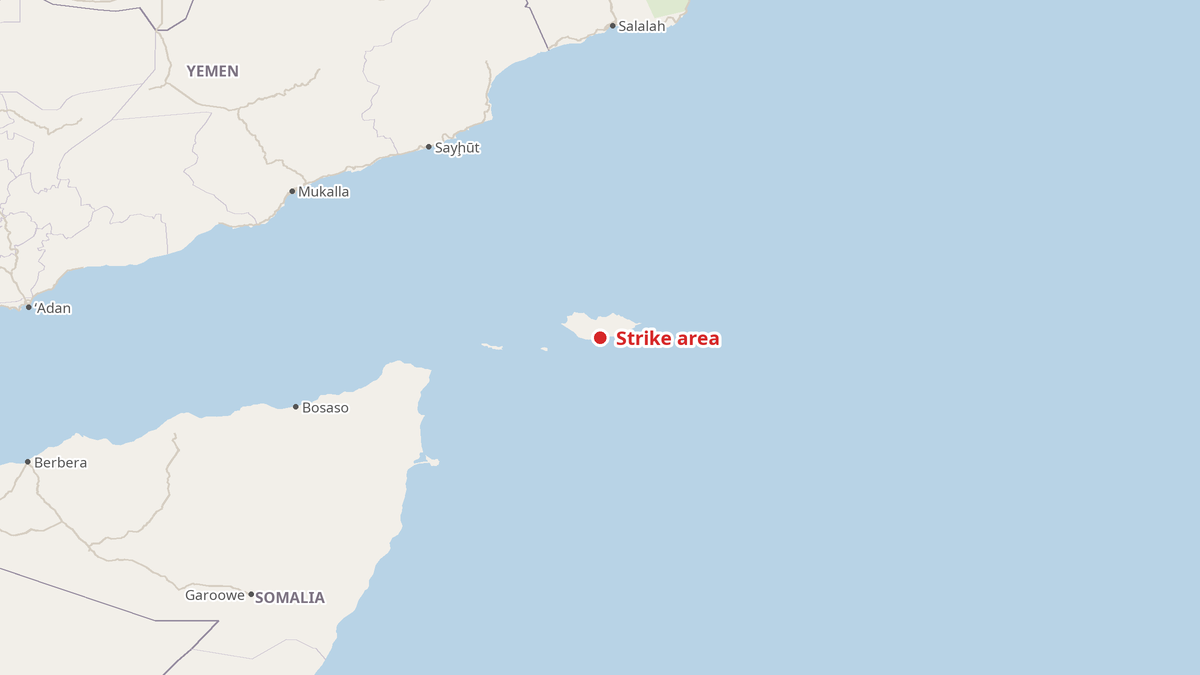
Sixty recruits died when Houthi missiles struck a government military camp in southern Yemen, Yemeni officials said Tuesday. More than 200 others suffered wounds. The missiles hit as recruits lined up for training at the al-Alam camp in Shabwa province. The governor said they were preparing to provide security, not fight on the front lines.
A security force in formation
The Shabwa provincial government said the Houthis fired three ballistic missiles at the camp on Monday. At least a dozen people were still missing a day later, three officials said. They spoke anonymously because they weren’t authorized to brief the media.
Videos that circulated online, analyzed by The Associated Press, showed motionless bodies on the camp’s sandy ground. A local government official said several wounded recruits had serious injuries and that officials transferred them to hospitals in other provinces in life-threatening condition.
At least 15 of those killed belonged to one Yemeni tribe, a local official said. Another official identified it as the Awlaki, one of Yemen’s most powerful tribes, centered in Shabwa and Abyan provinces.
Shabwa governor Awad Ibn al-Wazir said in televised comments aired by the Saudi-owned Al Arabiya satellite news television that the recruits came from across Shabwa. “These recruits have never before participated in any mobilization or on any front,” he said. “They have no connection to the front lines ... they were (part of) a non-offensive security force.” His account describes young people assembled under government authority for security work, caught in a missile strike claimed by the armed group fighting that government.
The Houthis claimed the attack, saying they had killed and wounded dozens, but they offered no further details. The al-Alam camp had previously served as a base for a militia backed by the United Arab Emirates. It sits in the Jardan district, north of Ataq, on a crucial supply line connecting to the government-controlled province of Marib.
The power line runs through the provinces
Shabwa, Marib and neighboring Hadramawt province contain what the article describes as the Yemeni government’s “triangle of power,” where the country’s oil and gas production is located. The camp’s position on the supply route puts the strike amid a contest over territory and the infrastructure serving government-controlled areas.
The attack came during a surge in fighting that began when forces from the internationally-recognized government and the Saudi-led coalition launched airstrikes on Houthi-held Sanaa International Airport in July. Those strikes shattered the 2022 ceasefire deal, which had largely stopped fighting in the country’s civil war. The account offers no report of grassroots organizations, mutual aid efforts or civilian-led alternatives around the camp; it documents armed authority confronting armed authority, with recruits and other civilians bearing the consequences.
The Houthis have also fired missiles and drones at Saudi Arabia. Saudi Arabia has struggled to counter the attacks despite having far superior U.S.-supplied arms. Late Tuesday morning, Saudi authorities warned of an attack in the capital area. An explosion followed in northern Riyadh, where King Khalid International Airport is located. Saudi Arabia said it intercepted a Houthi-fired ballistic missile, then issued an all-clear a short time later. The airport had faced repeated Houthi attacks that month, forcing it to suspend operations.
The ceasefire broke; civilians remain exposed
Yemen first plunged into civil war in 2014, when the Houthis seized Sanaa and much of northern Yemen and forced the government into exile. A Saudi-led coalition intervened the following year to restore the government to power. The conflict has killed more than 150,000 people and created one of the world’s worst humanitarian disasters.
The latest strike was described as the deadliest since fighting began escalating three months ago. The ceasefire deal had largely stopped the fighting, but July’s airstrikes ended that pause. Now government recruits, whom their governor described as non-offensive security personnel, lie among the dead and wounded after a missile attack claimed by the Houthis. The rival authorities’ statements name security, restoration and military response; the reported toll names the people who paid for them.
- houthi rebels
- yemen
- missile strike
- al-alam training camp
- shabwa province
- yemeni civil war
- military recruits
- awad ibn al-wazir