
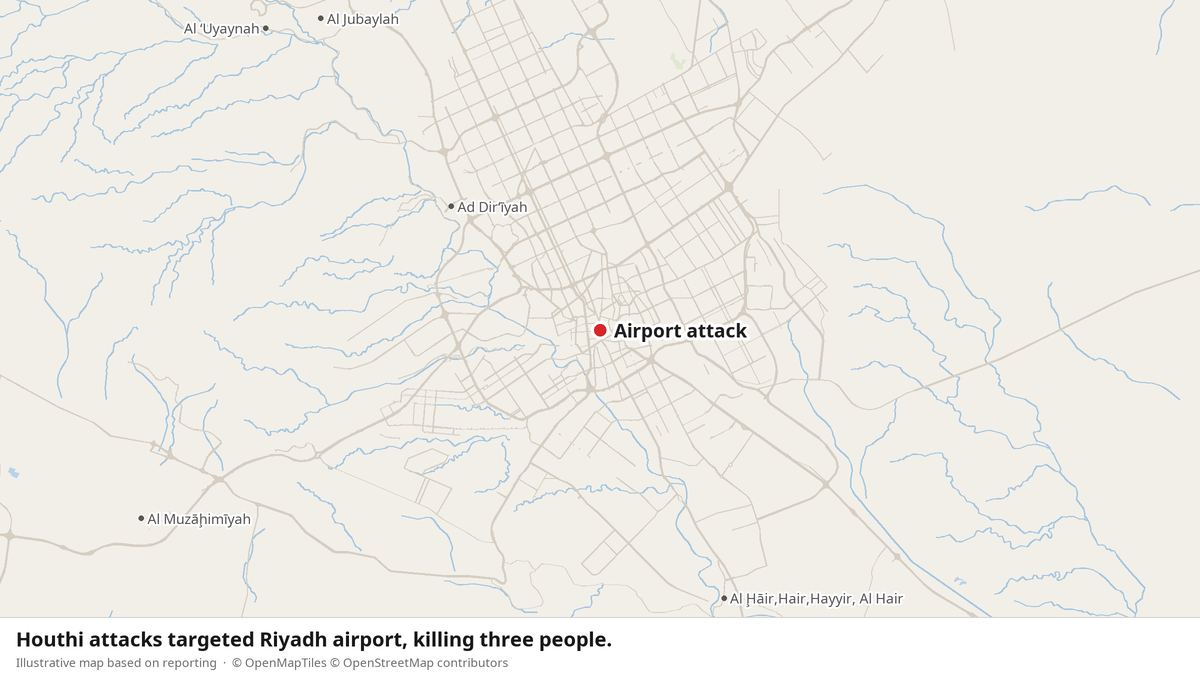
Thursday’s attacks on Riyadh airport killed three people and injured several others, Saudi authorities said Friday. A Saudia Airlines plane suffered damage, smoke rose above the airport, and the airline said one of the dead worked for the company. The people caught in the fighting weren’t directing it. They’re living with the consequences of rival forces trying to impose control through missiles, airstrikes and threats.
Civilians Inside the War Machine
The attacks disrupted flights to Saudi Arabia’s capital just days before it was due to host a major meeting of global oil chiefs. Many airlines cancelled flights. Saudi civil aviation authorities later said air traffic had returned to normal, while Flightradar24 showed flights gradually resuming, including services operated by some Middle Eastern airlines. The airport reopened, but that doesn’t undo the deaths or the damage to the plane.
The Houthis have announced repeated rounds of ballistic missile fire at Saudi Arabia, said they would close Saudi airspace and warned workers at oil facilities that they would strike them. Reuters reported that the group had already killed three people in strikes on airports in the kingdom earlier in the week. Those threats and attacks put workers and travelers within reach of a campaign aimed at pressuring the Saudi state.
Saudi authorities say the Houthis killed three people at Riyadh airport. Houthi officials and affiliated media, meanwhile, reported Saudi airstrikes on targets in Sanaa overnight. The coalition backing government forces in Yemen said it had destroyed three Houthi missile launch platforms and warned it would “respond firmly to attacks on civilians.” Its stated aim is to protect civilians; its method is another round of air war. The account gives no civilian casualty figure for the strikes in Sanaa.
Territory, Retaliation, More Territory
The Saudi-led air campaign seeks to reverse the Iran-allied group’s recent territorial gains, threats to international shipping and attacks on the kingdom. The Houthis have encircled Yemeni government forces in Taiz, Yemen’s third-largest city, and are trying to hold positions on the Red Sea coast against a Saudi-backed offensive. Armed groups contest territory on the ground, while Saudi forces strike targets from the air. People in and around those contested areas remain within reach of competing military power.
Last month, the Houthis advanced down Yemen’s Red Sea coast and took full control of the coastline around the strait. Saudi Arabia then re-entered the long-dormant conflict and backed a government counteroffensive. On Monday, government forces retook territory around the Bab el-Mandeb coastline after intense Saudi airstrikes, and fighting continued there. The map changes hands. The machinery of control keeps moving.
Houthi forces have also cut a key road connecting Taiz, a city of more than half a million people with a garrison of thousands of pro-government fighters, through advances in mountain districts. That detail makes the contest concrete: a road severed, a city and its residents caught amid armed advances, and government forces positioned there. The source doesn’t describe local mutual aid or independent community organizing; it describes the armed actors and the territory they fight over.
A Wider Conflict, More Allies
Yemen’s civil war has become the fiercest front in a wider regional conflict triggered by the U.S. and Israeli attack on Iran that began February 28. The Houthis have fired on shipping in the Red Sea and at the Bab el-Mandeb Strait, while Iran has partly blocked the Strait of Hormuz, further squeezing Gulf oil supplies. The fighting crosses national borders. Disrupted shipping and pressure on global energy markets are among its consequences.
Saudi Arabia is seeking assistance from Pakistan and Turkey, its partners in a mutual defence pact, to ward off Houthi attacks. It has also sought wider assistance from allies to reverse the group’s gains inside Yemen. The report names no aid organizations or grassroots initiatives. What it does show is a conflict answered with more military backing, more airstrikes and more missiles—with the people at the airport among those who pay the immediate price.