
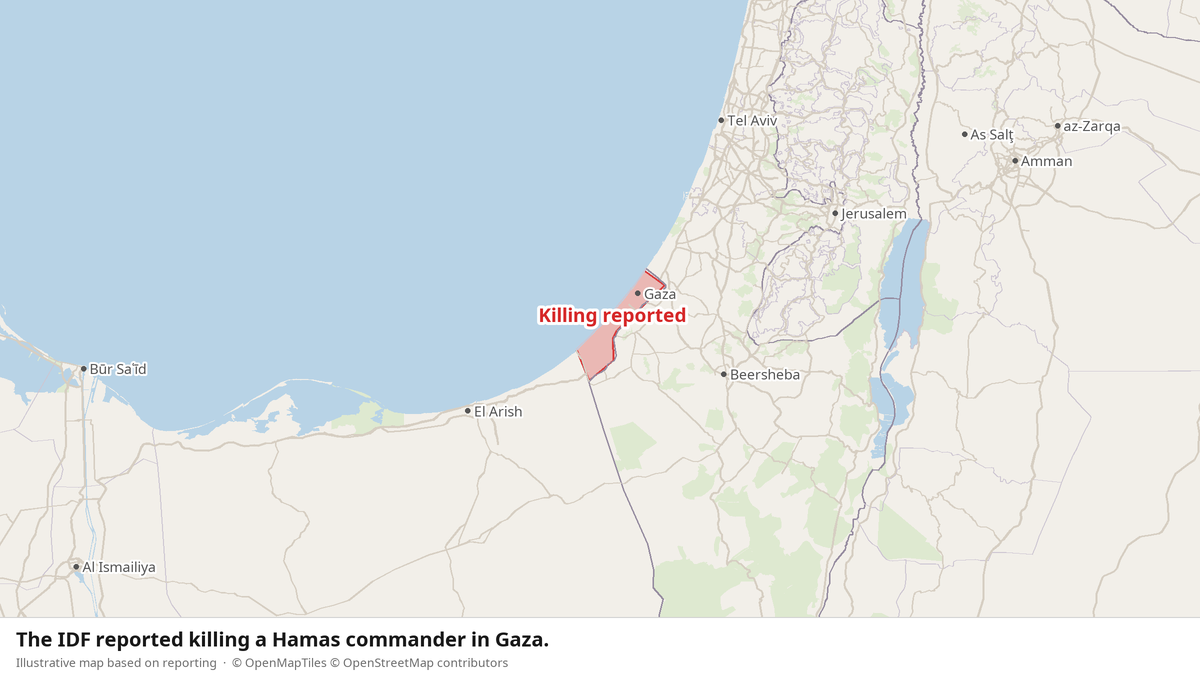
The Israeli military said it killed Momen Ahmad Salameh Ay in an airstrike in Gaza City on Tuesday, identifying him as a Hamas military commander and alleging he helped hold Israeli hostages captive. The claim comes from the military itself, and the article gives no further account of the strike or its effects. That gap matters. A military statement can name a target and state its case, but the information here doesn't independently establish those claims.
A Military Account, Not a Full Record
On Wednesday, the Israeli military said Ay served as an aide to commanders of Hamas' Gaza Brigade. It alleged he had recently advanced attacks on Israeli troops and civilians and sought to restore the group's capabilities in violation of the cease-fire. These remain the military's allegations; the article doesn't detail them independently.
The distinction isn't a technicality. The military presents a sequence: a named commander, alleged hostage-taking, alleged attacks, alleged efforts to rebuild capabilities, and an airstrike. The article doesn't say what information supports those claims, whether the military released evidence, or whether anyone else confirmed them. It also offers no statement from Hamas or people in Gaza City. The military's version takes up nearly all the space.
The strike itself is the clearest use of organized force described. The military said it carried out an airstrike in Gaza City and killed someone it identified as a commander. The account gives no details about other casualties, damage, or the strike's location beyond Gaza City. No broader conclusion about those effects follows from the facts provided.
The Names in the Claim
The military identified Ay by name: Momen Ahmad Salameh Ay. It described him as an aide to commanders of Hamas' Gaza Brigade, then linked him to alleged hostage-taking and attacks. The article calls him a Hamas military commander, but gives no account of his words or response. The stated case rests on the military's description of his role and actions.
Readers are left with a narrow record and a large use of force. The article doesn't provide information about a judicial process, public hearing, or other procedure before the strike. It doesn't describe how the military identified Ay or explain how it assessed the alleged cease-fire violation. Those omissions shouldn't be filled with guesses. They show what this report does—and doesn't—let readers verify.
What the Article Doesn't Establish
There is no information here about the Palestinian Authority, Hamas governance beyond Ay's alleged military role, international aid groups, or grassroots organizing. The article also doesn't mention security coordination, elections, outside governments, or civilian responses. Those subjects can't be added to this account as if they were reported facts.
The available facts are limited: an airstrike in Gaza City on Tuesday; the Israeli military's statement on Wednesday that it killed Ay; and its allegations about his role in hostage-taking, attacks, and efforts to restore Hamas capabilities. No independent corroboration or additional testimony appears in the account. The military's words are on the record. The rest of the record, in this article, is absent.