
The Board of Peace, the international body led by U.S. President Donald Trump, said Monday that Hamas has failed to meet its obligation to lay down its arms and has thereby "compounded the challenges facing Gaza's civilian population." The statement, issued one day ago, also called on Israel to "immediately" authorize and facilitate humanitarian supplies as winter closes in.
The two-sided message matters. The board acknowledged that Jerusalem has taken steps to meet Gaza's winter needs but called those steps "insufficient." It then widened the demand to everyone involved. All parties must fulfill their commitments, it warned, and those who don't "will bear responsibility for the consequences."
The Security Picture
Hamas's refusal to disarm sits at the center of the board's complaint. The ceasefire framework, announced in October 2025 according to Middle East Eye, was built on obligations running in both directions. One of them was that the armed group give up its weapons. It hasn't.
The board's language puts that failure on the record alongside its criticism of Israel. It names Hamas's non-compliance as a factor that has made life harder for the civilians the group claims to represent.
The Israeli Defense Ministry's Coordination of Government Activities in the Territories unit, known as COGAT, offered its own accounting on Monday. More than 91,000 tents and 8,200 trucks carrying winter supplies have entered the Gaza Strip since the winterization plan took effect, COGAT said. The plan runs in partnership with the Board of Peace, the International Committee of the Red Cross, UNICEF and other international organizations.
The Humanitarian Complication
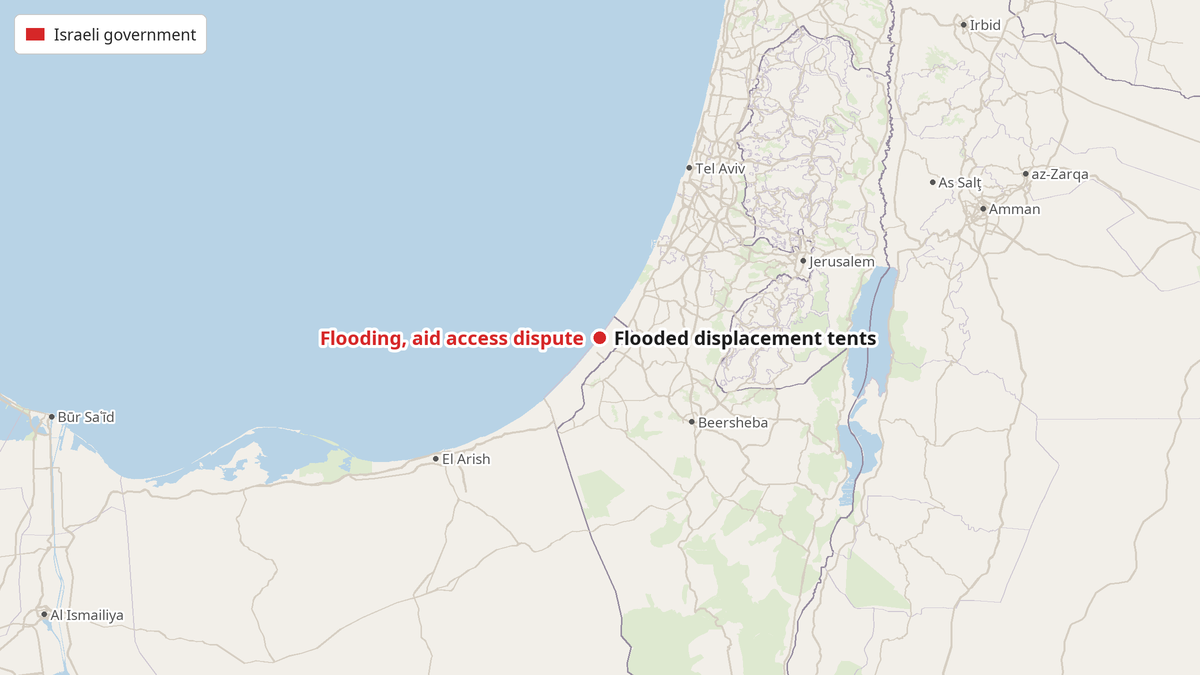
The need is real, and the storm showed it. Heavy rain and strong winds hit Gaza from the evening of November 6 and through the weekend, the first storm of the winter. Floods damaged the shelters and tents of tens of thousands of displaced Palestinians. The storm also brought down weakened buildings, hit humanitarian facilities and disrupted essential services, according to the UN's OCHA.
Palestinian sources describe a severe situation. Mohammed Salha, director of the Palestinian NGOs Network in Gaza, told The New Arab that about 350,000 people were left without shelter after some 70,000 tents were flooded or damaged. Gaza's Government Media Office, a Hamas-run body, reported the same tent figure. Salha said about 1,000 sites face high or very high flooding risk.
Salha also challenged Israel's figures. He said Israel allows in roughly 35 percent of the trucks agreed under the ceasefire's humanitarian protocol, and only about 20 percent of those carry aid. He said more than 50,000 tents are waiting on the Egyptian side of the border. COGAT's numbers and Salha's numbers don't match, and the base reporting doesn't reconcile them.
As of November 1, the UN-led shelter cluster estimated families needed about 121,000 tents and 561,000 tarpaulins. Aid groups had about 2,800 tents in stock inside Gaza. The Ministry of Public Works and Housing estimates about 3,000 buildings are at risk of collapse, and the Civil Defence warned after the storm that nearly 2,000 could fall at any moment.
Gaza's health ministry, whose figures the United Nations accepts, says more than 74,000 people have been killed. Most of the enclave's 2.1 million people have been displaced. The war is now in its fourth year.
The human voices are hard to dismiss. Youssef Abu Amer, 73, spent the night bailing water out of his tent in northern al-Mawasi, west of Khan Younis. "We're fighting every drop that falls from the sky," his son Mohammed, 45, told The New Arab. Maysa al-Farra, 46, said: "These tents are a recipe for a slow death." Human rights defender Dr Hussein Hammad called the flooding an "unprecedented humanitarian catastrophe."
Diplomatic Pressure and Its Targets
A Middle East Eye opinion piece argued that Israel must face sanctions. Its author said around 70,000 tents flooded in about a dozen hours, that 65 percent of Gaza's people live in tents or makeshift shelters, and that 150,000 donated tents sit in Egypt awaiting Israeli permission to enter. The piece noted the UK recently amended its Global Human Rights and International Humanitarian Law Sanctions Regulations to allow sanctions on those who block humanitarian aid, and cited a letter from dozens of politicians to Foreign Secretary Ed Miliband last month. It dismissed the Board of Peace as an "opaque concoction." The views are the author's alone, and Middle East Eye says they don't reflect its editorial policy.
The piece also noted that Prime Minister Benjamin Netanyahu's governing coalition has blamed Hamas. The Board of Peace, a body its own critics tie to Washington, reached a similar conclusion about the group's disarmament failure, even as it pressed Israel to do more.
Why This Matters: The Board of Peace's statement shows how thin the ceasefire's foundation is. Hamas hasn't disarmed, and an armed group that rejects Israel's existence keeps its leverage over any reconstruction or aid arrangement. Israel faces mounting pressure to open the gates wider while the party that started the war keeps its weapons. From this perspective, aid volumes and disarmament are linked, and winter relief won't solve the underlying problem. Calls for sanctions on Israel, meanwhile, risk punishing the side that has taken steps to supply Gaza while leaving Hamas's obligations unenforced. How the board follows through on its warning that non-compliers will "bear responsibility" will test whether that warning carries weight.
- gaza humanitarian aid
- gaza flooding
- board of peace
- israel
- hamas
- winter storm
- humanitarian supplies
- gaza shelter