
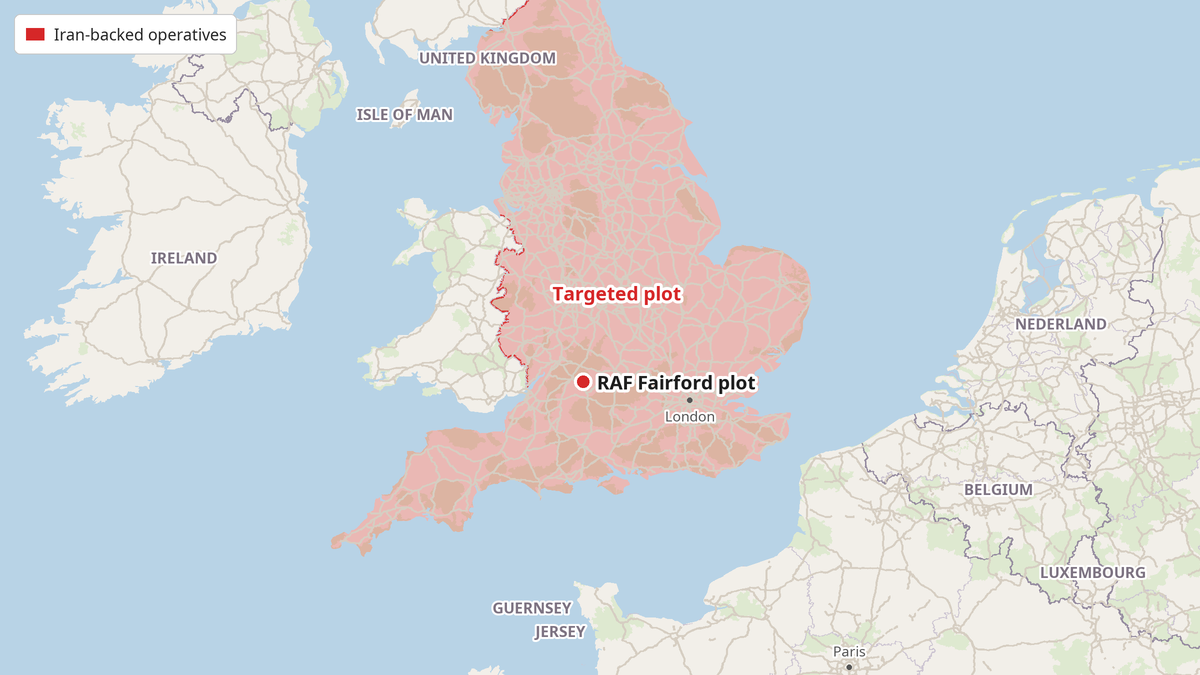
Federal prosecutors in New York unsealed an eight-count superseding indictment on late Tuesday, November 10, 2026, charging three Iranian nationals with terrorism-related offenses tied to nearly 20 attacks and attempted attacks in Europe and the United States. The U.S. Attorney's Office for the Southern District of New York says the men supported Kata'ib Hizballah and Iran's Islamic Revolutionary Guard Corps. The charges include providing material support to terrorists and conspiracy-related offenses.
The target at the center of the case is a military base. Prosecutors say the men were involved in a plot against RAF Fairford in Gloucestershire, England, a Royal Air Force site that hosts U.S. military aircraft and personnel. The Justice Department put the date of the alleged September 2026 attack at about two months ago. RAF Fairford is, in the base article's words, a key U.S. Air Force operating location in Europe that has supported deployments of American strategic bombers and other aircraft.
Who Has the Power
The voices in this story all belong to governments. Attorney General Todd Blanche delivered the line for the Justice Department: "Anyone who plans a terrorist plot on a military base housing American servicemembers will be prosecuted by the United States government." It reads less like a legal finding than a warning label on the apparatus itself.
British Prime Minister Andy Burnham had already stepped in earlier in October, saying Iran was involved in the incident at RAF Fairford that led to the arrest of five men on suspicion of explosives and terrorism offenses. Iranian Foreign Minister Abbas Araghchi answered on X, writing that Burnham was "barking up the wrong tree." Three governments, three accusations or denials, and not one of them is accountable to the people who live near that runway.
The indictment is an allegation. Nothing in the base article says any of the three men has been convicted, and nothing in it lets the public see the evidence. What the public gets is the framing: U.S. officials argue the case "underscores Iran's continued use of proxy organizations to advance its objectives while maintaining distance from direct operations." The Justice Department described an expanding threat from Iran-linked proxy groups operating beyond the Middle East.
What They're Calling "Order"
The language of the case is the language of states protecting their hardware. A base that houses strategic bombers is described as a place that must be defended, and the indictment is presented as proof that the defense works. The base article doesn't say what those bombers and aircraft are used for, or who stands beneath them when they fly. It doesn't need to. The state's side of the story is already complete: it names the enemy, announces the prosecution, and promises more.
Proxy war, as the officials themselves describe it, is a game played by states at arm's length. Iran, by the U.S. account, directs networks to stay one step removed from the violence. Washington and London, by their own account, answer with indictments, arrests and public accusations. Each side's hierarchy insists the other's is the aggressor.
Who Gets Crushed
The base article offers no voices from outside the chain of command: no one who lives near RAF Fairford, no one in the Gulf or Europe living under the threat of these plots or the military machinery they allegedly targeted. The article names a prime minister, a foreign minister, an attorney general. The people who absorb the consequences of rivalries between powerful governments aren't quoted. In a story about 20 attacks and attempted attacks, that silence is the story's own structure.
What survives the headlines is a pattern: states accuse, states deny, states prosecute, and the machinery of war keeps its runways open.
- iran
- kata'ib hizballah
- islamic revolutionary guard corps
- raf fairford
- terror plots
- material support to terrorists
- southern district of new york
- todd blanche