
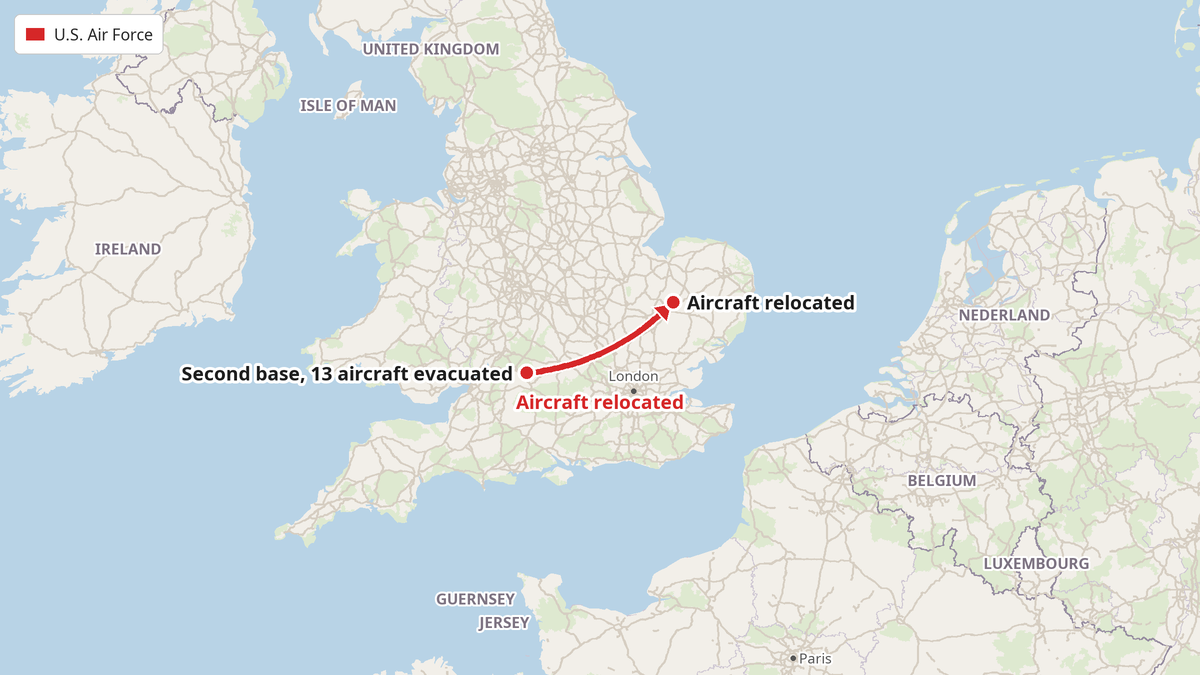
More than a dozen U.S. military aircraft slipped out of RAF Mildenhall in eastern England late Monday, and nobody who lives near the base was asked about it. The Air Force moved 13 planes, according to flight-tracking data and open-source analysts with the Military Air Tracking Alliance, as cited by the Associated Press. The people who found out first were the officers who gave the order and the reporters at the Wall Street Journal. Everyone else got a statement.
Who Has the Power
Commanders raised the base's security level to Force Protection Condition Charlie, the military's second-highest alert level, indicating a likely terrorist threat against personnel or facilities. A U.S. official told NBC News the aircraft were operating under "enhanced force protection measures," then declined to speculate on the nature of the threat. The Wall Street Journal, citing sources, said it originated in Iran. That's the whole public record: an alert level, a country's name from anonymous sources, and a refusal to say more.
Nine Boeing KC-135 Stratotankers went to airfields in Scotland, Germany and Spain. Three CV-22B Ospreys went to nearby RAF Lakenheath, which has hardened aircraft shelters. Planes get shelters. The towns around these bases get a press release at best.
What They're Calling "Order"
Secretary of State Marco Rubio waved it off Tuesday. "We are constantly repositioning forces around the world for a variety of reasons," he told reporters when asked about the evacuation. A 10 Downing Street spokesperson said British air bases remain secure and that London and Washington continuously share intelligence on potential threats.
Two governments, two statements, one message: nothing to see here. Yet the same week, the Justice Department unsealed indictments against three Iranian-backed operatives accused of involvement in coordinated terrorist plots across Europe, including RAF Fairford. A U.S. official told the AP the moves were precautionary. Precautionary for whom? The aircraft moved. The surrounding communities didn't.
Who Gets Crushed
This is the second major relocation of U.S. military aircraft from Britain in less than two months. In early October, about five weeks ago, the Air Force pulled heavy bombers from RAF Fairford in Gloucestershire after British counterterrorism police stopped three suspicious vans headed toward the base on Sept. 27, about six weeks ago. Two men have since been charged under the United Kingdom's National Security Act.
RAF Mildenhall is home to the 100th Air Refueling Wing, the only permanently based U.S. tanker wing in Europe. Its KC-135 Stratotankers support allied aerial refueling and long-range strike missions across the region. Read that again. These bases exist to keep long-range strike missions flying, and a foreign military runs them on British soil. When someone decides to target the base, the people who live in its shadow inherit the risk without ever having been consulted on the arrangement.
The Pattern
The source material offers no account of any community response, no local voice, no resident quoted. That silence is the story. The decisions flow downward from commanders to officials to spokespeople, and information flows to the public only after the planes are gone. Nobody was asked whether they wanted tankers, bombers and strike-support wings parked near their homes. Nobody was told what the threat was. The apparatus protects its hardware first and explains itself never.
- rafmildenhall
- raf mildenhall
- u.s. air force
- iran
- raf fairford
- kc-135 stratotanker
- force protection
- military aircraft relocation