
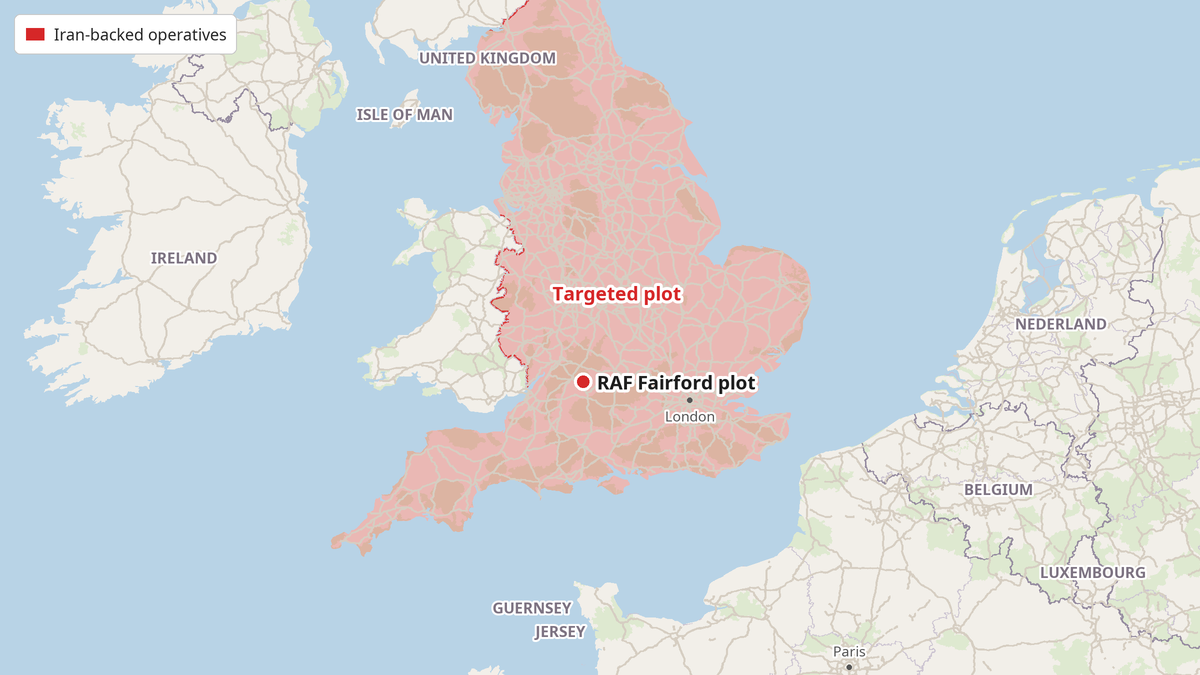
Three Iranian nationals now face an eight-count superseding indictment tied to nearly 20 attacks and attempted attacks across Europe and the United States, federal prosecutors in New York announced after unsealing the charges late Tuesday. The case includes an alleged September 2026 plot against RAF Fairford, the English air base where American troops were stationed.
The U.S. Attorney's Office for the Southern District of New York says the defendants supported Kata'ib Hizballah and Iran's Islamic Revolutionary Guard Corps, groups U.S. officials have long accused of directing attacks on American and allied interests. The charges include providing material support to terrorists and conspiracy-related offenses.
Who Was in the Crosshairs
RAF Fairford sits in Gloucestershire. It's a key U.S. Air Force operating location in Europe, and it has supported deployments of American strategic bombers and other aircraft. Prosecutors say the 2026 plot aimed at a base that housed U.S. military personnel, the kind of people who live and work alongside British communities and rely on their governments to keep them safe.
The Justice Department said the suspects played roles in attacks or attempted attacks across multiple countries. Officials described what they called an expanding threat from Iran-linked proxy groups operating well beyond the Middle East. Authorities allege the Fairford operation was one piece of a broader campaign directed by Iranian-backed networks.
Official Response
"Anyone who plans a terrorist plot on a military base housing American servicemembers will be prosecuted by the United States government," Attorney General Todd Blanche said, according to CNBC's reporting.
U.S. officials argued the case underscores Iran's continued use of proxy organizations to advance its objectives while keeping its distance from direct operations. That distance is the point of the proxy model: it blurs responsibility and complicates any legal or diplomatic response.
In Britain, the allegations have already carried political weight. Earlier in October, Prime Minister Andy Burnham said Iran was involved in the incident at RAF Fairford that led to the arrest of five men on suspicion of explosives and terrorism offenses. Iranian Foreign Minister Abbas Araghchi rejected the claim. Writing on X, he said Burnham was "barking up the wrong tree."
A Case Built Through Courts, Not Just Commands
The indictment is a reminder that the response to cross-border political violence can run through open courts and public charges, not only through military or covert channels. Prosecutors have put specific allegations on the record, named the defendants' alleged affiliations, and laid out statutory charges that a judge and jury can test. Tehran disputes the British government's account, and the defendants are entitled to answer the charges in court.
The case also shows how closely allied governments are working the same problem. A plot in England, an indictment in New York, an arrest of five men in Britain: the pieces connect across borders, and so does the response.
Why This Matters:
The charges put a public, legal frame around an alleged campaign that officials say reaches from the Middle East into Western Europe and the United States. For service members and their families at bases like RAF Fairford, and for the surrounding communities, the stakes are immediate and physical. For the public, the case tests whether democratic institutions can respond to proxy violence through transparent prosecution, evidence, and due process rather than escalation alone. It also underscores how much depends on allied cooperation. Prosecutors in New York, British authorities, and two governments now trade accusations and denials over the same events. How that dispute is resolved, in a courtroom and through diplomacy, will shape both public safety and public trust in the institutions asked to protect it.
- iran
- kata'ib hizballah
- islamic revolutionary guard corps
- raf fairford
- terror plots
- material support to terrorists
- southern district of new york
- todd blanche