
Nearly 20 attacks on Jewish communities in Europe and the United States, plus an assault on a British airbase housing American troops. That's the scope of the plot federal prosecutors laid out Tuesday in a superseding indictment unsealed in Manhattan federal court, which accuses three men of acting as Iran-supported operatives.
The defendants are Mohammad Baqer Saad Dawood al-Saadi, a dual Iranian-Iraqi national; Mohsen Mohajeri, an Iranian national; and Mohammad Ali al-Hassani, an Iraqi national. Only al-Saadi is in custody. He was arrested in the spring and, according to U.S. Attorney Jamie McDonald in New York, continued to coordinate with his co-defendants in the days leading up to the attempted September plot at RAF Fairford in the United Kingdom, where U.S. bombers and troops had been stationed.
Who Was Targeted
The indictment alleges a campaign aimed at Jewish communities on two continents, along with the service members stationed at the British base. McDonald didn't mince words. "These defendants helped orchestrate a campaign of terror on behalf of terrorist organizations affiliated with Iran that targeted Jewish communities in Europe and the United States, and the British military base, RAF Fairford, housing American service members," he said. "The threat presented by Iran and Iran-backed terrorist groups to America and our allies is not hypothetical — it is very real."
Attorney General Todd Blanche added: "Anyone who plans a terrorist plot on a military base housing American servicemembers will be prosecuted by the United States government."
The charging document describes how the alleged scheme worked from behind bars. According to the indictment, al-Saadi used coded language in communications with relatives from jail to direct that money be passed to others who could carry out attacks. Prosecutors say the three conspired to use a network of contacts in the United Kingdom to commit attacks on behalf of an Iran-aligned terrorist network, including the Islamic Revolutionary Guard Corps and Kata'ib Hizballah. Both are designated by the U.S. as foreign terrorist organizations, and prosecutors say al-Saadi was a Kata'ib Hizballah commander.
What Happened at RAF Fairford
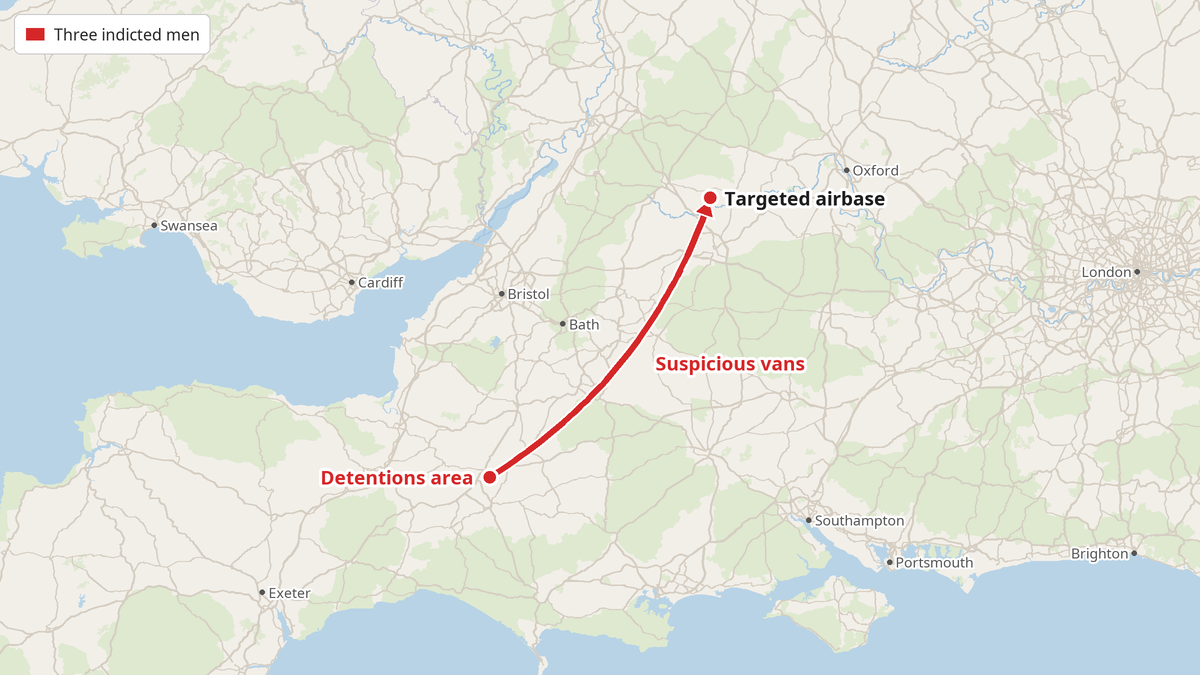
The indictment sheds light on an episode that had been shrouded in mystery for more than a month. Five men were detained after midnight on Sept. 27 on suspected explosives and terrorism offenses after three suspicious vans were spotted traveling toward the base in western England. A sixth suspect, a British-Iranian dual national, was arrested several days later. All were released on bail.
British authorities linked the incident to Tehran. Iran denied involvement. Even so, the arrests prompted the U.S. to withdraw its bombers stationed there, and they were redeployed to their home bases in the United States. RAF Fairford, 100 miles (160 kilometers) west of London, has been used by American bombers during decades of Middle East conflicts. A linked report noted that British police rearrested two men on suspicion of assisting Iran over the suspected plot.
The Defense
In June, al-Saadi pleaded not guilty to charges that he plotted at least 18 attacks in Europe in retaliation for the U.S. and Israel's war with Iran. He called himself a "prisoner of war" and has been held without bail. His lawyers didn't immediately respond to requests for comment. Mohajeri and al-Hassani remain uncaptured, and the allegations against all three are unproven in court.
Why This Matters:
The indictment describes a plot that, if the allegations hold, would have put Jewish communities and military personnel in harm's way across two continents, and it shows how targeted violence can be coordinated across borders, even from a jail cell. The case also underscores why intelligence sharing and law enforcement cooperation between the U.S. and the U.K. carry real weight: British authorities detained suspects near the base before an attack was carried out. For Jewish communities in Europe and the U.S., the allegations land as a concrete reminder of how exposed they can be when conflicts abroad spill into domestic security threats. And because al-Saadi's trial will proceed through the courts, the case tests whether established legal institutions can handle accusations of state-linked terrorism with due process intact, including the presumption of innocence he's entitled to despite the gravity of the charges.
- terror plot
- rafe fairford
- iran
- mohammad baqer saad dawood al-saadi
- kata'ib hizballah
- jewish communities
- u.s. air force
- federal court