
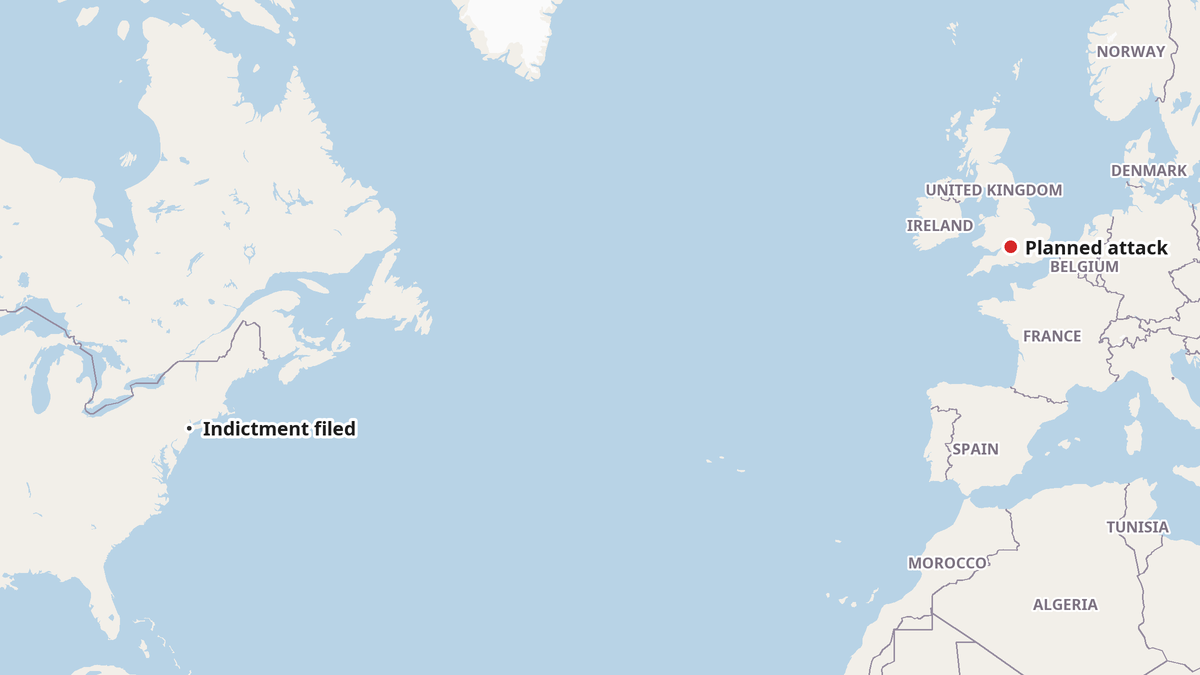
Federal prosecutors in New York unsealed a superseding indictment Tuesday charging three men with running a terror campaign for Iran-aligned groups that targeted Jewish communities and a British air base housing American troops. The scope is staggering. Nearly 20 attacks and attempted attacks across Europe and the United States.
The defendants are Mohammad Al-Saadi, a dual Iranian-Iraqi national; Mohsen Mohajeri, an Iranian national; and Mohammad Ali Al-Hassani, an Iraqi national. Only Al-Saadi is in custody. He was arrested in the spring and, according to prosecutors, kept coordinating with his co-defendants in the days leading up to the attempted September plot at RAF Fairford, the British base where U.S. bombers and troops had been stationed.
The Charges
The Justice Department said the three were indicted on terrorism-related charges. The alleged plots included a September 2026 attack on RAF Fairford in the U.K. Prosecutors say the men conspired to use a network of contacts in the United Kingdom to carry out attacks on behalf of an Iran-aligned terrorist network, one that included Iran's Islamic Revolutionary Guard Corps and Kata'ib Hizballah. The U.S. government has designated both as foreign terrorist organizations.
U.S. Attorney Jamie McDonald, whose office is handling the case, didn't soften his language. "As alleged, these defendants helped orchestrate a campaign of terror on behalf of terrorist organizations affiliated with Iran that targeted Jewish communities in Europe and the United States, and the British military base, RAF Fairford, housing American service members," he said. "The threat presented by Iran and Iran-backed terrorist groups to America and our allies is not hypothetical — it is very real."
Attorney General Todd Blanche added a warning of his own. "Anyone who plans a terrorist plot on a military base housing American servicemembers will be prosecuted by the United States government," he said.
Directing a Plot From a U.S. Prison
The most unsettling detail may be how the alleged coordination worked. According to the indictment, Al-Saadi helped direct the RAF Fairford plot while sitting in a U.S. prison. He made video and phone calls to family members in Iraq, who allegedly passed coded messages to Al-Hassani and Mohajeri. In a July call with his sister, Al-Saadi asked, "What are we doing about all our old work?" Investigators say that was a reference to terrorist activity. Her reply, per investigators: "It isn't cancelled."
In June, Al-Saadi pleaded not guilty to charges that he plotted at least 18 attacks in Europe in retaliation for the U.S. and Israel's war with Iran. That was about five months ago.
The Fairford Operation
The indictment also fills in an episode that has been shrouded in mystery for more than a month. Five men were detained after midnight Sept. 27 on suspicion of explosives and terrorism offenses, after three suspicious vans were spotted traveling toward the base in western England. That was about six weeks ago. Two men have since been charged under the United Kingdom's National Security Act.
Prosecutors allege Al-Hassani paid associates to surveil RAF Fairford in August, then paid several people to advance the plot in September "by procuring vans and barrels of fuel, researching the purchase of chemical accelerants, including large quantities of potassium chloride, and purchasing metallic objects that could be used as explosive shrapnel." The group allegedly made custom decals so the vans would look like they belonged to a fuel company and a swimming pool supply business. Al-Hassani is alleged to have tasked the people to go to the base with the fuel just as U.K. law enforcement took the men into custody.
Tehran Denies It
Earlier in October, British Prime Minister Andy Burnham said Iran was involved in the incident at RAF Fairford. Iranian Foreign Minister Abbas Araghchi rejected the claim, writing on X that Burnham was "barking up the wrong tree." The indictment now puts detailed allegations on the record, including the alleged links to the Revolutionary Guards and Kata'ib Hizballah.
RAF Fairford, in Gloucestershire, is a key U.S. Air Force operating location in Europe and has supported deployments of American strategic bombers and other aircraft. In early October, the Air Force pulled heavy bombers from the base after British counterterrorism police stopped the three vans headed toward it Sept. 27.
Why This Matters:
This case shows what a state-backed proxy network can do when it's allowed to operate across borders: surveillance, procurement, disguised vehicles, coded family calls from a prison cell. The Air Force's decision to pull heavy bombers from Fairford shows the plot had operational consequences, not just legal ones, and shifting forward-deployed assets costs money and complicates alliance planning. For policymakers, the allegations bolster the argument that terrorist designations and prosecutions matter, and that allies need tight intelligence sharing and credible deterrence. Prosecutors say the threat from Iran-backed groups is "very real." Whether Washington and London back that assessment with sustained resolve, rather than episodic attention, is the question this indictment raises.
- mohammad al-saadi
- mohsen mohajeri
- mohammad ali al-hassani
- raf fairford
- terror plot
- iran
- jewish communities
- kata'ib hizballah