
Federal prosecutors in Manhattan on Tuesday accused three men of working as Iran-supported operatives who plotted nearly 20 attacks on Jewish communities in Europe and the United States, along with a planned assault on a British airbase used by the U.S. Air Force.
The charges, outlined in a superseding indictment unsealed in Manhattan federal court, name Mohammad Baqer Saad Dawood al-Saadi, a dual Iranian-Iraqi national; Mohsen Mohajeri, an Iranian national; and Mohammad Ali al-Hassani, an Iraqi national. Only al-Saadi sits in custody.
The Charges
U.S. Attorney Jamie McDonald in New York said al-Saadi, who was arrested in the spring, kept coordinating with his co-defendants in the days leading up to the attempted September plot at RAF Fairford in the United Kingdom, where U.S. bombers and troops had been stationed.
"These defendants helped orchestrate a campaign of terror on behalf of terrorist organizations affiliated with Iran that targeted Jewish communities in Europe and the United States, and the British military base, RAF Fairford, housing American service members," McDonald said. "The threat presented by Iran and Iran-backed terrorist groups to America and our allies is not hypothetical — it is very real."
Attorney General Todd Blanche was blunt. "Anyone who plans a terrorist plot on a military base housing American servicemembers will be prosecuted by the United States government," he said.
The indictment alleges that al-Saadi used coded language in communications with relatives from jail, directing that money be passed to others who could carry out attacks. Prosecutors say the three men conspired to use a network of contacts in the United Kingdom to strike on behalf of an Iran-aligned terrorist network. That network includes the Islamic Revolutionary Guard Corps and Kata'ib Hizballah, both designated by the U.S. as foreign terrorist organizations. Prosecutors say al-Saadi was a Kata'ib Hizballah commander.
In June, al-Saadi pleaded not guilty to charges that he plotted at least 18 attacks in Europe in retaliation for the U.S. and Israel's war with Iran. He called himself a "prisoner of war" and has been held without bail. His lawyers didn't immediately respond to requests for comment.
What Happened at RAF Fairford
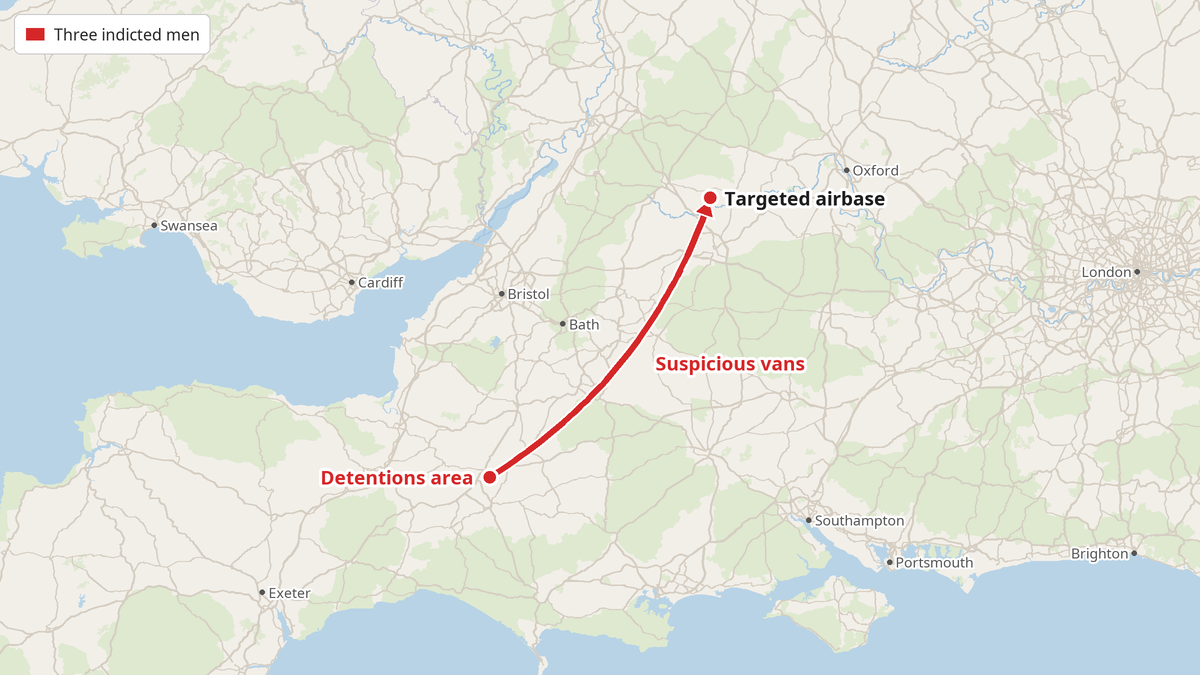
The indictment sheds light on an episode that stayed shrouded in mystery for more than a month. Five men were detained after midnight on Sept. 27 on suspected explosives and terrorism offenses after three suspicious vans were spotted traveling toward the base in western England. A sixth suspect, a British-Iranian dual national, was arrested several days later. All were released on bail.
British authorities linked the incident to Tehran. Iran denied involvement. But the arrests carried a real military cost: the U.S. withdrew its bombers stationed there, and they were redeployed to their home bases in the United States.
RAF Fairford, 100 miles (160 kilometers) west of London, has been used by American bombers during decades of Middle East conflicts. A linked report noted that British police rearrested two men on suspicion of assisting Iran over the suspected plot.
Why This Matters: A foreign-backed plot didn't have to succeed to change American force posture. The mere attempt, and the arrests that followed, led the U.S. to pull its bombers from a base that has supported operations across the Middle East for decades. That's a strategic price paid without a single shot fired. The case also tests a basic principle: that those who plot violence against American troops and civilians face prosecution under the rule of law, even when they allegedly act through proxies and from behind bars. Washington's allies will be watching whether the charges hold, and whether Iran-aligned networks face consequences that deter the next attempt. For Americans and their partners overseas, the prosecutors' warning that the threat is "very real" frames the stakes plainly.
- terror plot
- rafe fairford
- iran
- mohammad baqer saad dawood al-saadi
- kata'ib hizballah
- jewish communities
- u.s. air force
- federal court