
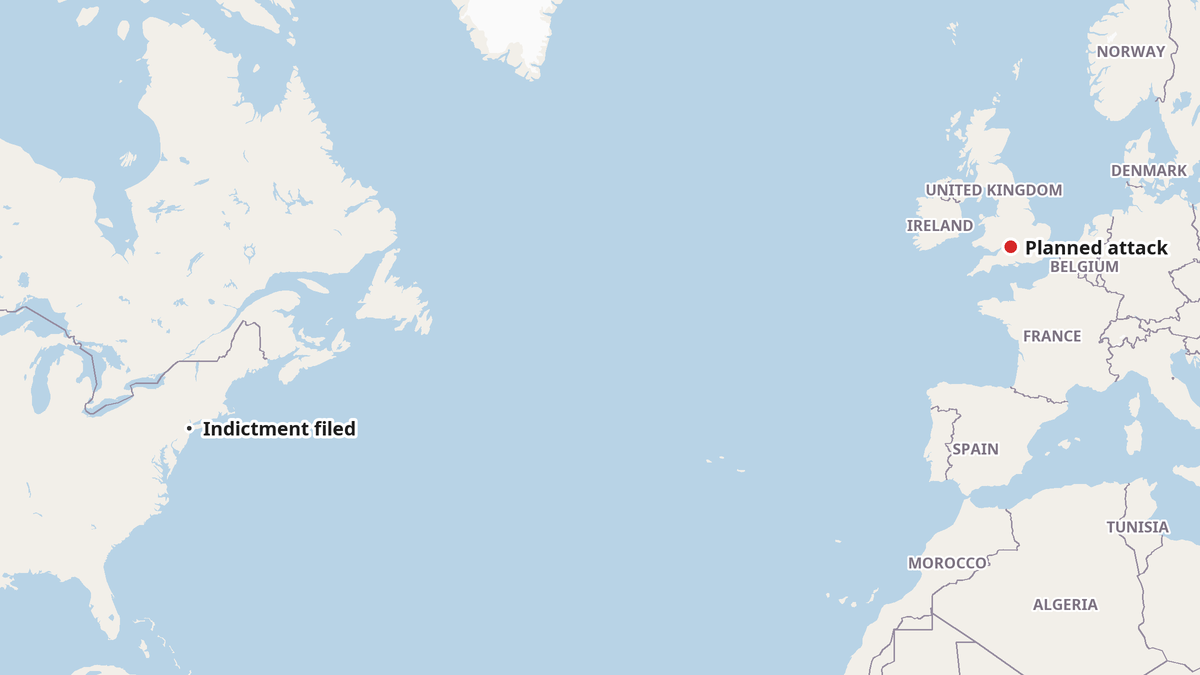
Federal prosecutors in New York unsealed a superseding indictment Tuesday accusing three men of running a campaign of nearly 20 attacks and attempted attacks on Jewish communities in Europe and the United States, plus a September plot against a British air base that hosts U.S. bombers. Only one of the three, Mohammad Al-Saadi, is in custody. He was arrested in the spring.
The charges name Al-Saadi, a dual Iranian-Iraqi national; Mohsen Mohajeri, an Iranian national; and Mohammad Ali Al-Hassani, an Iraqi national. The Justice Department says they worked on behalf of an Iran-aligned network that included Iran's Islamic Revolutionary Guard Corps and Kata'ib Hizballah, both designated by the U.S. government as foreign terrorist organizations.
The War Behind the Charges
The indictment's own timeline places the alleged violence inside a war. In June, Al-Saadi pleaded not guilty to charges that he plotted at least 18 attacks in Europe "in retaliation for the U.S. and Israel's war with Iran." That is the reason prosecutors give for the plots, and the base facts of the case never separate it from the conflict.
The target in the September plot was RAF Fairford, in Gloucestershire. The base is described as a key U.S. Air Force operating location in Europe that has supported deployments of American strategic bombers and other aircraft. U.S. military personnel were stationed there. Early in October, after British counterterrorism police stopped three suspicious vans headed toward the base on Sept. 27, the Air Force pulled its heavy bombers out.
What Prosecutors Allege
According to the indictment, Al-Hassani paid associates to surveil RAF Fairford in August. In September he allegedly paid several people to procure vans and barrels of fuel, research large quantities of potassium chloride as a chemical accelerant, and buy metal objects that could serve as shrapnel. The group allegedly made custom decals so the vans would look like they belonged to a fuel company and a swimming pool supply business.
Five men were detained after midnight Sept. 27, about six weeks ago, on suspicion of explosives and terrorism offenses. Two have since been charged under the United Kingdom's National Security Act.
Al-Saadi allegedly directed the plot from inside a U.S. prison. He made video and phone calls to family in Iraq, who allegedly passed coded messages to Al-Hassani and Mohajeri. In a July call, he asked his sister, "What are we doing about all our old work?" She replied, "It isn't cancelled," investigators said.
The State's Framing
U.S. Attorney Jamie McDonald said the defendants "helped orchestrate a campaign of terror on behalf of terrorist organizations affiliated with Iran." He added: "The threat presented by Iran and Iran-backed terrorist groups to America and our allies is not hypothetical — it is very real." Attorney General Todd Blanche said that "anyone who plans a terrorist plot on a military base housing American servicemembers will be prosecuted by the United States government."
Both statements define the victims as American servicemembers and allies, and the threat as coming from Iran. Neither mentions the war the defendants allegedly cited as motive.
Denial and Escalation
British Prime Minister Andy Burnham said earlier in October that Iran was involved in the incident at RAF Fairford. Iranian Foreign Minister Abbas Araghchi rejected the claim, writing on X that Burnham was "barking up the wrong tree." The indictment is the first formal U.S. charging document tying the base plot to the Revolutionary Guards network.
The case offers a view of how a bomber garrison in an English county becomes a target. Strategic aircraft deployed to a foreign base for a war carry that war's consequences to the surrounding area. Prosecutors are pursuing the individuals. The war and the basing arrangement that put U.S. bombers at Fairford sit outside the indictment.
- mohammad al-saadi
- mohsen mohajeri
- mohammad ali al-hassani
- raf fairford
- terror plot
- iran
- jewish communities
- kata'ib hizballah