
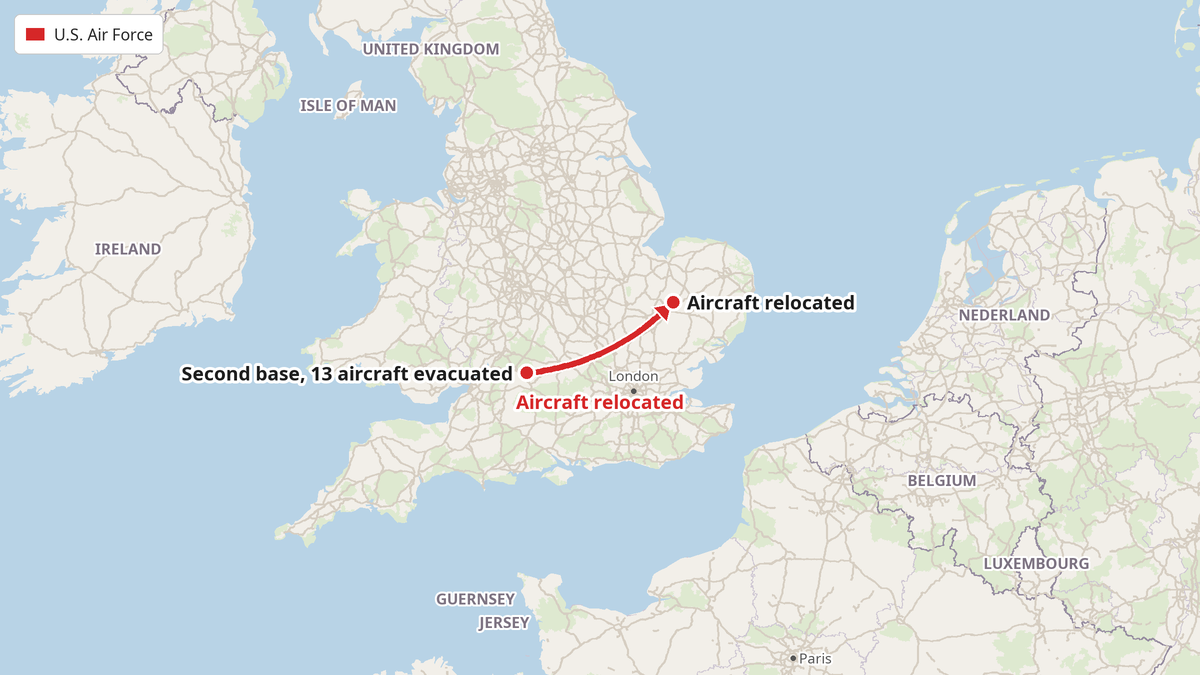
The U.S. Air Force pulled 13 aircraft out of RAF Mildenhall in eastern England late Monday, moving them to other airfields as commanders raised the base to Force Protection Condition Charlie, the military's second-highest alert level, which indicates a likely terrorist threat against personnel or facilities. U.S. officials confirmed the move Tuesday. The Wall Street Journal first reported it, citing sources who said the threat originated in Iran.
A U.S. official told NBC News the aircraft left because security at the base had increased, and that those remaining were operating under "enhanced force protection measures." The official would not speculate on the exact nature of the threat. Flight-tracking data and open-source analysts with the Military Air Tracking Alliance counted 13 aircraft leaving, according to the Associated Press.
Where the Aircraft Went
Nine Boeing KC-135 Stratotankers were moved to airfields in Scotland, Germany and Spain. Three CV-22B Ospreys went to nearby RAF Lakenheath, which has hardened aircraft shelters. A U.S. official told the AP the moves were precautionary and said some aircraft were on rotational deployments while others were permanently stationed in the United Kingdom.
RAF Mildenhall hosts the 100th Air Refueling Wing, the only permanently based U.S. tanker wing in Europe. Its KC-135s support allied aerial refueling and long-range strike missions across the region. The aircraft carry the fuel that lets long-range bombers and strike aircraft reach their targets. When they scatter, the machinery of power projection scatters with them.
A Second Withdrawal in Weeks
This is the second major relocation of U.S. military aircraft from Britain in less than two months. In early October, about five weeks ago, the Air Force pulled heavy bombers from RAF Fairford in Gloucestershire. That followed an incident about six weeks ago: British counterterrorism police stopped three suspicious vans headed toward the base on Sept. 27. Two men have since been charged under the United Kingdom's National Security Act.
On Tuesday, the Justice Department unsealed indictments against three Iranian-backed operatives accused of involvement in coordinated terrorist plots across Europe, including RAF Fairford.
What Officials Said
Secretary of State Marco Rubio described the movement as routine. "We are constantly repositioning forces around the world for a variety of reasons," Rubio told reporters when asked about the evacuation. He didn't address the alert level or the Iranian threat reporting directly in the remarks quoted.
A 10 Downing Street spokesperson said British air bases remain secure and that London and Washington continuously share intelligence on potential threats. The statement didn't say who decided to raise the alert at Mildenhall or what the British public was told about the risk to the communities around these installations.
The Garrison and Its Neighbors
The facts in the record show a pattern. A foreign military maintains permanently stationed units and rotational deployments on British soil. Those units fly the tankers that sustain "long-range strike missions across the region." When a threat emerges, the aircraft are moved to hardened shelters or to other countries. The base, its personnel and the surrounding area remain.
The officials quoted in the record spoke of aircraft, alert levels and repositioning. None of them addressed the people who live near RAF Mildenhall, RAF Lakenheath or RAF Fairford, or whether they were consulted before their neighborhoods became the object of Iranian-backed plots. The public record in this case comes from the military and its government spokespeople, who called the relocation precautionary and routine while confirming a likely terrorist threat.
- rafmildenhall
- raf mildenhall
- u.s. air force
- iran
- raf fairford
- kc-135 stratotanker
- force protection
- military aircraft relocation