
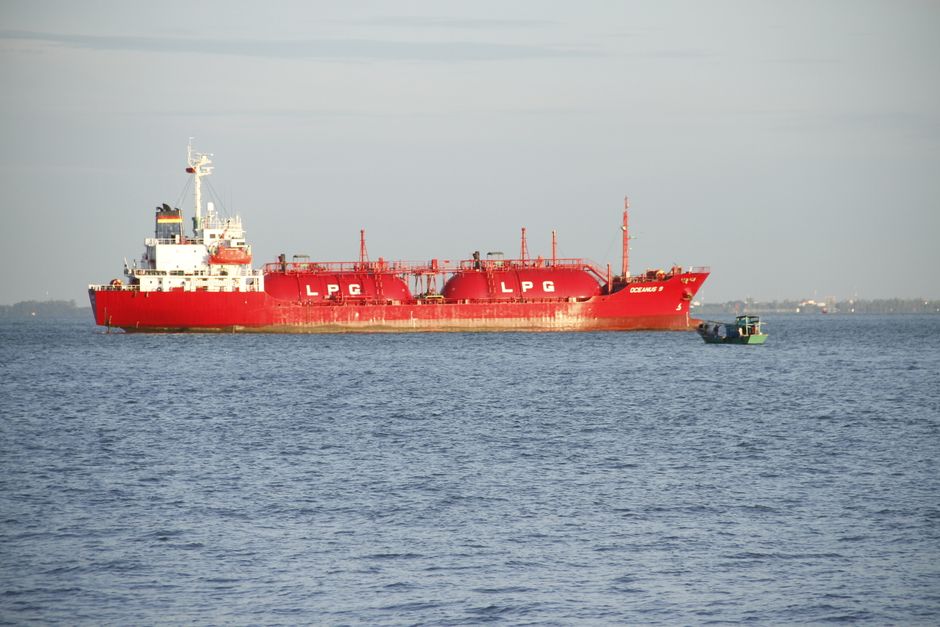
Iran shipped 4.1 million barrels of liquefied petroleum gas since the U.S. naval blockade began in mid-July, compared with about 30 million barrels over the same period last year, according to data reported by Iran International. The figures show how control over trade routes now intersects with damage to energy facilities: exports have fallen sharply, and millions of tons of gas may have nowhere to go but the domestic market.
The blockade and the numbers
Kpler and Vortexa data obtained by Iran International put recent shipments at around 350,000 tons. The same trackers estimate that Iran exported between 10.5 million and 11 million tons of LPG in 2025, worth more than $5 billion. Iranian Chamber of Commerce figures cover a different period: they show 9 million tons of propane and butane exports worth $4.35 billion during the Iranian financial year that ended on March 20, 2026.
The totals don’t match exactly. Iran International reports that they cover different periods and may use different methods, but both show the scale of the trade before the war. These figures aren’t interchangeable; they’re competing measurements of an export system now constrained by a naval blockade.
Iran produced around 13 million tons of LPG last year, exporting about 80%. Under normal conditions, domestic demand is below 2 million tons annually. Refineries produced around 2.4 million tons, half consumed inside Iran and half exported, according to a document from Iran's National Iranian Oil Products Distribution Company obtained by Iran International. South Pars processing facilities produced around 7 million tons. Other gas facilities and petrochemical plants, mainly in Assaluyeh and Mahshahr, supplied the remainder.
War, damaged infrastructure, and lost revenue
Israel targeted gas processing units at South Pars and petrochemical plants in Assaluyeh and Mahshahr. Iranian officials say the initial loss of 230 million cubic meters of South Pars gas production has narrowed to around 100–130 million cubic meters as damaged units returned to operation. The head of Iran's National Petrochemical Company says the company has rebuilt around 60% of damaged petrochemical units and returned them to operation.
Based on those figures, LPG production may have dropped by around 20–25% since the war, to roughly 10 million tons annually. Exports have fallen more sharply than production, potentially leaving millions of tons of surplus. The reported figures describe two pressures on ordinary life: military attacks on production infrastructure and a blockade that cuts off seaborne trade. They don’t show how households, workers, or industries share the costs.
Iran has faced a similar, though less severe, export problem under U.S. sanctions. Kpler and Vortexa data show that in 2020, LPG exports fell to less than half the previous year’s level. Iranian official statistics indicate domestic consumption rose about 2.5-fold, to around 5 million tons—roughly half of production. Iran still exported 4.4 million tons in 2020 and 5.8 million tons in 2021.
A domestic outlet, with limits
Iran could divert more propane and butane to domestic use, including limited injection into the national gas network or fuel for industries and power plants equipped to burn LPG. That could ease recurring winter gas shortages and reduce the need to burn mazut, a major source of air pollution. But the article says domestic use depends on technical constraints, available infrastructure, and demand. A surplus on paper doesn’t automatically become usable fuel.
The trade-off is clear in the figures: redirecting some LPG could help cover domestic needs, while a prolonged blockade could cut off an export business worth around $5 billion annually before the war. The source also notes a much larger loss of oil export revenue. OPEC estimates daily crude output fell from around 3.26 million barrels in 2025 to 1.96 million barrels in September. The state can redirect production, but the available data don’t say who decides how much or who absorbs the loss.
- iran
- lpg exports
- naval blockade
- liquefied petroleum gas
- south pars
- assaluyeh
- mahshahr
- oil production