
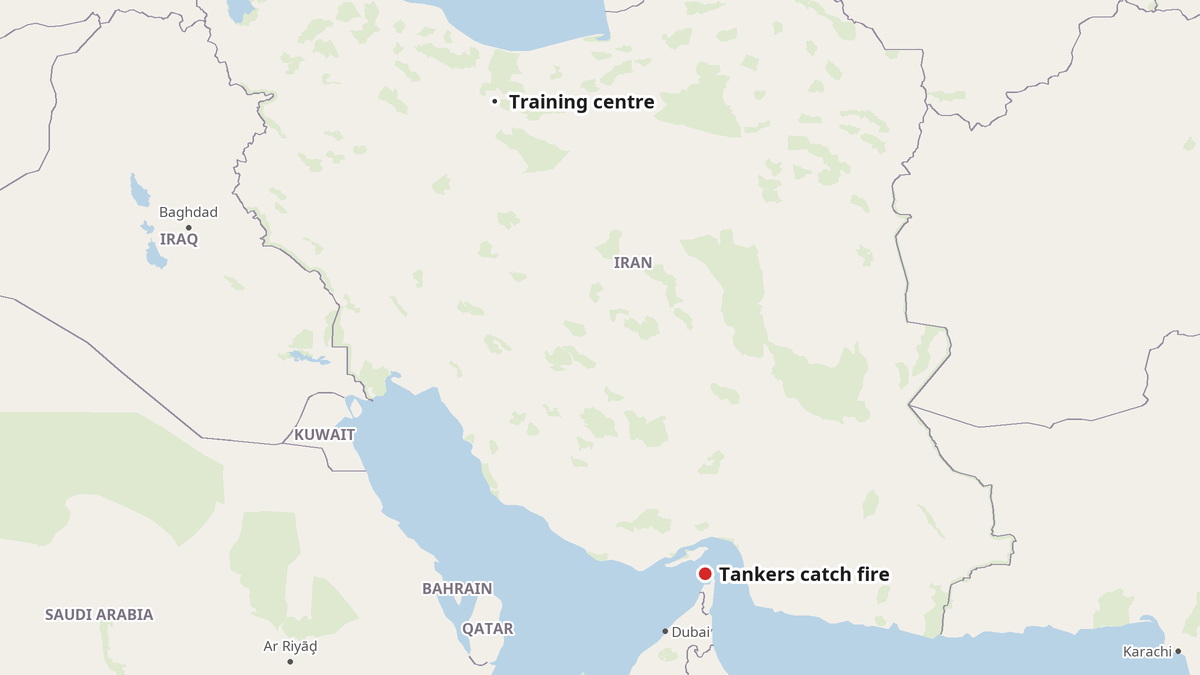
Four oil tankers were ablaze south of the Strait of Hormuz on Wednesday after striking naval mines, according to Iran's Islamic Revolutionary Guard Corps. The IRGC statement, carried by the official IRNA news agency, said the vessels had tried to cross a "prohibited passage." It said two other ships were detained for violating shipping restrictions. The reports couldn't be independently verified, and the base reporting says nothing about the fate of the crews aboard.
That's the human uncertainty at the center of a crisis moving fast. The same day, Iran called the US reply to its conditions for reopening the strait "unconvincing," while President Donald Trump confirmed American strikes on an Iranian anti-aircraft facility on Qeshm Island. The diplomacy hasn't stopped. It's running alongside preparations for something much larger.
Diplomacy and Threats, Side by Side
The indirect talks concern an Iranian proposal to reopen the waterway over two days if Washington meets seven demands, including lifting sanctions and ending a US naval blockade. Mohsen Rezaei, secretary of Iran's Supreme National Security Council, wrote on X that America "must fully and explicitly address Iran's seven conditions and act upon them." Only then, he said, "will the Strait of Hormuz be reopened."
Qatar is trying to keep the channel open. Majed al-Ansari, a spokesperson for Qatar's Ministry of Foreign Affairs, said the talks were continuing and both sides "remain committed to the negotiation process." Qatar is facilitating the "real-time exchange of proposals" between Washington and Tehran. Gulf News, though, described the talks as "stalled."
President Masoud Pezeshkian said his government still sought to resolve the crisis "through dialogue" and that "no one will benefit from this war" if it reignited. He said the supreme leader had recently given the government new powers to negotiate issues previously considered "off-limits." Yet Mojtaba Khamenei, Iran's supreme leader, ordered the military at the weekend to respond immediately to any threat without geographical limits and to update its target list. Iranian officials suggested European countries and undersea cables in the Gulf could be targets.
Strike Plans and a Region Bracing
Trump told Fox News the US hit the anti-aircraft facility early Tuesday. "They built an anti-aircraft facility. It took them about two months. We watched it get built. As soon as it was completed, we hit it last night," he said, calling it a "minor attack" that "wasn't war." US officials described the strikes as "defensive," following Iranian fire at an American aircraft. Trump said, "I'm not looking to ... kill lots of people," then added, "If we have to, we'll have to."
He also said "We have to do something large," and floated a "heavy hit." US media, citing officials, reported that Central Command had prepared strike plans that could begin as early as Wednesday, after the midterm elections, with three American aircraft carriers in the region. The Wall Street Journal reported Trump had "leaned toward" a large attack but hadn't decided.
Preparations are visible on the ground. Reports citing flight-tracking data described at least 10 US military cargo planes landing at Ovda and Nevatim air bases in southern Israel. Washington was reportedly "rapidly replenishing" THAAD and Patriot batteries there ahead of an expected wave of Iranian ballistic-missile retaliation. Tracker accounts said Kiryat Shmona and Safed had opened public shelters, though that came from open-source accounts, and Israeli outlet Walla reported "no unusual rise" in US aircraft arrivals over the past week. There's no US confirmation of an attack plan.
The Wider Cost
The fallout is already spreading beyond the strait. A Saudi-led coalition said it intercepted three drones targeting Saudi territory, one over the western Mecca region. Yemen's Houthi group said it had launched drone and ballistic-missile attacks on an airport and an airbase in southwestern Saudi Arabia. Etihad Airways extended its suspension of flights between Abu Dhabi and Dammam and Riyadh through November 19.
The UK Maritime Trade Operations reported two unidentified projectiles struck a tanker's engine room about 14 nautical miles northeast of Oman's coastal village of Limah on Tuesday. No casualties were reported. The IRGC also claimed it shot down a US-made MQ-9 drone over the strait.
In Yemen, the US Embassy accused the Houthis of killing Mohammed Al Shami, a UN Human Rights Office staff member and father of three, while he was detained. The embassy said he had been denied contact with his family and kept from visiting his dying father or attending his funeral. It accused the Houthis of concealing his body for months in a morgue in Sana'a while claiming he was alive, and called for the release of all detained UN, diplomatic and humanitarian staff.
John Mearsheimer, a US political scientist, questioned whether another short bombing campaign could work. "If the 40-day bombing campaign didn't work, how is the three-day bombing campaign going to work?" he asked, warning that an Iranian response could prompt further US escalation and damage the global economy.
Iranian negotiator Mohammad Bagher Ghalibaf said Iran was "ready for battle with its finger on the trigger." After Democratic midterm gains, he posted that Americans said "NO TO WAR." Trump acknowledged rising petrol prices hurt Republicans, saying voters "didn't like it," and credited Iran as "a part" of the defeat.
Why This Matters: Every escalation in this standoff lands on people with no say in it: tanker crews in a mined shipping lane, residents of southern Israel opening shelters, travelers stranded by cancelled flights, and a detained UN worker who never came home. A short, intense campaign may sound contained on paper, but Iran has already said it could answer without geographical limits. The talks Qatar is brokering remain the only channel that doesn't end in more casualties. Whether Washington and Tehran use it, or let the military clocks run out first, will decide how many ordinary lives this crisis touches next.
- strait of hormuz
- iran
- united states
- donald trump
- military strikes
- qatar
- commercial shipping
- iran-us tensions