
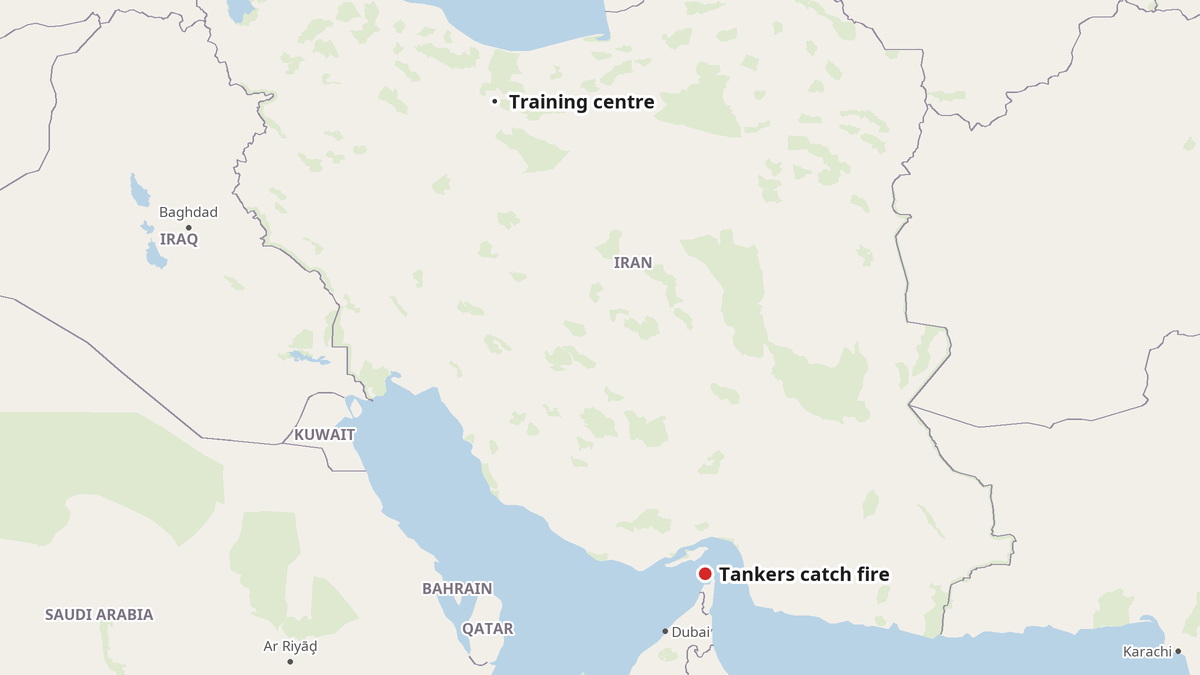
Four oil tankers burned south of the Strait of Hormuz on Wednesday after striking naval mines in a lane Iran's Revolutionary Guard Corps declared off-limits, according to a statement carried by the official IRNA news agency. The IRGC called the vessels "non-compliant," said two more ships were detained for violating shipping restrictions, and claimed it had shot down a US-made MQ-9 drone over the strait, the 56th it says it has downed. None of the incidents could be independently verified.
The claim lands in the middle of a diplomatic exchange that Tehran itself has set up as a hostage negotiation over one of the world's most important energy routes.
The Security Picture
Iran's offer is blunt. It would reopen the waterway over two days if Washington meets seven demands, including lifting sanctions and ending a US naval blockade. Mohsen Rezaei, secretary of Iran's Supreme National Security Council, wrote on X that America's response "was not convincing" and that the United States "must fully and explicitly address Iran's seven conditions." He added: "Only in this case will the Strait of Hormuz be reopened."
The strait is a vital global energy conduit. Tehran claims control over it and, since the war began, has targeted vessels attempting to cross without its authorization. That means a shipping lane open to the world under international custom now operates at the pleasure of the IRGC.
The military friction is real. President Donald Trump confirmed American strikes early Tuesday on an Iranian anti-aircraft facility on Qeshm Island. "They built an anti-aircraft facility. It took them about two months. We watched it get built. As soon as it was completed, we hit it last night," he told Fox News, calling it a "minor attack" that "wasn't war." US officials described the strikes as "defensive" and said they followed Iranian fire at an American aircraft. Separately, the United Kingdom Maritime Trade Operations reported two unidentified projectiles hit a tanker's engine room about 14 nautical miles northeast of Oman's coastal village of Limah on Tuesday. No casualties were reported.
Iran's leadership is signaling it expects more. Supreme leader Mojtaba Khamenei ordered the military at the weekend to respond immediately to any threat without geographical limits and to update its list of targets. Iranian officials suggested European countries and undersea cables in the Gulf could be targets. Chief negotiator Mohammad Bagher Ghalibaf said Iran was "ready for battle with its finger on the trigger."
Diplomatic Dead End
Qatar is trying to keep a channel open. Majed al-Ansari, a spokesperson for its Foreign Ministry, said both sides "remain committed to the negotiation process," with Doha facilitating a "real-time exchange of proposals." President Masoud Pezeshkian said his government still sought a resolution "through dialogue" and that "no one will benefit from this war" if it reignited. He said the supreme leader had recently given the government new powers to negotiate issues previously considered "off-limits."
Gulf News described the talks as "stalled." Trump, meanwhile, said he was "not looking to ... kill lots of people," but added, "If we have to, we'll have to." He told the Financial Times, "We seem to be getting everything we want," and told Fox News, "They will never have a nuclear weapon."
US media, citing officials, reported that Central Command had prepared strike plans that could begin as early as Wednesday, after the midterm elections, with three American aircraft carriers in the region. The Wall Street Journal reported Trump had "leaned toward" a large attack but had not decided. CENTCOM commander Adm. Brad Cooper reportedly briefed Trump on options, including a short, intense campaign. Trump said he was ready to act but that there might be no reason to.
The politics cut both ways. Trump acknowledged rising petrol prices hurt Republicans, saying voters "didn't like it," and that the Iran war played a part in the defeat. Ghalibaf seized on the result: "Americans said NO TO WAR, and we endorse this message." Critics of escalation are also being heard. Political scientist John Mearsheimer asked: "If the 40-day bombing campaign didn't work, how is the three-day bombing campaign going to work?"
The Regional Threat
The fallout is spreading beyond the strait. A Saudi-led coalition said it intercepted three drones targeting Saudi territory, including one over the western Mecca region. Yemen's Houthi group said it launched drone and ballistic-missile attacks on an airport and an airbase in southwestern Saudi Arabia. Etihad Airways extended the suspension of flights between Abu Dhabi and Dammam and Riyadh until November 19.
The US Embassy in Yemen accused the Houthis of killing Mohammed Al Shami, a UN Human Rights Office staff member and father of three, while he was detained. The embassy said the group concealed his body for months in a morgue in Sana'a while claiming he was alive, and called for the unconditional release of all detained UN, diplomatic and humanitarian staff.
Israel sits inside the likely retaliation zone. Washington was reportedly "rapidly replenishing" THAAD and Patriot batteries in southern Israel ahead of an expected wave of Iranian ballistic-missile retaliation. One report counted at least 10 US military cargo planes landing at Ovda and Nevatim air bases, most departing from Fort Bliss in Texas, a pattern also seen before the previous strike on Iran. Those details came largely from open-source tracker accounts; there was no US confirmation of an attack plan, and Israeli outlet Walla reported "no unusual rise" in US aircraft arrivals over the past week. A THAAD battery has been in Israel since October 2024.
Why This Matters: Iran is using control of a global chokepoint, plus mines, drones and Houthi proxy fire, as leverage to extract sanctions relief and an end to a naval blockade. Its supreme leader has ordered target lists updated without geographical limits, and its officials have floated European and undersea-cable targets. For Israel and Gulf states, the buildup of missile defenses signals how seriously Washington takes the risk of retaliation. Whether a short strike campaign can change Tehran's calculus is contested, even among those wary of escalation. What's not contested in the reporting is that the strait remains closed to anyone outside Iran's terms.
- strait of hormuz
- iran
- united states
- donald trump
- military strikes
- qatar
- commercial shipping
- iran-us tensions