
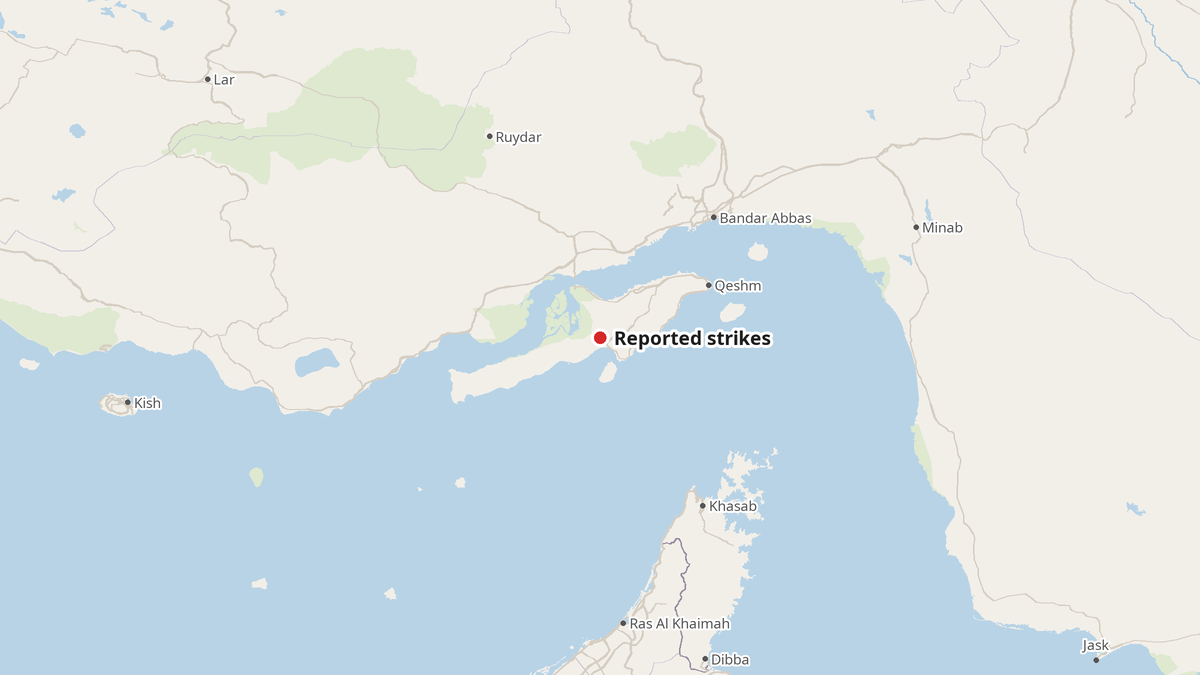
President Donald Trump confirmed Friday that U.S. forces had struck Iran, while Iranian state media reported two missile strikes in the Suza area of Qeshm Island, a crucial route for oil shipments through the Strait of Hormuz. The people living beneath this military machinery got no say in whether the machinery would start up again.
Iran’s Ali Bagheri Kani, deputy secretary of Iran’s Supreme National Security Council, said Tehran wanted more than “paper commitments” before a new phase of diplomatic talks. “We must see practical measures by the Americans,” he told IRIB, according to Press TV.
Trump described the attacks as “minor” and said Washington had made “a lot of progress” in talks with Tehran. He didn’t specifically confirm that his remarks referred to Qeshm, telling reporters, “I don't want to talk about it.” Tasnim, citing Reuters, also reported missile strikes on the island; it said there was no official information on damage.
The military apparatus stays in motion
Trump said U.S. forces had knocked out an Iranian air-defence device in “about 15 minutes, maybe five.” IRIB reported that Iran’s army said its air-defence forces intercepted and destroyed an American MQ-9 drone over Qeshm. U.S. Central Command, which oversees U.S. military operations in the Middle East, called the situation “relatively calm” and told Al Jazeera it was aware of reports but had no further comment.
The strikes were the first since Tuesday’s U.S. midterm elections. The United States had struck the same island on Monday; a U.S. official told MS Now that action was a “defensive measure.” The label changes. The missiles still land.
On Thursday, Trump said the United States might have to “destroy” the rest of Iran. “Now we're making a decision, do we want to go further? I would rather not destroy the rest of the country if possible but maybe I'll have to. You'll know soon enough,” he told reporters. In October, he had said the United States wouldn’t attack Iran before the midterms, without saying whether strikes would resume afterward.
Unnamed Pentagon officials and military commanders told The New York Times that thousands of U.S. air and naval forces, aboard more than a dozen ships and at bases around the Middle East and in the United States, were poised to resume major combat operations on Trump’s orders. NBC News reported that two U.S. officials said some of Trump’s advisers believed the window to restart major operations was closing and urged him to act before a new Congress took office in January.
The bill lands far from the decision-makers
The U.S.-Israeli war killed Supreme Leader Ali Khamenei, his top commanders, nuclear scientists and hundreds of civilians, and destroyed key military sites. The United States imposed a maritime blockade on Iran and reinstated sanctions as the conflict stagnated, further straining the economy. The International Monetary Fund forecast Iran’s consumer prices would rise by an average of 78.6% in 2026.
Trump said Iran wanted “to make a deal very badly,” pointing to inflation and damage to its military and infrastructure. The IMF forecast, however, was a 78.6% average rise in consumer prices—not the “300% inflation” Trump claimed. Iran has demanded that Washington meet seven conditions before Tehran opens the Strait of Hormuz, including ending the war “on all fronts,” compensation, withdrawal of U.S. forces and lifting sanctions. Whether Washington would accept those demands was unclear.
The State Department’s Rewards for Justice program offered up to $20 million and possible relocation for information on Iran’s nuclear program, assets and associated individuals. The department said information could be sent through Signal or its Tor-based tip line. The state’s answer to a conflict, then, includes both military force and paid informants.
Election theater, with missiles still on the table
Trump acknowledged in a call with Fox News that the war was partly to blame for Republican midterm losses. Vice President JD Vance wrote on X, “the reason we lost is the war.” An Al Jazeera opinion article by Rami G Khouri argued that the war amplified existing voter anger about costs, militarism and the lack of congressional authorization. Khouri also cited corruption, wealthy political donors and corporations, military and high-tech sectors, anti-immigration policing, and corporate media as grievances that predated the war.
Vance identified four voter demands after the election, according to Khouri: “End the war,” “Focus on the cost of living and inflation,” “Put America First” and “Change our relationship to Israel.” Those demands now sit beside Trump’s threats and the reported preparations for renewed operations. The account describes no community-led relief effort or mutual-aid response; its named actors are presidents, military commands, diplomats and political officials.
Iran’s hardliners intensified calls for Washington to make no compromises. Supreme Leader Mojtaba Khamenei warned against the “slightest inclination towards submission.” Qatar rejected reports that U.S.-Iran negotiations had failed. Majed al-Ansari, spokesperson for the Qatari Ministry of Foreign Affairs, said: “Promoting such false claims serves only those seeking to prolong the war and destabilise the region.” Talks continue. So do the threats, the sanctions and the machinery of war.
- iran
- donald trump
- qeshm island
- united states
- iran war
- us iran talks
- strait of hormuz
- midterm elections