
U.S. officials are weighing a new assault on Iran as their naval blockade disrupts commercial shipping, drives up insurance costs and threatens a wider regional confrontation. The clash now extends beyond military positions. Merchant ships face attacks, shipping capacity is contracting, and the cost of insuring an oil tanker carrying crude from the Middle East to East Asia rose about 200-fold from January to the end of October, reaching $12.29 per barrel, OPEC said.
The blockade and its costs
The United States imposed its blockade on April 13, lifted it in June after reaching an understanding with Tehran, then reinstated it on July 14 after the agreement collapsed. The measures target a route that has allowed Iranian petroleum products to reach international markets. On Wednesday, U.S. Central Command warned that ships receiving cargo through ship-to-ship transfers from vessels loaded at Iranian ports or along Iran's coastline could be treated as evading the blockade, even if they hadn't entered Iranian ports or approached the coastline.
“Such ships may be stopped, boarded, diverted, captured, or directed to proceed to the Iranian port where the cargo originated,” CENTCOM said. It warned that ships failing to comply could face enforcement action, including force. The advisory extends enforcement to cargo transfers and vessels operating beyond Iran's ports, making the blockade's reach a major point of friction with commercial shipping.
An internal U.S. Maritime Administration memo acknowledged the disruption. “Merchant ships now face kinetic action from both sides, and the threat has spread to Gulf anchorages and the Gulf of Oman,” the October 12 memo said. It warned of further war-risk premium spikes, crew refusals and “effective tanker capacity contraction.” Al Jazeera obtained the memo through a Freedom of Information Act request. The origin of the alert remained unclear; MARAD or another agency may have issued it.
The International Maritime Organization recorded about 130 attacks on vessels in the region since the conflict began, killing at least 25 seafarers. October brought the worst month for shipping since the war began, with 35 vessels targeted, the IMO said. Industry estimates cited in the Parliament of Singapore put war-risk cover at 3.5%–7.5% of a vessel's market value as of July, up from 0.10%–0.25% before the war. Crude oil and fertilizer prices surged at points during the war by as much as 60% and 112%, respectively.
Military escalation and political stakes
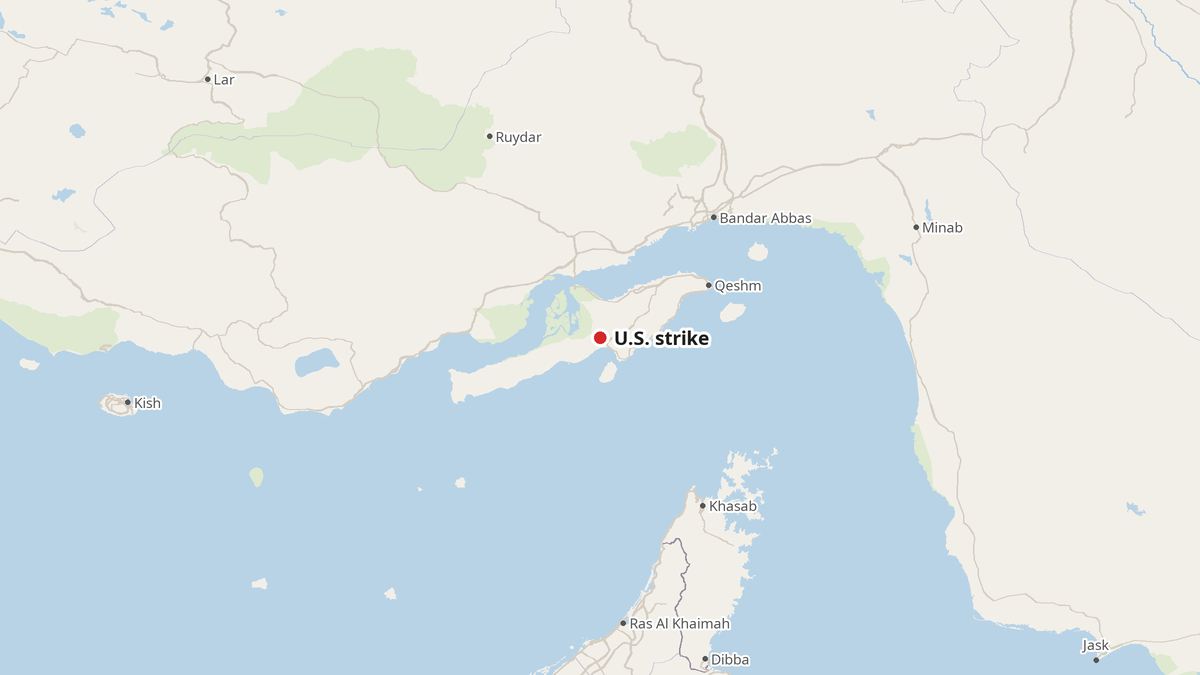
The United States struck Iran's strategic Qeshm Island in the Strait of Hormuz on Tuesday. American officials called the strike self-defense, citing Iranian strikes on U.S. assets in Bahrain, which the U.S. military said it intercepted. Iran also struck Kuwait this week; officials said the attacks caused no damage.
Israel fears Iran is rebuilding ballistic-missile manufacturing and moving military and nuclear infrastructure underground, sources familiar with the matter told CBS News. Israel's military stands prepared for renewed fighting and is at peak defensive posture against a first Iranian attack. The Israeli government would prefer a joint operation with the United States, but it's unclear whether President Trump will order military action or what form it might take.
The U.S. has tens of thousands of forces and two aircraft carriers with associated strike groups in the region, amounting to dozens of warships and aircraft. CBS News reported that a new offensive operation could be mounted within two to four days if ordered. U.S. Central Command chief Adm. Brad Cooper met senior Israeli security officials at Israel's defense ministry on Wednesday for a “joint, comprehensive situational assessment.” Israel's most senior general, Eyal Zamir, and Mossad director Roman Gofman attended.
Political claims and resistance to escalation
Months of indirect U.S.-Iran negotiations haven't produced a ceasefire deal to reopen the Strait of Hormuz. Iran has refused to discuss its nuclear program unless the United States lifts the blockade and accepts six other key conditions. Tehran has also rejected a ceasefire or nuclear talks unless Washington accepts seven demands, including ending hostilities on all fronts in the Middle East and ending the blockade of Iranian ports and vessels.
Trump has alternated between threats and delay. “I'm going to finish it off,” he told Fox News on Wednesday, adding, “Yeah, soon. I mean, one way or the other, we'll finish it off.” On Thursday, he said he was “not rushing into any decision” and told Israel's Channel 12, “We will see what happens after the beginning of the year.” The war remains deeply unpopular in the United States, and CBS News reported it was a key factor in Republicans' recent midterm defeat. The GOP-led U.S. Senate rejected a measure aimed at curbing the war on Thursday.
Iran has warned that any renewed attack would draw a response beyond its earlier actions. Iranian officials have threatened U.S. military infrastructure in Persian Gulf states, U.S. bases in Europe, Gulf energy infrastructure and undersea internet cables. A statement attributed to Iran's Supreme Leader Ayatollah Mojtaba Khamenei said that, if open hostilities resume, “there would be no geographical limit for Iranian missiles.”
The blockade's commercial consequences also threaten to draw neighboring governments deeper into the conflict. Andreas Krieg, associate professor in Security Studies at King's College London, said Gulf-based commercial networks had facilitated Iranian oil exports through ship-to-ship transfers, though the degree of official government involvement remained unclear. He warned that confrontation over tankers could prompt retaliation against Gulf energy infrastructure. “The danger is that an operation intended to test American resolve becomes the trigger for another full-scale regional war,” he said.
- iran
- united states
- israel
- naval blockade
- strait of hormuz
- military strikes
- nuclear program
- ceasefire negotiations