
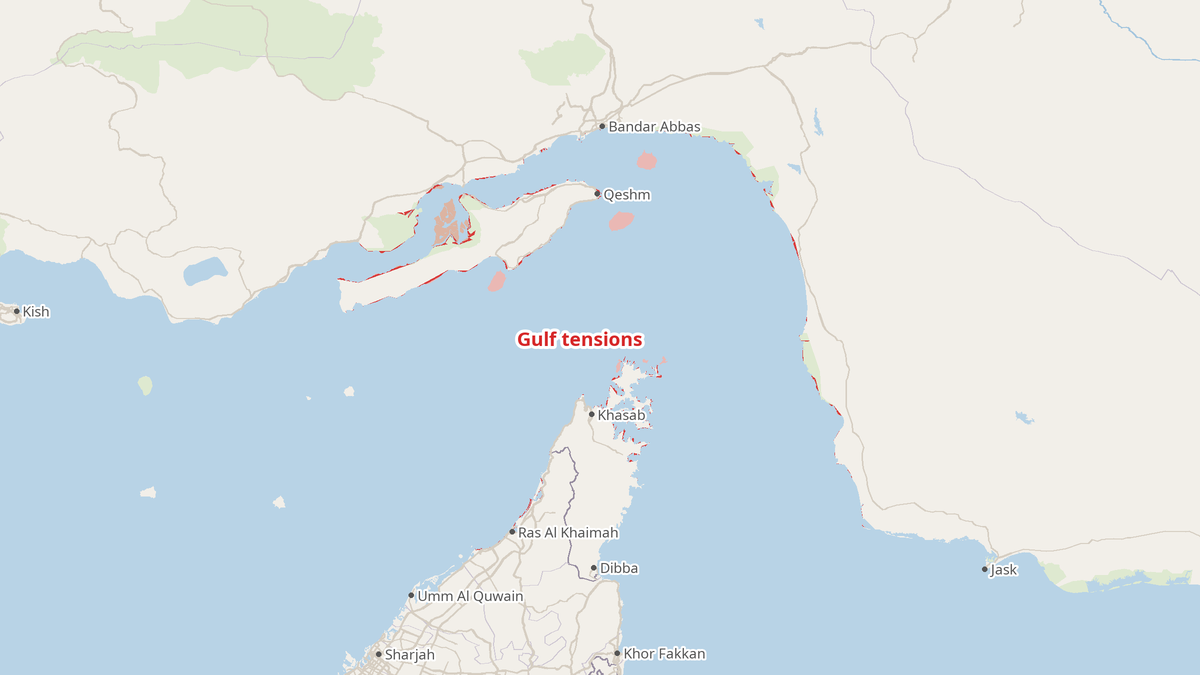
Iran warned of a “fierce military response” and immediate strikes on Gulf energy infrastructure if efforts to stop its tankers continued. Attacks on shipping near the Strait of Hormuz heightened concern over a wider confrontation, as the United States enforced a naval blockade and weighed whether to resume military strikes.
Shipping Under Threat
The Joint Maritime Information Centre said attacks had hit seven oil tankers in the area since November 16. Three vessels came under attack near Oman’s coast between November 20 and 21. The latest attacks targeted outbound tankers 8 to 17 nautical miles from Khasab, Oman. The United Arab Emirates and Oman were searching for a Jordanian sailor missing after an attack on an ADNOC Logistics and Services tanker in the strait.
Iranian media, citing the country’s navy, reported that two oil tankers caught fire after entering a “restricted area” east of the strait. Separately, the United Kingdom Maritime Trade Operations agency reported an incident involving a tanker and “military forces” in the Gulf of Oman, east of the Strait of Hormuz near Chabahar. It didn’t identify the vessel or link it to a reported Iranian convoy.
Iranian reports said more than 14 tankers were gathering near Kharg Island, the country’s main crude export terminal, for a possible attempt to breach the blockade. The reports cited satellite imagery and vessel-tracking data, but no one had independently confirmed them. Whether the ships would try to cross remained unclear. A UANI adviser called a 14-ship breakout almost logistically impossible and based on propaganda. Another report claimed 31 laden tankers would attempt to cross, also without independent confirmation.
Windward AI’s Maritime Intelligence Operations Centre identified 31 laden, sanctioned tankers positioned beyond the Strait of Hormuz between November 13 and 20. Four crude-oil tankers carried an estimated 4.9 million barrels, and satellite imagery confirmed their positions. The closest, the Suezmax tanker TOUR 2, appeared off Chabahar, about three to six hours’ sailing from the blockade line. The other 27 vessels carried liquefied petroleum gas or refined petroleum products; 20 sat at the Shinas and Sohar anchorages.
Blockade and Military Readiness
U.S. President Donald Trump threatened to sink Iranian vessels that tried to breach the blockade. Fox News chief foreign correspondent Trey Yingst asked Trump on Sunday, November 22, about reports Iran was preparing to test it. Trump replied: “I hope they do, they'll all be at the bottom of the sea like the rest of the navy.” Yingst also reported that Trump was inclined to resume strikes after the New Year if negotiations failed.
The United States was reportedly weighing a delay in renewed strikes, despite pressure from Israel for military action. Ynet reported, citing U.S. administration officials, that Washington had decided to delay a potential attack by at least a week for now. Israeli Prime Minister Benjamin Netanyahu was pressing for a short, intensive campaign that he believed could severely weaken Iran’s government and potentially lead to its collapse. Trump’s advisers remained divided: would an offensive achieve that aim, or should Washington keep relying on its economic blockade?
U.S. Central Command remained at maximum readiness and favored a joint strike with Israel, i24NEWS reported, citing Israeli security officials. A U.S. source told the broadcaster CENTCOM wanted either to attack or stand down, rather than stay on heightened alert indefinitely. An Israeli source described the situation as “anxious waiting.” No decision to attack had been made.
Diplomacy and Escalation Risks
Iranian Deputy Foreign Minister Kazem Gharibabadi said negotiations with Washington were continuing and the window for diplomacy remained open. Iranian Foreign Minister Abbas Araghchi said “the path of diplomacy continues.” Gharibabadi also called the blockade an “act of war.” Iran warned that stopping its tankers could trigger strikes on Gulf energy infrastructure.
Iran’s seven-point proposal, reportedly transmitted through Qatar, called for lifting the U.S. blockade, easing oil sanctions and addressing other economic restrictions before further negotiations could progress. Tehran also sought assurances against renewed hostilities and maintained its position on retaining its enriched uranium stockpile. The United States sought an agreement addressing Iran’s nuclear program and regional military activities. A Qatari delegation visited Tehran on November 21, and Gharibabadi said Iran remained in contact with mediators, including Qatar.
The Strait of Hormuz connects the Arabian Gulf to international markets and carries major oil and gas traffic. Disruption could affect shipping, oil supplies and energy markets. The Associated Press reported renewed U.S.-Iran military exchanges after a roughly two-month lull, including Iranian attacks on U.S. military targets in Bahrain and a U.S. strike on an Iranian missile-launch site on Qeshm Island. The blockade and shipping attacks have added to the risks around the vital route.
- iran
- united states
- strait of hormuz
- oil tankers
- military blockade
- israel
- diplomacy
- gulf of oman