
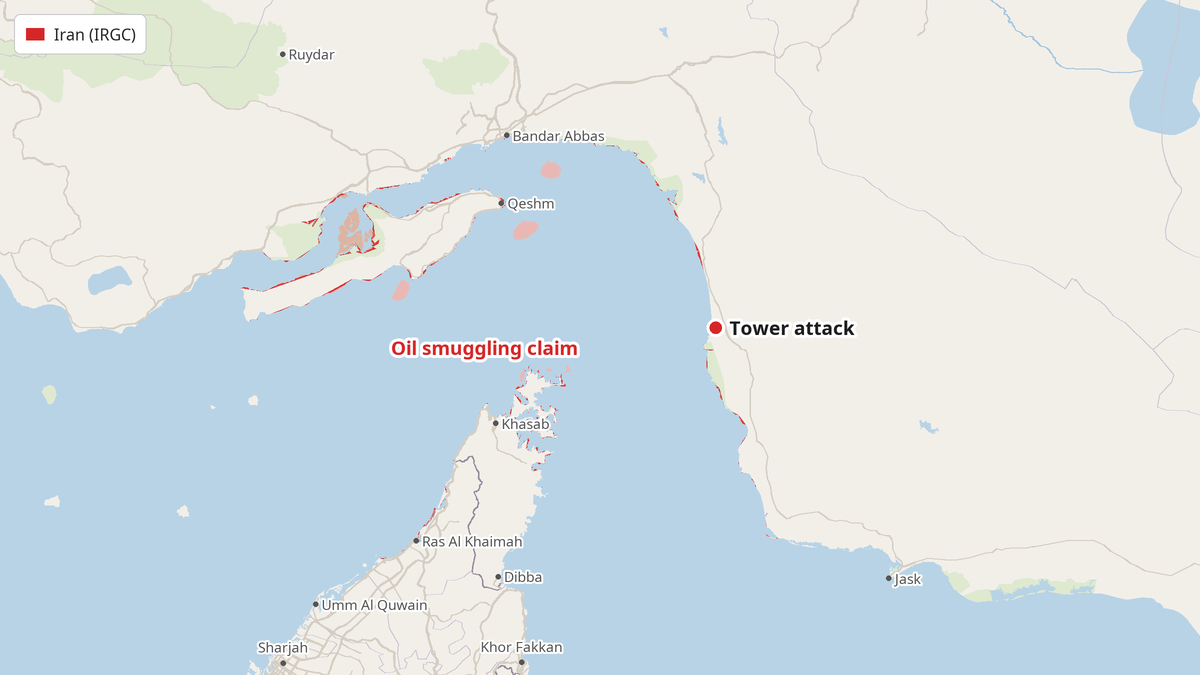
"A few hours ago, IRGC Aerospace Force fighters targeted and destroyed the US aggressors' early-warning radar on the island of Bahrain in response to the enemy's air aggression against a telecommunications tower in Sirik," the Guards said Friday. Neither Washington nor Manama has confirmed it. Nobody outside the IRGC's own media pipeline has verified a thing.
That pipeline is worth noticing. The statement ran through Tasnim, Fars and Iranian state media, and the state broadcaster posted it on Telegraph. The claim came hours after IRNA, citing official sources, reported that Sirik, in Hormozgan province, was hit by "enemy fire" on Thursday. IRNA named no attacker and gave no word on damage or casualties. The IRGC's own statement stopped short of blaming the United States directly. A retaliation with no named target, announced by an army that also runs the news agencies carrying it.
The Apparatus Talks to Itself
The Guards called the strike "a serious warning" to the "aggressor enemy" to stop what they described as "aerial provocations and oil smuggling in the Strait of Hormuz." They added: "Should these violations and acts of aggression recur, the IRGC Aerospace Force stands in full readiness to engage without limits." They also threatened harsher measures against companies they accused of being "misled by the United States."
Washington speaks the same language in a different accent. President Donald Trump told Hugh Hewitt on Salem News Channel, "No. No hesitation," when asked about using force against Iranian threats to US allies and shipping. "If I saw things going the other way, I would do that. And it's possible I would do it right now." On Truth Social on November 12 he wrote: "We don't need a deal with Iran. Those days have long since passed. We've got their money, Hundreds of Billions of Dollars, and we've got their Strait!" He also warned that Iran "will not exist very long any longer" if it killed a senior US official.
Iran's Supreme National Security Council Secretary Mohsen Rezaei said Thursday that military bases involved in any renewed US attack would become legitimate targets, including those in Europe. Two governments, each announcing who is a legitimate target, and the people living near the targets unconsulted.
Who Gets Crushed
Sirik sits on the Hormuz coast and hosts part of Iran's radar and communications network, according to RFE/RL, which reports it has been hit repeatedly since the war began with US and Israeli strikes on February 28. Gulf countries, the base article notes, bore the brunt of Tehran's wrath, with Iran striking airports, seaports, energy facilities and landmarks in US-allied countries. Bahrain hosts the headquarters of the US Navy's Fifth Fleet. It is the host, not the decider, and it absorbs the retaliation anyway.
The war is now in its ninth month (AFP calls it an eight-month war). The US naval blockade of Iranian ports is about seven months old. In August Washington announced what it called an "economic asphyxiation" campaign aimed at Iran's trade and financial flows. US Central Command says its forces are strictly enforcing the blockade, and says it helped Gulf countries export 1.5 billion barrels of oil via Hormuz since the summer. Iran, meanwhile, keeps restricting shipping. On November 12, Iran's army said two oil tankers caught fire after hitting naval mines in the eastern strait, claiming the vessels had entered a "prohibited and unsafe zone." RFE/RL reports numerous recent explosions on ships from drones or mines. Crews on those tankers had no say in whose zone they were sailing through.
Talks Without Anyone to Talk To
Parliament speaker and chief negotiator Mohammad Bagher Ghalibaf told Al Jazeera that Tehran awaits Washington's answer to seven conditions, saying "the ball is now in the American court." He insisted the strait would not return to its pre-war status. Analyst Shayan Samii told RFE/RL's Radio Farda that when Foreign Minister Abbas Araqchi says Iran will negotiate while Rezaei says there will be no negotiations until America accepts those conditions, world leaders conclude there is "no reliable decision-maker" in the Islamic republic. The conditions, per RFE/RL, include ending the blockade, releasing frozen assets and halting fighting on all fronts.
On the American side, Trump sidelined Vice President JD Vance, who had spent months leading efforts toward a cease-fire and revived nuclear talks, and told him to focus on what Trump called corruption and crime in Democratic-run cities. Samii says that put the war file in the hands of Marco Rubio and Pete Hegseth. AFP reports Washington appeared to dial back strike threats after Trump's party lost in recent midterms, partly because the war is unpopular. Policy, in other words, bends to polling. Israeli broadcaster KAN reported that CENTCOM advised Israel to prepare for possible resumed operations; a CENTCOM official called that "pure speculation."
The claim in Bahrain is the first Iranian report of targeting a Gulf facility since early September, about two months earlier. Two states, each holding the other's money, ships or radar hostage, and each telling its public that restraint is weakness.
- iran
- irgc
- bahrain
- strait of hormuz
- us military
- donald trump
- sirik
- air strike