
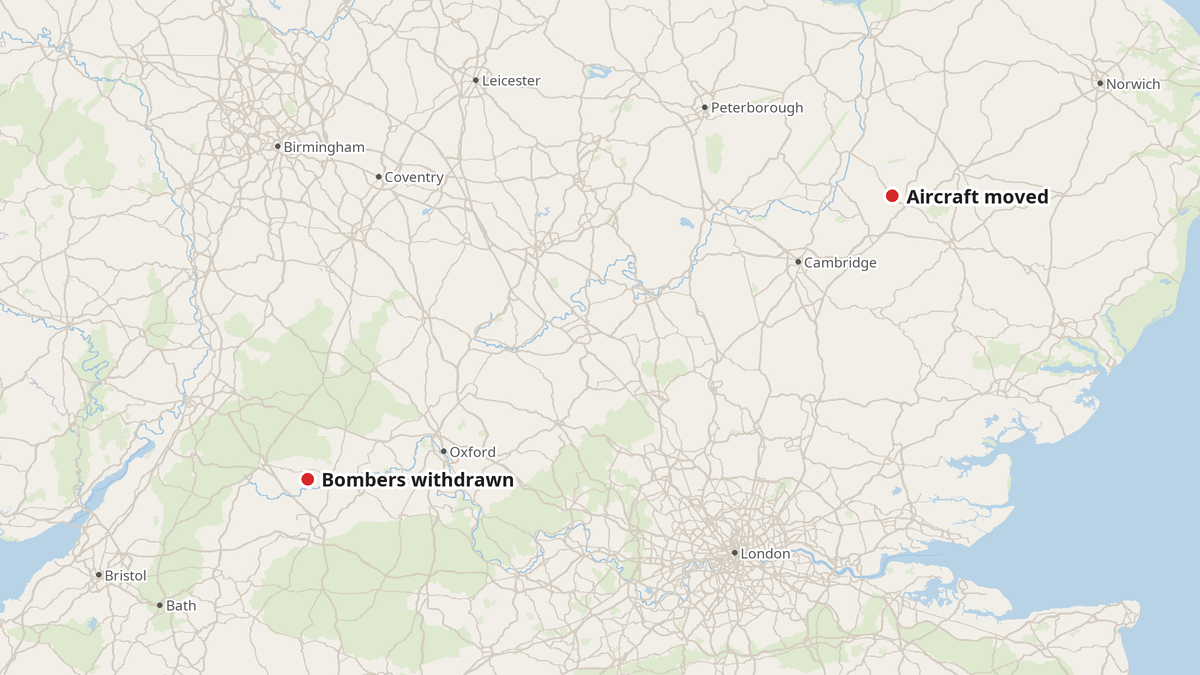
At least eight air refueling tankers and three Ospreys left RAF Mildenhall in Suffolk on Monday, flight tracking data showed, as the Iran war entered its ninth month with no end in sight and American officials cited a security threat they wouldn't describe.
A U.S. official confirmed to NBC News that several aircraft had left the eastern England base because the security posture there had increased. The planes were operating under "enhanced force protection measures," the official said, and wouldn't speculate on the exact nature of the threat. The Wall Street Journal first reported the movements and said the evacuation followed a threat from Iran, citing people familiar with the matter. The nature of that threat remains under discussion by U.S. officials.
Where the Aircraft Went
Some of the tankers, Boeing KC-135 Stratotankers, flew to airbases in Germany and Spain. One moved to the area of Glasgow Prestwick Airport in Scotland. The Ospreys relocated to nearby RAF Lakenheath, also in Suffolk.
"We take proactive measures to ensure our aircraft, our people, and our installations remain safe and secure," a U.S. official told NBC News. A U.S. European Command official said aircraft rotate between installations "for a variety of reasons including training and real world requirement," and that they're hosted under access, basing and overflight agreements with allies. Citing operations security, the command wouldn't provide more detail. The U.K. Ministry of Defense said it does "not routinely comment on the activity of other nations."
The tight-lipped responses leave British communities that host these bases with few answers about what's heading their way.
A Pattern at British Bases
It isn't the first time. Weeks ago, the U.S. withdrew bombers from RAF Fairford in Gloucestershire after police foiled a suspected terror plot linked to Iran. Two U.S. officials previously told NBC News the aircraft were pulled following reports of a possible Iranian drone attack. Five men were detained on Sept. 27, about six weeks ago, after three suspicious vans were spotted traveling toward the base. Other arrests followed, and two men were charged under the National Security Act.
The incident remains largely unexplained. British Prime Minister Andy Burnham said the activity was likely to have been coordinated in Iran. Tehran has denied involvement, though its Revolutionary Guard warned in July that any base used to launch attacks against Iranian territory was a legitimate target. The U.S. has used bases in the U.K. to strike Iran. Iran has vowed retaliation for any renewal of the American-Israeli war against it and has threatened to expand its response beyond the Middle East.
Diplomacy and Its Limits
Secretary of State Marco Rubio said Monday that Washington had addressed concerns about reported threats from Tehran against American diplomats overseas by "moving people away from the threat." He added: "Obviously, we're always worried about the safety and security of our personnel and their families overseas."
President Donald Trump, citing new "momentum" in negotiations to end the war, downplayed the prospect of new U.S. attacks after meeting Qatar's Prime Minister Sheikh Mohammed bin Abdulrahman Al-Thani at the White House. "Iran militarily is effectively over," Trump said. Further attacks "won't be necessary" for now, but Washington remains "locked and loaded" should circumstances change. The U.S. will keep its economic blockade of Iran in place, according to The Hill's video summary.
Tehran's response was far less conciliatory. Fox News' newsletter headline reported that Iran claims the U.S. is spreading "Fake News" and is demanding surrender to deal conditions. The full article wasn't available.
The Cost at Home
The war began February 28. Gas prices are up more than 30% since then, according to NBC News, a squeeze that lands hardest on households with the least room in their budgets. NBC also reported that the administration isn't alone in blaming the war for Republican midterm losses. Vice President JD Vance said the day after the midterms that "the reason we lost is the war."
There's one more measurable effect. A study in Nature Climate Change projects a 0.4% decrease in global climate-warming emissions for 2026, largely due to the war and its effects on energy markets.
Why This Matters: Nine months in, the war's costs are spreading well beyond the battlefield. American families are paying more than 30% extra at the pump. Host communities in Britain are living with the security fallout of a conflict they didn't vote for, and officials on both sides of the Atlantic are declining to explain what the threats actually are. That opacity matters in democracies where basing agreements depend on public trust. Trump's talk of negotiating momentum sits awkwardly beside a continued blockade, a "locked and loaded" posture and Tehran's demand for surrender. The fact that voters, by Vance's own account, punished the governing party over the war suggests the public is demanding accountability and a diplomatic exit. The modest emissions dip, tied to energy market disruption rather than any deliberate climate policy, is hardly a silver lining.
- iran
- iran war
- united states
- raf mildenhall
- donald trump
- marco rubio
- peace talks