
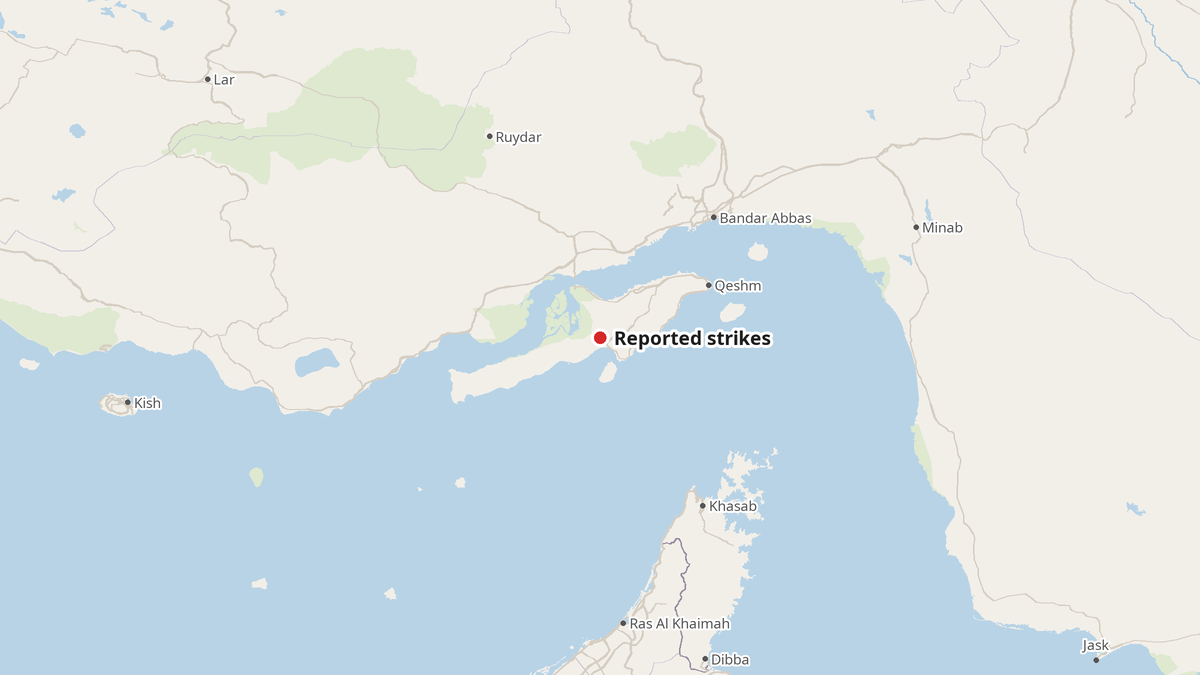
President Donald Trump confirmed Friday that U.S. forces had struck Iran's Qeshm Island, calling the attacks "minor" even as a war that voters just punished at the ballot box edges toward a possible new round of major combat. Iranian state media reported two missile strikes in the Suza area of the island, which sits in the Strait of Hormuz, a crucial route for oil shipments. There was no official information on damage.
It was the first strike since Tuesday's midterm elections. Trump wouldn't say much about it. "I don't want to talk about it," he told reporters, though he described a U.S. operation this way: "We do minor strikes, but they knock out. They built a little bit of an anti-aircraft device, and we knocked it out in about 15 minutes, maybe five." Iran's army, meanwhile, said its air-defence forces destroyed an American MQ-9 drone over Qeshm. U.S. Central Command called the situation "relatively calm" and declined further comment.
A War That Cost Votes
The political fallout was blunt. Trump acknowledged in a call with Fox News that the war was partly to blame for Republican midterm losses. Vice President JD Vance put it more simply in a Wednesday post on X: "the reason we lost is the war." Vance also identified four voter demands after the election: "End the war," "Focus on the cost of living and inflation," "Put America First" and "Change our relationship to Israel."
The economic pinch was real. In an Al Jazeera opinion piece, Rami G Khouri, a Distinguished Public Policy Fellow at the American University of Beirut, wrote that restrictions on Strait of Hormuz shipping raised prices for groceries, gasoline, diesel, travel and other necessities, and that about 90 percent of voters considered the cost of living a major or crucial factor. He also noted voters questioned the lack of congressional authorization for the attack, and he said the administration had offered no clear, consistent or credible strategic goals beyond preventing Iran from developing a nuclear weapon. Al Jazeera noted the views were the author's own.
Trump, for his part, insisted the pressure was falling on Tehran. "They have 300% inflation. Their navy's gone. Their airport, everything's gone, and they want to make a deal," he said. The International Monetary Fund's Oct. 13 report forecast Iranian consumer prices rising by an average of 78.6% in 2026. Asked about the war's scale, Trump said: "This is a war that we may have been there for seven months, but we probably fought for three or four weeks, really fought."
Mixed Signals, Narrowing Window
Since the midterms, Trump has swung between threat and reassurance. On Thursday he said the United States might have to "destroy" the rest of Iran. "I would rather not destroy the rest of the country if possible but maybe I'll have to. You'll know soon enough," he said. On Friday he said talks with Tehran had made "a lot of progress," without offering details.
The military machinery keeps turning. Unnamed Pentagon officials and commanders told The New York Times on Wednesday that thousands of U.S. air and naval forces, aboard more than a dozen ships and at bases around the Middle East and in the United States, were poised to resume major combat operations on Trump's orders. NBC News reported that two U.S. officials said some of Trump's advisers believed the window to restart major operations was closing and urged him to act before a new Congress took office in January. Fox News reported that Nov. 9 would bring a new moon in the Middle East, a condition senior U.S. officials called favourable for military operations. Central Command was finalizing preparations but had not received a new directive from Washington, according to reports citing a U.S. official.
Diplomacy Under Pressure
Qatar pushed back Saturday on reports that negotiations had failed. Majed al-Ansari, spokesperson for Qatar's Foreign Ministry, said on X: "Promoting such false claims serves only those seeking to prolong the war and destabilise the region." Qatar said Trump had called Emir Sheikh Tamim bin Hamad Al Thani to discuss de-escalation, and Iranian negotiators had shuttled between Tehran and Doha in recent weeks.
But Tehran is hardening. Ali Bagheri Kani, deputy secretary of Iran's Supreme National Security Council, said: "We must see practical measures by the Americans." Supreme Leader Mojtaba Khamenei warned against the "slightest inclination towards submission." Hamidreza Azizi of the International Crisis Group told CNN that Iran's leadership sees the election results as vindication of its strategy and that Tehran's position on a deal "is likely to harden further." Iran has demanded seven conditions before opening the Strait of Hormuz, including ending the war "on all fronts," compensation, withdrawal of U.S. forces and lifting sanctions. It was unclear whether Washington would accept them.
The human toll sits beneath all of this. The U.S.-Israeli war killed Supreme Leader Ali Khamenei, his top commanders, nuclear scientists and hundreds of civilians, and caused major economic losses. A U.S. maritime blockade and reinstated sanctions have further strained Iran's economy, even as the State Department's Rewards for Justice program offered up to $20 million for information on Iran's nuclear program.
Why This Matters:
The war is now eight months old, and its costs are landing in two places: Iranian civilians living with a shattered economy, and American households paying more at the pump and the grocery store. Voters delivered a verdict on Tuesday, yet the decision to escalate or de-escalate still rests with a president who, according to reports, faces advisers urging action before a new Congress arrives. That raises a basic question of democratic accountability: a war that critics say lacked congressional authorization could resume within days, with no new directive publicly debated. Meanwhile, diplomacy, led by Qatari mediators, hinges on whether either side will move first. If talks collapse, the ones paying will again be ordinary people, far from the rooms where the decisions get made.
- iran
- donald trump
- qeshm island
- united states
- iran war
- us iran talks
- strait of hormuz
- midterm elections