
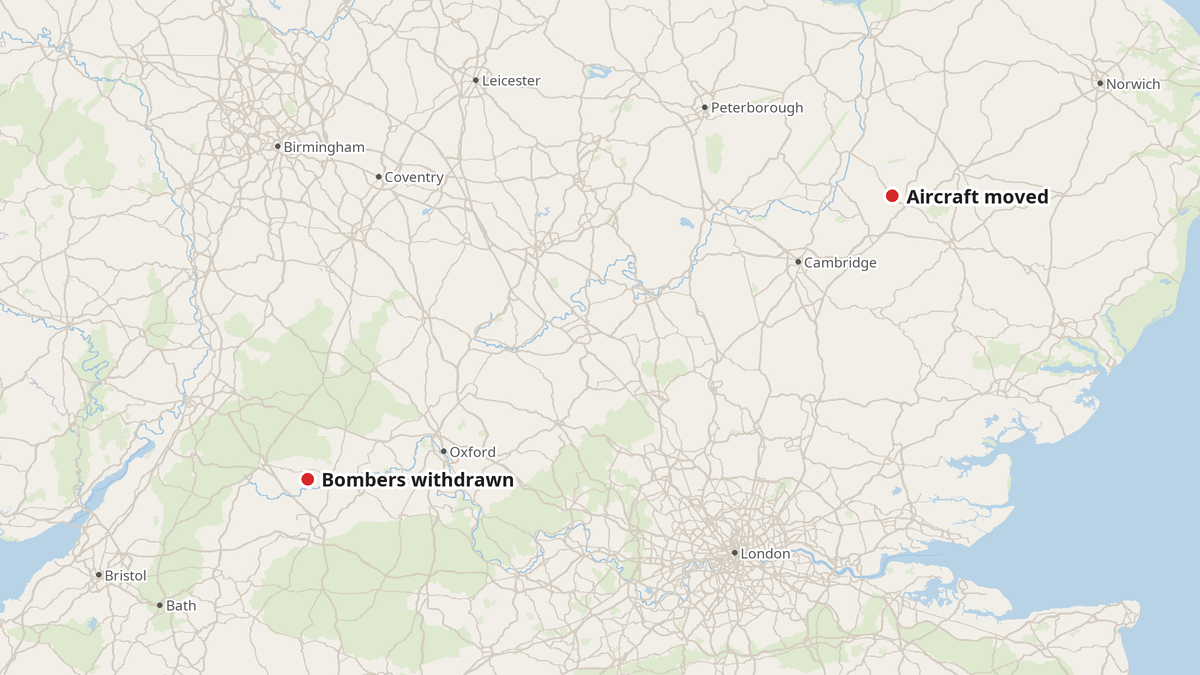
At least eight air refueling tankers and three Ospreys left RAF Mildenhall in Suffolk on Monday, flight tracking data showed, after the United States pulled military aircraft from a British base amid threats from Iran. A U.S. official confirmed to NBC News that the aircraft had left "as the security posture there had increased."
The aircraft are now operating under "enhanced force protection measures." The official wouldn't speculate on the exact nature of the threat. Some of the Boeing KC-135 Stratotankers went to airbases in Germany and Spain. One moved to the area of Glasgow Prestwick Airport in Scotland. The Ospreys relocated to nearby RAF Lakenheath, also in Suffolk. The Wall Street Journal was first to report the movements, citing people familiar with the matter, and said the evacuation followed a threat from Iran. Its exact nature remains under discussion by U.S. officials.
Who Decided
No one in Britain announced it. The U.K. Ministry of Defense said it does "not routinely comment on the activity of other nations," adding that "aircraft and other assets move regularly according to operational requirements." A U.S. European Command official said American aircraft are hosted "in accordance with access, basing, and overflight agreements with our Allies and partners," and that "due to operations security, we will not provide further information on movement of assets."
So the people of Suffolk, who live beside the base, are told nothing. Aircraft arrive, aircraft leave, and the arrangements governing them sit in agreements the public hasn't seen. The U.S. has used bases in the U.K. to strike Iran, according to the base article. Iran has vowed retaliation for any renewal of the American-Israeli war against it. It has threatened to expand its response beyond the Middle East.
What It Costs the People
This isn't the first withdrawal. The move comes weeks after the U.S. pulled bombers from RAF Fairford in Gloucestershire, after police foiled a suspected terror plot linked to Iran. Five men were detained on Sept. 27 — about six weeks ago — after three suspicious vans were spotted traveling toward the base. Other arrests followed. Two men were charged under the National Security Act. The incident remains largely unexplained.
British Prime Minister Andy Burnham said the activity was likely to have been coordinated in Iran. Tehran has denied involvement. Its Revolutionary Guard warned in July that any base used to launch attacks against Iranian territory was a legitimate target.
The war itself began February 28 and is now in its ninth month. Gas prices are up more than 30% since it started, according to NBC News. British soil hosts the launch points for a conflict in which Britons had no say, and British communities now sit inside a declared target zone.
The Political Cost in Washington
The war has cost the governing party at home, too. NBC News reported that Vice President JD Vance said the day after the midterms that "the reason we lost is the war."
President Donald Trump, citing new "momentum" in negotiations to end the war, downplayed new attacks on Monday. "Iran militarily is effectively over," he said after meeting Qatar's Prime Minister Sheikh Mohammed bin Abdulrahman Al-Thani at the White House. Further attacks "won't be necessary" for now, but Washington remains "locked and loaded" should circumstances change. The U.S. will maintain its economic blockade on Iran, according to The Hill's summary.
Secretary of State Marco Rubio said Washington had addressed reported threats against American diplomats overseas by "moving people away from the threat." Fox News' newsletter reported that Iran claims the U.S. is spreading "Fake News" and demands surrender to deal conditions.
American personnel can be moved away from the threat. The threat, though, stays where the bases are.
- iran
- iran war
- united states
- raf mildenhall
- donald trump
- marco rubio
- peace talks