
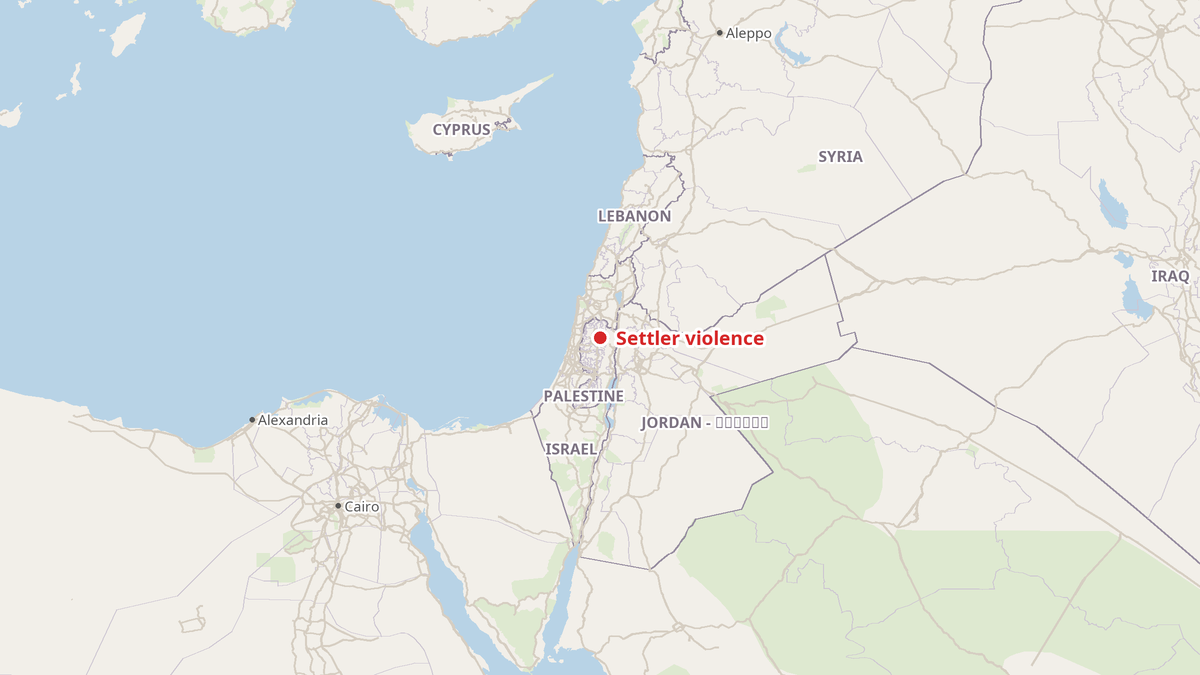
Masked Israeli settlers attacked Palestinian olive harvesters near Abu Falah on October 16. Heidi Levine, an American photojournalist with the Washington Post, was beaten despite wearing clearly marked press gear; doctors hospitalized her with a severe hand injury that required surgery. At least two people were injured in the attack. Yesh Din said settlers had carried out at least 170 attacks on Palestinians since September 27, around the start of the annual olive harvest.
Crackdowns, warnings and the apparatus
The following day, masked Israelis reportedly attacked a delegation visiting olive groves near the Palestinian Christian village of Taiba. Diplomats from Belgium, France and Poland were there. A Belgian consular vehicle was damaged, and French Mayor Bernard Baudoux was reportedly assaulted. Police opened an investigation, and the IDF condemned the attack.
But the government had already turned its attention to activists accompanying Palestinian farmers. On October 8, Defense Minister Israel Katz instructed officials to pursue administrative removal orders against activists considered threats to public order during the harvest. The Yesha Council, which represents Israeli settlements, had requested action, citing concerns about provocations and confrontations. The directive targeted left-wing and foreign activists. The Jerusalem Post editorial said the IDF had prepared for nationalist violence, clashes and terrorist attacks, and reported that it planned to reinforce its West Bank presence. It asked officials to establish what forces they had available, when warnings arrived and how units responded.
The IDF said an alert during the Taiba incident reached a brigade operations room meant for security personnel, not civilians. Foreign Minister Gideon Sa'ar condemned the assault, while saying advance coordination with the IDF could have helped protect the delegation. The editorial also referred to a reported warning, during the previous week, of a planned Hamas attack. Security officials had warnings to assess and forces to deploy. The delegation was attacked anyway.
U.S. Secretary of State Marco Rubio said on October 17 that the United States wanted Israel to do more to deter settler attacks. “We're very disturbed by those images and what we're seeing,” he said. “We've asked the Israelis and continue to ask them to crack down on that stuff.” Rubio said the State Department had asked about the incident involving Levine and expected a response from the U.S. Embassy in Jerusalem by Sunday.
Condemnations and the election machinery
Prime Minister Benjamin Netanyahu's office said, “Any violence against diplomats is unacceptable.” It also said, “The more serious the accusation, the greater the demand for compelling evidence,” pointed to the ongoing police investigation and argued that video footage didn't establish the complete sequence of events. The statement described Baudoux as “a French Communist Party mayor who previously raised the Palestinian flag over his municipal building, prompting French authorities to order its removal,” and suggested the reports reflected a campaign to smear Israel and Jewish residents of the West Bank.
President Isaac Herzog called Levine and said, “I was morally tormented during Shabbat when I thought about it, and I express deep sorrow and apologize for what you went through.” He urged law enforcement to investigate and prosecute those responsible. U.S. Ambassador Mike Huckabee, condemning a separate West Bank incident in August, called violent intruders “Israeli terrorists” and said there was “no excuse for such thuggish behavior.”
The attacks come ahead of Israel's October 27 election, framed as a choice over whether the country will move further toward hard-right nationalism. Netanyahu returned to power in December 2022 with once-shunned ultra-nationalists. His government expanded settlements in the occupied West Bank, where settlers—described as acting with the blessing of far-right National Security Minister Itamar Ben Gvir—attacked Palestinians on their land, with occasional pushback from authorities.
A vote over who runs the state
The election follows the October 7, 2023 attack on Israel. Three years after the attack, the account described the trauma as raw: stickers bearing the faces of young people killed by Hamas remained on station walls and lampposts, while restaurant patrons carried assault rifles, which it said were now liberally allowed. Netanyahu led a multi-front regional war after the attack. Israel reduced Gaza to rubble, occupied part of Lebanon and, with U.S. help, bombarded Iran. The Gaza campaign left Israel with pariah status in many once-friendly Western countries, and Netanyahu faced an arrest warrant from the International Criminal Court.
The opposition's challenge isn't opposition to the war. Its leaders focused on Netanyahu's failure to prevent October 7, while none criticized his decision to wage war. A recent survey found 21 percent of the population identified as anywhere left of center. Polls identified former military chief Gadi Eisenkot as Netanyahu's strongest rival. “Netanyahu may have his perfect English, but even with perfect English he got us October 7,” Eisenkot said at a security conference at Reichman University.
Eisenkot, military chief during the 2006 Lebanon war, had promoted using massive force, including against civilian infrastructure in areas used by militants such as Hezbollah. The opposition's contest is also a contest over who commands the state and its force. Gideon Rahat, a political scientist at the Hebrew University of Jerusalem and the Israel Democracy Institute, said, “The state without a monopoly on the use of force is a failed state.” The harvest attacks, the missed alert and the coming vote put that monopoly plainly in view.
- west bank
- israeli settlers
- settler violence
- palestinians
- benjamin netanyahu
- israel election
- heidi levine
- olive harvest