
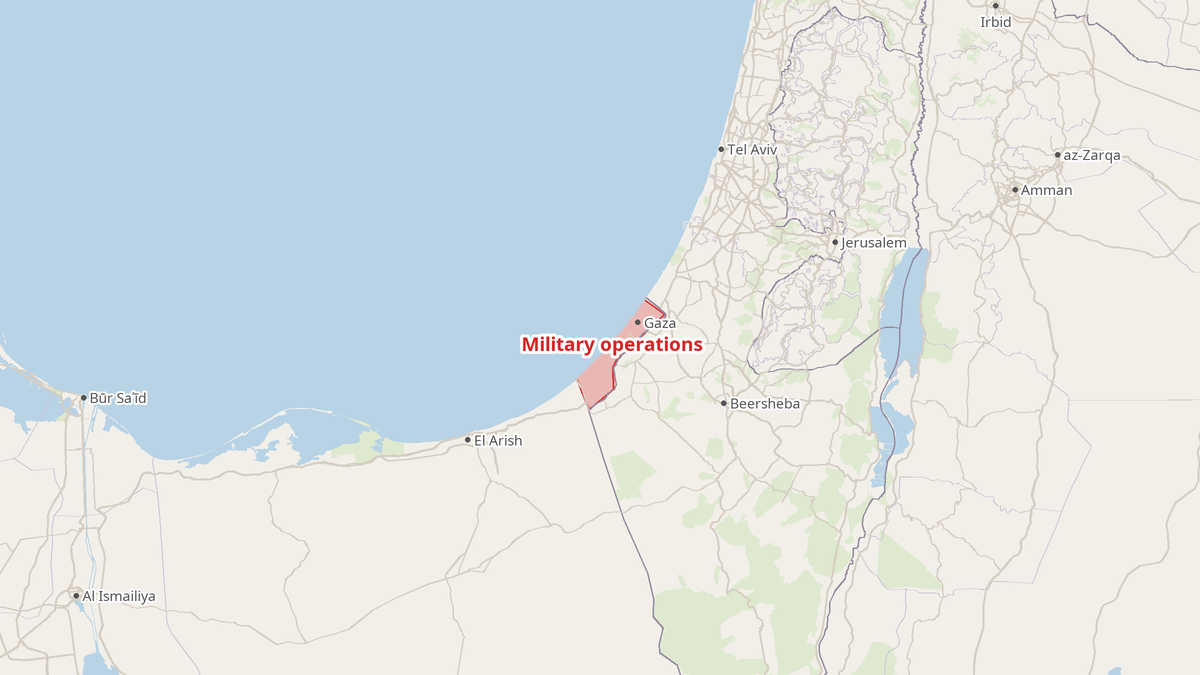
Israeli forces destroyed a Hamas tunnel in central Gaza after an operation lasting more than 12 hours on Wednesday, and on Tuesday Israeli forces demolished a family home in the West Bank despite an Israel Supreme Court order freezing the demolition. The tunnel operation took place near the Nuseirat refugee camp, beyond the ceasefire’s “yellow line.” Thirty-two family members shared the demolished home. The state said the court-order violation resulted from “human error.”
A ceasefire enforced by force
The Israel Defense Forces said Hamas had tried to restore the tunnel for operational use, that it posed an immediate threat to Israeli forces and that it violated the ceasefire. Troops from the 162nd Division, the 10th Brigade combat team, armored and combat engineering units, and Shin Bet domestic security agency personnel took part. Before the operation, the Coordination and Liaison Administration for Gaza warned residents to stay away.
Hamas condemned the operation, called on U.S. President Donald Trump's administration to intervene, and said the action breached the ceasefire and could force residents to flee their homes. The IDF said its forces were deployed in accordance with the ceasefire and would keep acting against immediate threats, including beyond the yellow line. The boundary divides areas under Israeli military control from the rest of the Gaza Strip; it hasn't stopped military operations on either side of the ceasefire’s promises.
Security officials described a more aggressive Southern Command approach to Hamas efforts to rebuild infrastructure and military capabilities. Recent operations have included targeted killings of senior Hamas commanders and attacks on infrastructure that authorities say Hamas has tried to reactivate. The military has reinforced positions and outposts along the yellow line and continued operations against underground infrastructure.
Hamas, meanwhile, has not disarmed. Israeli intelligence identified increased use of hospitals and medical compounds for military, intelligence and administrative purposes, alongside efforts to repair the tunnel network. Security assessments said Hamas was trying to preserve surviving infrastructure, recover lost capabilities, maintain revenue sources and reestablish parts of its governing authority. These are claims by Israeli authorities, not independent findings in the report.
The peace plan’s paperwork and the rubble
An international Board of Peace overseeing implementation of Trump's Gaza peace plan warned that the ceasefire was increasingly vulnerable to collapse. In a 12-page report submitted to the United Nations Security Council and obtained Wednesday by Reuters, the board accused both Israel and Hamas of failing to meet commitments. “The distance between what has been agreed and what is happening on the ground nonetheless remains the principal risk to the process,” it said. It added that “a ceasefire that delivers nothing visible cannot be sustained indefinitely.”
Large-scale fighting hasn't resumed, but Israeli troops haven't withdrawn, Hamas hasn't disarmed, and reconstruction of the devastated Gaza Strip hasn't begun. The board said the ceasefire had produced no concrete political or humanitarian progress. Hamas agreed in July to a roadmap calling for it to surrender its weapons and transfer control of Gaza to a transitional civilian authority. Israel rejected the roadmap because Hamas had not disarmed. The board said, “Every day that Israel continues strikes against Hamas targets, it delays putting Hamas' agreement to the roadmap to the test.”
The report also said Hamas had not fully stopped military activity and that residents faced “another winter in tents and rubble.” It criticized the Israeli government for not deciding how to train and deploy a civilian Palestinian police force to replace Hamas as Gaza’s law enforcement authority. Israeli restrictions on supplies and equipment, the board said, had undermined residents’ ability to prepare for winter. Many Palestinians remain displaced in temporary shelters or damaged buildings.
Orders, claims and consequences
Hamas rejected the board’s assessment. Senior Hamas official Basem Naim called it “pure disinformation” and accused the board of covering for Israel as it evaded commitments and continued operations in Gaza. Hamas spokesperson Hazem Qassem criticized the board and its representative, Nikolay Mladenov, saying Mladenov had embraced the Israeli government's position. The board says it is seeking to preserve the ceasefire framework and prevent escalating friction from derailing the peace plan.
In Kafr ad-Dik, west of Salfit in the central West Bank, soldiers demolished a home despite the court order freezing it. The family’s lawyer said soldiers ignored attempts to show them the order. The state promised an investigation after calling the demolition “human error.” No grassroots groups, mutual-aid efforts or independent aid organizations appear in the account. What it records instead is a military operation, competing authorities arguing over a peace plan, and a family left without its home while officials promise to investigate.
- gaza
- hamas
- israel defense forces
- ceasefire
- tunnel demolition
- nuseirat refugee camp
- board of peace
- gaza reconstruction