
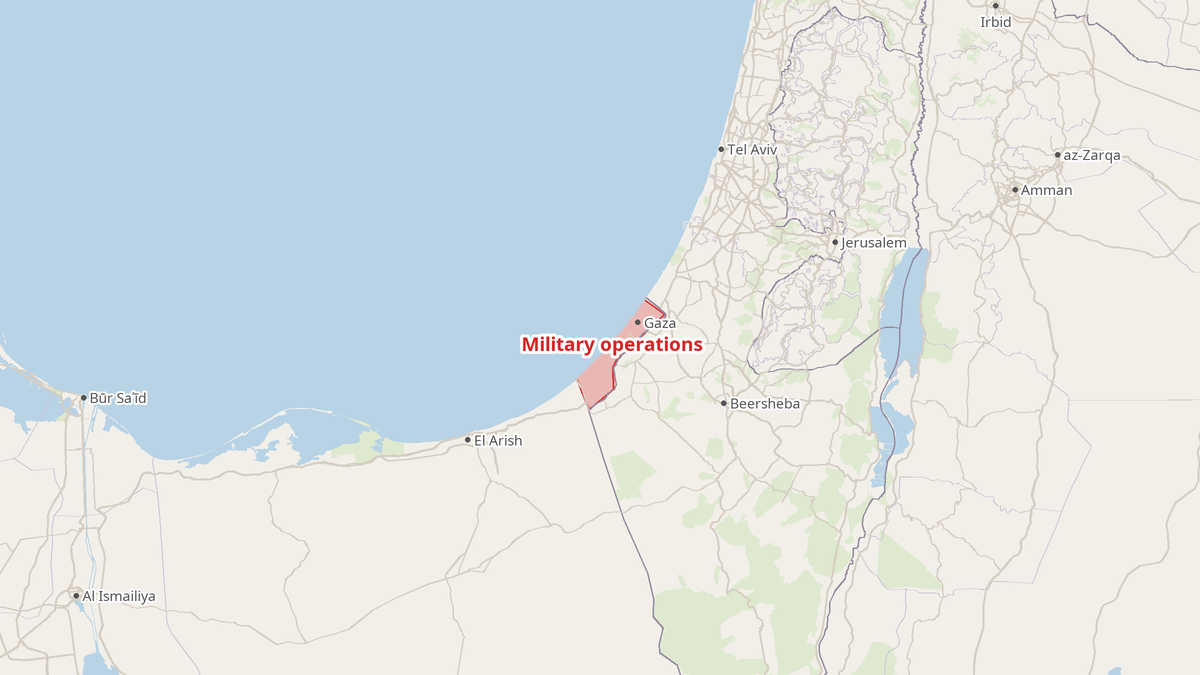
Israeli forces destroyed a Hamas tunnel near the Nuseirat refugee camp after an operation lasting more than 12 hours on Wednesday, saying Hamas had tried to restore the structure for operational use and that it posed an immediate threat to Israeli troops. The tunnel lay beyond the “yellow line,” the boundary under the ceasefire agreement between areas under Israeli military control and the rest of the Gaza Strip.
Hamas Rebuilds Underground Infrastructure
The Israel Defense Forces said the restored tunnel violated the ceasefire terms. Troops from the 162nd Division, the 10th Brigade combat team, armored and combat engineering units, and Shin Bet domestic security agency personnel took part in the operation. Before it began, the Coordination and Liaison Administration for Gaza warned residents to stay away.
The IDF said its forces were deployed in accordance with the ceasefire and would continue acting against immediate threats, including beyond the yellow line. Hamas condemned the operation, called on U.S. President Donald Trump's administration to intervene and said the demolition breached the ceasefire and could force residents to flee their homes.
Security officials have described a more aggressive Southern Command approach to Hamas efforts to restore infrastructure and military capabilities. Recent operations have included targeted killings of senior Hamas commanders and attacks on military infrastructure that authorities say Hamas tried to reactivate. Israel has reinforced positions and outposts along the yellow line and continued operations against underground infrastructure.
Israeli intelligence has identified two main areas of Hamas activity: increased use of hospitals and medical compounds for military, intelligence and administrative purposes, and efforts to repair and restore the extensive tunnel network damaged during the war. Security assessments say Hamas is seeking to preserve infrastructure that survived the fighting and gradually recover lost capabilities. Officials also say the group is working to maintain revenue sources and reestablish elements of its governing authority.
Authorities say Hamas has returned to practices seen during the war, including using hospitals and surrounding areas to support operatives and commanders. IDF leadership is concerned that a relative lull could give the group time to rebuild its forces and underground infrastructure, creating greater threats later. Southern Command officials said similar infrastructure beyond the yellow line could be targeted if considered an immediate threat.
Ceasefire Under Strain
An international Board of Peace overseeing implementation of Trump's Gaza peace plan warned that the ceasefire was increasingly vulnerable to collapse. In a 12-page report submitted to the United Nations Security Council and obtained Wednesday by Reuters, the board accused both Israel and Hamas of failing to meet commitments. The findings were expected to be presented to the Security Council in late November.
“The distance between what has been agreed and what is happening on the ground nonetheless remains the principal risk to the process,” the report said. It warned that “a ceasefire that delivers nothing visible cannot be sustained indefinitely.” Large-scale fighting has not resumed, but Hamas has not disarmed, Israeli troops have not withdrawn, and reconstruction of the devastated Gaza Strip has not begun.
The report said Hamas agreed in July to a Board of Peace roadmap calling for it to surrender its weapons and transfer control of Gaza to a transitional civilian authority. Israel rejected the roadmap because Hamas had not disarmed. “Every day that Israel continues strikes against Hamas targets, it delays putting Hamas' agreement to the roadmap to the test,” the report said.
The document also said Hamas had not fully met its commitment to cease military activity. “Meanwhile, Hamas militant activity continues, the commitment to cease all military activities has not been met in full by the parties, and the population faces another winter in tents and rubble,” it said.
Disputes Over Gaza's Future
The board faulted the Israeli government for not deciding arrangements to train and deploy a civilian Palestinian police force that would replace Hamas as Gaza's law enforcement authority. It also said Israeli restrictions on supplies and equipment had undermined residents' ability to prepare for winter. Many Palestinians remain displaced in temporary shelters or damaged buildings after years of fighting.
Hamas rejected the board's assessment. Senior Hamas official Basem Naim called the report “pure disinformation” and accused the board of covering for Israel as it evaded commitments under the plan and continued operations in Gaza. Hamas spokesperson Hazem Qassem criticized the board and its representative, Nikolay Mladenov, saying Mladenov had embraced the Israeli government's position.
Separately, Israeli forces demolished a home on Tuesday in Kafr ad-Dik, west of Salfit in the central West Bank, despite an Israel Supreme Court order freezing the demolition. Thirty-two family members shared the home. Their lawyer said soldiers ignored attempts to show them the order. The state said the demolition resulted from “human error” and promised to investigate.
- gaza
- hamas
- israel defense forces
- ceasefire
- tunnel demolition
- nuseirat refugee camp
- board of peace
- gaza reconstruction