
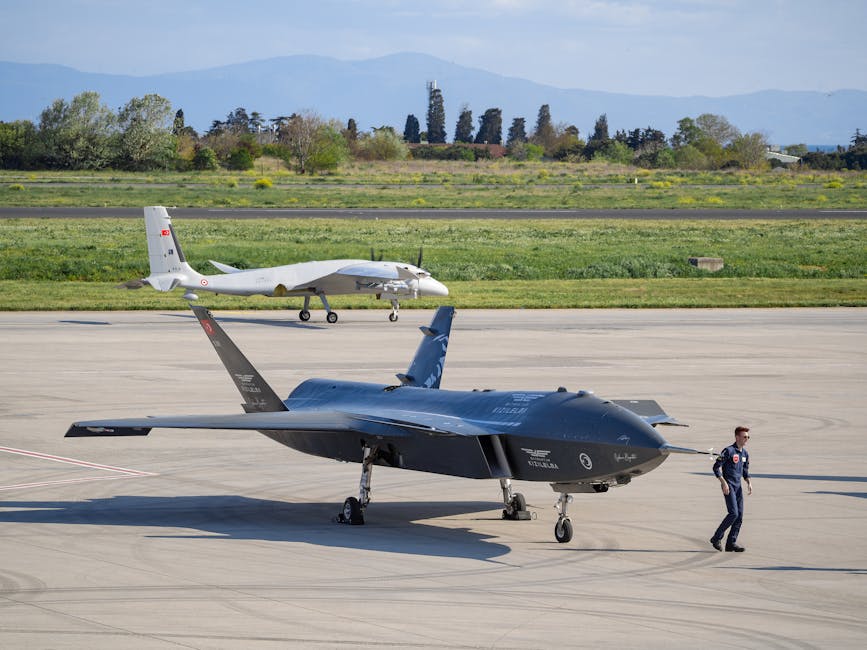
The head of the Israel Air Force’s UAV and Intelligence Department said remotely piloted aircraft have become “central to every front” as the IDF prepares its UAV fleet for the next war with Iran. Col. K told Defense & Tech by The Jerusalem Post that the force has rapidly expanded its capabilities, adapted to new threats and proven its resilience under fire, while the machinery of war keeps getting more polished and more distant from the people ordered to live with its consequences.
Who Gets Put in the Line of Fire
K said, “Over the past two years of fighting, including the recent campaign against Iran, our RPAs have become central to every front. From Gaza to Lebanon to deep inside Iran, UAVs allow us to operate near and far without risking human life.” That is the logic of the apparatus in plain language: the state’s air arm extends its reach across Gaza, Lebanon and Iran while insulating its own operators from danger.
The comments were published on April 13, 2026, as the ceasefire with Iran “hangs on by a thread,” according to the article. It said Operation Roaring Lion was marked by long-range strikes, dense missile barrages and unprecedented drone activity across the region, with thousands of hours and countless operations carried out by RPAs. The article said the 12 Day War in June 2025, known as Operation Rising Lion, marked a turning point.
K said, “For the first time, in June, we opened the door to sending drones far beyond our borders.” She added, “Most of the officers in my department are engineers, and their work is what gives these platforms the ability to fly such long distances.”
The Machinery Behind the Strikes
The article said Israel is a global leader in UAV technology and has several different platforms capable of flying to Iran and carrying out missions, from ISR, or intelligence, surveillance and reconnaissance, to striking targets. During the June war, Israeli UAVs flew thousands of hours and carried out around 500 attacks in Iran, making up around 50 percent of the total aerial attacks. The article said that this time around, Israeli RPAs flew even longer, alongside American systems.
K said that unlike manned aircraft, UAVs cannot refuel during missions and rely solely on the fuel they receive before takeoff. As Iran launched waves of missiles and attack drones toward Israel and regional targets, the IAF relied heavily on its unmanned fleet to locate and strike launch sites, weapons warehouses and logistical hubs.
K said, “Every aircraft is valuable; we prefer to send a UAV rather than send a manned platform if they can achieve the same at the end of the day, to attack and destroy threats.” She said UAVs “hunted missile launchers, warehouses, and weapons infrastructure, and we succeeded very nicely.”
The article said local defense companies Aeronautics, Israel Aerospace Industries, Elbit Systems and Rafael Advanced Defense Systems are responsible for the UAVs, and that all sensors and payloads carried by IAF UAVs are also domestically produced and were upgraded significantly during the war. K said, “We use technologies that allow our aircraft to fly in GPS-denied environments.” She added, “While Gaza may be easier, operationally, there is no difference between Iran and Lebanon in that regard. Each conflict teaches us something new.” The article said the IAF has invested heavily in technologies that allow drones to operate even when GPS signals are jammed or denied, conditions common in Iranian and Lebanese airspace.
K said, “All our payloads are Blue and white, just like our platforms. They give us day-and-night visibility to protect our troops and identify targets, whether in Gaza, Lebanon, or Iran. Over the past two years, we’ve increased both our munitions capacity and the capabilities of our payloads.”
What the Fleet Can Absorb
The article said one of the most dramatic incidents of the war involved a Heron that survived a direct hit during a mission over Iran. K said, “One of our platforms was hit by a missile over Iran. It came back with holes everywhere, even in the fuel tank. It was a miracle that it returned home. We restored it, and it went back out on more missions.”
The article said Israel and the United States have remained tight-lipped about the number of UAV losses, while the US is estimated to have lost at least 20 Reaper drones and Israel is rumored to have lost over a dozen. K said, “It’s a war. You plan for something, and then you meet the enemy. We lost some platforms, and every platform is important, but we learned even more. Thanks to our people and how we prepared our systems, the number of losses remained low, and we continued to operate.”
Looking ahead, K said the IAF plans to further expand its unmanned fleet. “We are about to receive more Heron MK2 aircraft and will open a new squadron this year,” she said. “Next year, we’ll bring in the Hermes 650 Spark. The future is UAVs. There are endless possibilities for these platforms.” She added that the IAF continues to study other conflicts, including the war in Ukraine, even as Israel faces its own evolving threats.
K said, “The war in Ukraine is different, but you are always learning and investigating,” and, “The Ukrainian arena is different, but every conflict teaches us something.” She closed with, “There was a huge success on our side. But we are always ready. We cannot afford not to be ready. We will always be ready.”