
Poland's President Karol Nawrocki and Prime Minister Donald Tusk walked side by side through Krakow's Main Square on Monday evening, two days after a gunman killed six people there. Their shared presence at a March of Silence marked an unusual moment of political unity in a country where the two rarely agree on anything.
A City in Mourning
The march began at 20:00 to the sound of the St Mary's bugle call, at the junction of the Main Market Square and Sławkowska Street, where the first shots were fired on Saturday. Participants walked toward St Mary's Basilica and finished near the Town Hall Tower. Krakow mayor Łukasz Gibała issued the invitation. Besides Nawrocki and Tusk, those who joined included the Archbishop of Kraków, Cardinal Grzegorz Ryś, Małopolska region governor Krzysztof Klęczar and regional marshal Łukasz Smółka.
No speeches were planned. Candles were lit at each of the three locations where victims were killed. At the end, the bugler played "The Sound of Silence" on the trumpet, and Cardinal Ryś said a short prayer for the dead.
"In this difficult time, let us show solidarity and show that Kraków will always be a proud city, but also hospitable and open," Gibała wrote on social media. Tusk wrote on X: "This evening in Kraków thousands of Poles have gathered to pay tribute to the victims of the attack of 7 November. May they rest in peace."
The march fell on the last day of national mourning that Nawrocki declared for November 8 and 9. Krakow's own mourning runs until the end of Wednesday, November 11. Flags on public buildings fly at half-mast or are draped in black crepe, and buses and trams carry black ribbons. A book of condolence sits in the lobby of Kraków City Hall on Wszystkich Świętych Square until Wednesday, open between 9:00 and 19:00. An online book stays open until November 11 at 19:00.
What Happened on Saturday
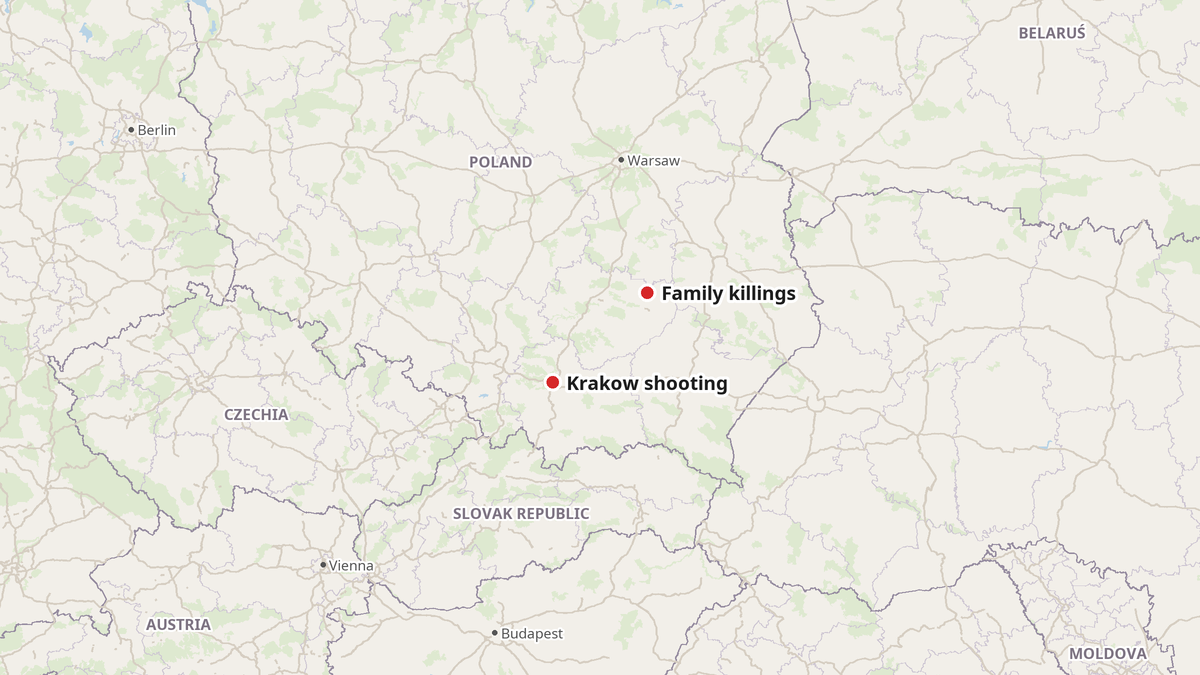
A 24-year-old man, Michał Oksiński, drove a car onto the Main Square and opened fire with an automatic weapon, apparently at random. Six people died and 16 were injured, including two police officers and the attacker himself, who died in hospital early Monday. The dead were four Polish citizens, a British man and an Austrian woman. Among the 15 wounded, other than the attacker, were people from Britain, Portugal, Russia, Germany and Austria.
The toll was wider than the square. In Ostrowiec Świętokrzyski, police found the bodies of the attacker's parents and sister in the family flat. They are believed to have been killed hours before the attack.
The victims' nationalities underline how exposed Europe's open public spaces are. Krakow's Main Square is a tourism hotspot, and the casualties came from across the continent. Which state answers for their safety, and with what powers, remains a question for national governments.
The Officers Who Stopped Him
Senior Constable Artur Morański, 27, and Senior Constable Jakub Kulik, 24, were the first to confront the attacker directly. They neutralised him but were shot themselves and taken to hospital in critical condition, then placed in medically induced comas. Doctors began waking them on Sunday. Mayor Gibała reported that Morański had been extubated and his condition was improving. Muszyna mayor Jan Golba said Morański's first words were: "Is Kuba alive?"
Bartosz Grodecki, head of the National Security Bureau, announced that Nawrocki had awarded both officers the Officer's Cross of the Order of Polonia Restituta for special services in public safety and order, courage and dedication. "The heroic conduct of the officers, who at the risk of their own lives stopped the attacker, inspires admiration and deserves the highest recognition. I thank both officers for their decisive intervention and their readiness to defend others. I wish them a swift recovery," Grodecki said. Both officers received the decorations from Nawrocki in person.
Why This Matters:
The shooting landed in a place Europeans treat as safe, and the response came from national institutions: a president, a prime minister, a cardinal, a mayor and two police officers who ran toward the gunfire. Public trust in the state rests on its ability to protect citizens in ordinary public life, and Poland's leaders appearing together signals they understand that. Questions about how an armed man reached the square, and what warning signs existed, will fall to Polish authorities and Polish voters to answer. Those answers will shape how citizens judge security in their cities. It's a reminder that protection of public spaces remains, above all, a national responsibility that no supranational framework can discharge for a government.
- krakow shooting
- karol nawrocki
- donald tusk
- mass shooting
- march of silence
- poland
- krakow
- police officers