
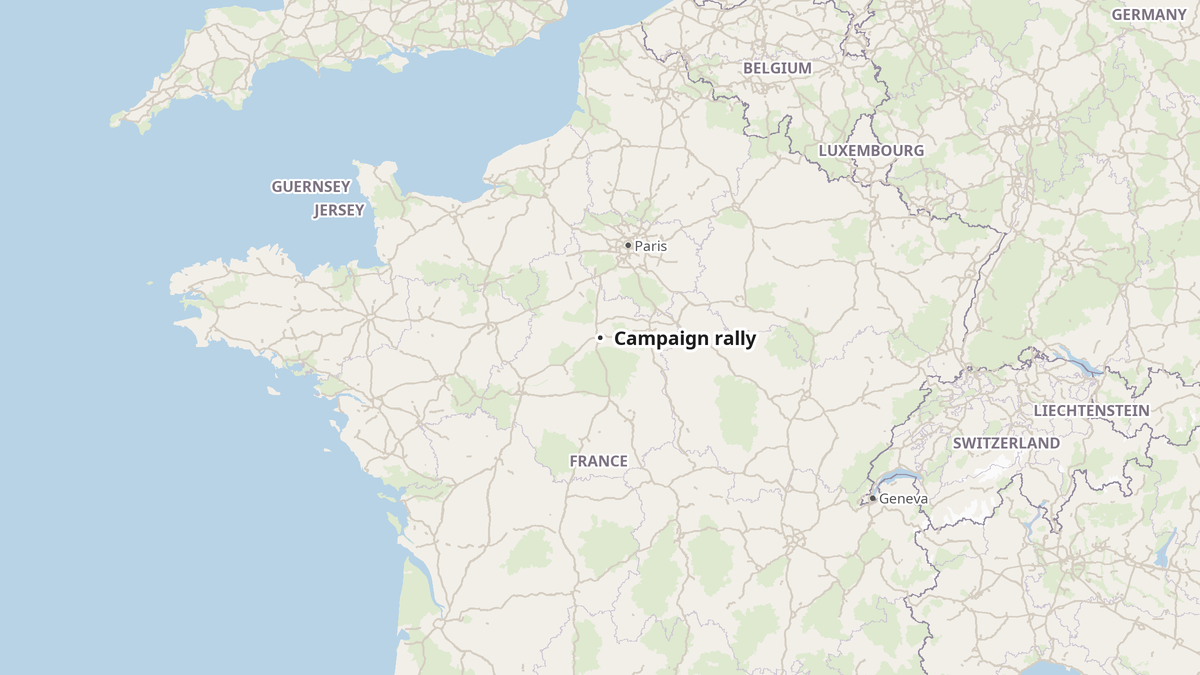
Marine Le Pen opened her presidential campaign in Orléans on Sunday with a promise to restore the rule of law, one day after 1,314 people were arrested and 53 police officers injured during cost-of-living protests across France. The National Rally candidate, the poll frontrunner six months before the vote in April and May 2027, spoke to a crowd that party organisers put at 8,500 and France 24 described as about 10,000.
"Who can claim there is a rule of law when hordes come to ransack and burn our buildings, or carry out real raids in front of law-enforcement officers who have been deliberately disarmed, both materially and morally?" Le Pen asked, referring to looting and clashes on Oct. 17. "The rule of law is not the law against the state." She accused Emmanuel Macron's government of lacking authority and "denying reality."
The Street and the State
The numbers from Saturday explain the mood. The Interior Ministry counted 410,000 marchers in major cities; organisers claimed nearly 800,000. Most of the demonstrations passed peacefully. Then masked groups broke away, and the familiar scenes followed: police responded to 75 fires, and 24 shops were looted. Interior Minister Laurent Nuñez blamed much of the violence on "ultra-left" extremists.
Two protesters were seriously injured, Nuñez said, one in Toulouse and one in Clermont-Ferrand. A man in Poitiers was hurt in the eye during a riot-police charge involving stun grenades and tear gas, according to La Nouvelle Republique. Officials said investigations had opened in at least some cases. Rights groups and protesters accuse the government of restricting the right to demonstrate, while Macron faces pressure to restore order and keep talking to unions and student groups at once.
It isn't over. The Yellow Vest movement called another protest day for next Saturday, and the CGT union urged a strike campaign from Nov. 5. The unrest follows four weeks of student demonstrations over the state of France's schools.
Security, Borders and Identity
Le Pen pledged certainty that cases would be brought and sentences carried out, along with the expulsion of foreign offenders. She called for "national priority" and "a double border: French and European," and promised to preserve the country's language, traditions, values and way of life. She framed her programme as "not a revolutionary act but a normal breath of democratic life."
On foreign policy she was blunter. Without naming Ukraine, she said France "will not send" its young people "to die in reckless or irresponsible military adventures, and even less in wars that are not ours." She is critical of NATO and of French support for Ukraine against Russia's invasion.
Jordan Bardella, the party president, introduced her by attacking the government. "The French have seen a power that has fallen, that has given up, that has abdicated even the idea of protecting our compatriots," he said. He called the RN "the only option capable of restoring order and bringing back authority," and accused La France Insoumise and its leader Jean-Luc Mélenchon of "fanning the flames of insurrection."
His speech was briefly interrupted when members of the Union of French Jewish Students unfurled a banner referring to Mediapart revelations about antisemitic messages attributed to Bardella when he was 18. He rejects the accusations. He urged supporters "not to give publicity to the far left, which hates democracy" and asked them to sing the Marseillaise.
The Fiscal Constraint
Le Pen has pledged to cut living costs through capped household energy bills, reduced taxes and a smaller French contribution to the European Union. The arithmetic is awkward. France's debt and budget deficit already exceed EU limits, and Macron's government is struggling to pass a cost-cutting budget. Whoever wins next spring inherits little room for new spending.
Supporters in Orléans weren't thinking about fiscal rules. Karine, an RN voter, told Euronews that security, jobs and housing "keep the country going." Another attendee said: "In any case, it's the only party we haven't tried yet, so we want to try it."
A counter-demonstration by unions and left-wing parties drew 13,000 people by local council and police counts, and 26,000 by organisers' estimates. It was peaceful. About 3,000 security and emergency personnel were deployed in Orléans over the weekend. An Ipsos survey published Saturday put Le Pen at 32% to 34% of first-round votes and found a majority saying the government was responsible for the crisis.
The RN congress the day before re-elected Bardella as party president with 98.98% of the vote. He is positioned as her prime minister if she wins. Le Pen gave up chairing the RN group in the National Assembly to focus on the campaign; Sébastien Chenu took over.
Why This Matters: A campaign launched against a backdrop of arson, looting and injured officers makes public order the first question of the 2027 race, whether or not the incumbent camp wants that terrain. The Ipsos finding that a majority blames the government, not the protesters, is the number Macron's successors on the mainstream right and centre will have to answer. France's breached EU deficit and debt limits narrow every candidate's promises on energy bills and taxes, and a pledge to cut the French contribution to the EU would put Paris in direct tension with Brussels. For Europe, the outcome in a founding member state will turn on whether a government can show citizens that order, borders and public finances are under control.
- marine le pen
- national rally
- france
- presidential election
- cost of living protests
- orleans
- jordan bardella
- rule of law