
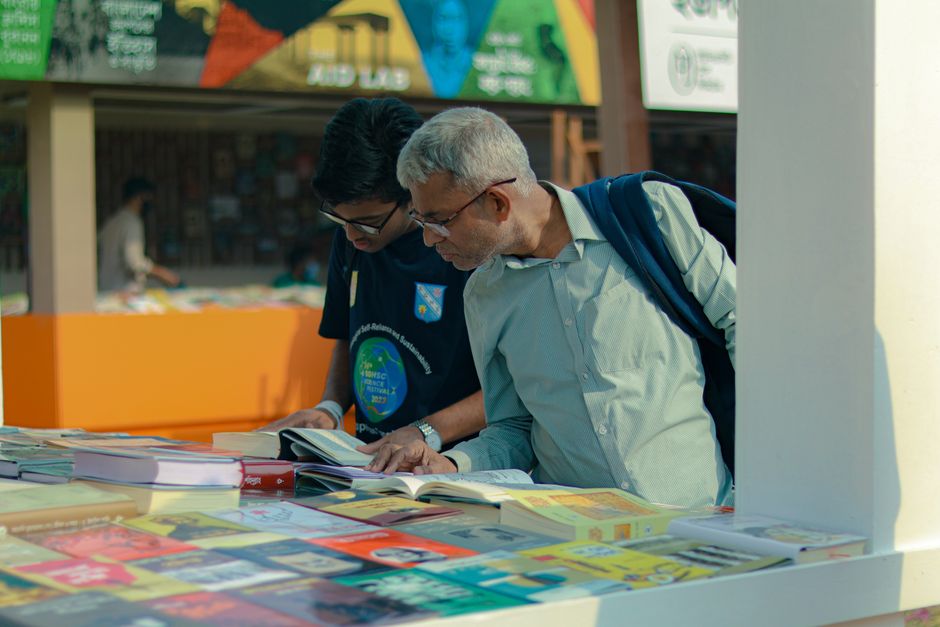
A prize jury in Berlin said it wanted scholarship that “reopens questions” instead of repeating what’s already known. On Oct. 16, 2026, three books on Arab and Islamic intellectual history received the inaugural Riwaq Prize for Science and Culture. Der Divan presented it during its fourth Arab Book Fair. Along with exhibitions and competitions across Europe and the Gulf, the ceremony marks a busy stretch for Arab culture.
Scholarship That Resists Simple Answers
Der Divan – The Arabic Cultural House and the German Orient Institute Beirut created the prize to recognise scholarly monographs on Arab cultures and societies. It awards €3,000 in total, split equally among Arabic, German and English categories. Clemens Hach, Deputy Head of the Middle East and North Africa Division at Germany’s Federal Foreign Office, also spoke at the ceremony.
The Arabic-language award went to Dr Raed Al-Samhouri for “Ibn Taymiyya al-Tarikhi wa-l-Mustaʿad,” published in 2024 by the Arab Center for Research and Policy Studies. The book examines how people represent the medieval thinker in contemporary consciousness and invoke his thought in present-day debates. It challenges readings that reduce his work to violence and takfir, the practice of declaring another Muslim an unbeliever. Al-Samhouri’s central call is to “free Ibn Taymiyya from our time—or perhaps free our time from him.”
Prof. Dr Yvonne Albers won the German-language award for “Beirut und die Zeitschrift Mawaqif. Eine arabische Intellektuellengeschichte 1968–1994,” published by Brill Fink in 2023. She presents the Beirut journal as an institution where people produced and debated ideas. Nora K. Schmid won the English-language award for “The Ascetic Qur’an and its Kharijite Readers.” The jury praised her sensitivity to language and her contribution to a more differentiated understanding of early Islamic piety.
Dr Lorans Al Hennawi, Director of Der Divan, said research reaches its full value “when it has the methodological courage to question assumptions, restore historical contexts and open up questions obscured by hasty or reductive interpretations.” Prof. Dr Jens Hanssen, Director of the German Orient Institute Beirut, said the prize highlights work that treats Arab societies as subjects of critical inquiry “rather than fixed images or closed narratives.” The organisers will award the prize every two years, alternating between humanities and social sciences. The next edition will focus on social sciences.
Gulf Artists Take the Stage Abroad
Saudi artists are showing work in several cities abroad. Ayman Zedani presents “In the Bellies of the Rocks” at Paris International, an art fair running Oct. 20-24 alongside Art Basel Paris. Commissioned as part of AlUla’s Cultural Season in Paris, the installation pairs a two-channel video with sculptural interventions and invites audiences to consider human-nature symbiosis and the Gulf’s ecological future.
In Rome, Sarah Brahim’s “Let us Love the Distance” opens Oct. 26 at Forof and runs until July 27, 2027. It takes visitors underground to the remains of the Basilica Ulpia, where enslaved people once gained legal freedom. Brahim built a well in the floor using documents from her father’s archive. In London, Mohammed Alfaraj’s solo show at the Delfina Foundation runs until Nov. 22, 2026. Drawing on his upbringing in Al-Ahsa oasis, the show examines fragile ecological networks.
Frieze Abu Dhabi, the inaugural fair, runs Nov. 19-22. Athr presents work by five Saudi artists, including rare pieces by the late pioneering female Saudi artist Mounira Mosly.
An Open Call to Imagine Resilience
Abu Dhabi Sustainability Week has opened its fourth Global Digital Art Competition, asking: “Can art help us picture a world that can withstand whatever comes next?” Anyone 18 or older can enter by Nov. 16. Organisers will honour one winner and two finalists in Abu Dhabi on Jan. 13. Artists who use AI tools must declare it and explain what the tools contributed.
Saudi Arabia took part in 71 international cultural events in 2025, more than twice its target of 34, according to the Saudi Press Agency.
Why This Matters: None of these events changes conditions on the ground in a region marked by conflict and displacement. But they show where Arab scholars and artists are directing their energy: contextual research that resists reductive readings, and creative work on ecological fragility and historical memory. The Riwaq jury’s emphasis on questioning assumptions and avoiding premature judgments sets a standard worth noting. It’s one the region’s political debates rarely meet. For readers, the cultural calendar is a reminder that Arab societies produce critical, self-reflective work, even as headlines focus elsewhere.
- middle east art
- alula
- paris international
- abu dhabi sustainability week
- digital art competition
- riwaq prize
- arab book fair
- arab culture