
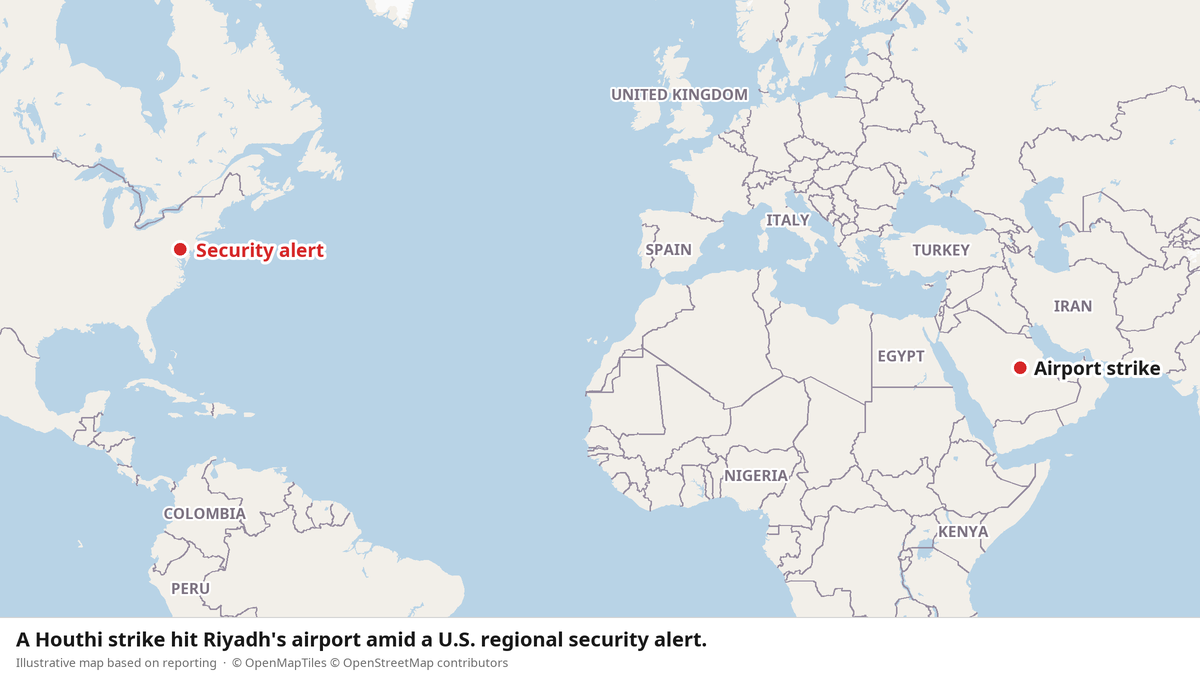
Three people were killed when Yemen's Houthi rebels struck Saudi Arabia's Riyadh airport on Thursday. On Friday, the United States issued an urgent security alert across the Middle East, urging Americans to "exercise heightened vigilance."
The attack came amid an escalating series of Houthi missile strikes on Saudi Arabia. The rebels have carried out deadly attacks on airports in the kingdom's southern region and in the capital; debris from an intercepted ballistic missile also damaged civilian sites in Riyadh itself. According to reporting cited by Haaretz, the group has explicitly sought to shut down Saudi Arabia's airspace.
The strikes lay bare the fragility of regional stability. Airports, refining facilities and shipping routes all sit where geopolitical conflict meets economic vulnerability. Events in the Middle East reverberate through global oil markets and the daily lives of ordinary Americans and residents across the region.
The Regional Escalation
The Houthis' operational tempo has accelerated as part of broader "ongoing fighting between Saudi Arabia and its allies against the Houthis," analysts Soojin Kim and Edward Bell of MUFG said. That conflict has "kept the geopolitical risk in oil markets elevated while shipping in the Gulf and Strait of Hormuz continues to be threatened."
The Strait of Hormuz, a vital chokepoint for global crude shipments, has seen more attacks on commercial vessels. These aren't abstract market movements. Real threats to shipping and trade put the economic lifelines of developing nations at risk.
President Donald Trump said Thursday that he had no intention of ordering attacks on Iran before next month's midterm elections, easing some immediate concerns about war. In a Truth Social post, he said the U.S. remained committed to maintaining its blockade on Iranian shipments through the Strait of Hormuz "in full force" and described U.S.-Iran relations as involving "productive discussions."
Markets calmed, at least for a time. Brent crude, the benchmark for two-thirds of the world's oil supply, initially fell Friday after Trump's comments. At 10:35am UAE time, Brent traded 0.82 percent lower at $103.42 a barrel, though regional tensions kept it on track for a weekly gain.
The Economic Pressure Campaign
The United States announced fresh sanctions on 17 vessels transporting millions of barrels of Iranian crude oil and petroleum products to markets in southern and eastern Asia. Treasury Secretary Scott Bessent described the move as part of a deliberate strategy to "starve the tyrannical regime in Tehran of the money it uses to wage war in the region." His statement reflected Washington's intent to pressure Tehran economically as what the Treasury Department called "the regional war" continues.
At the same time, Hurricane Isaias was bearing down on the U.S. Gulf of Mexico, where roughly 63 percent of American offshore oil production sits idle. The storm threatened refining infrastructure and export terminals, adding to the geopolitical risk. About 500,000 barrels per day of U.S. capacity faced disruption, with the hurricane expected to reach the Gulf coast late Friday or early Saturday.
Oil prices reflected those pressures. Brent crude rose 4.1 percent to $104.20 per barrel on Thursday as Middle East tensions coincided with hurricane-related production shutdowns. West Texas Intermediate crude, which tracks U.S. oil, swung over the week. Prices settled higher Thursday, then fell Friday after Trump's comments on Iran suggested a temporary reprieve from escalation.
Nick Stadtmiller, chief economist and group head of research at Emirates NBD, said markets were absorbing multiple shocks at once: "Brent crude rose 4.1 per cent to $104.20 per barrel on Thursday as renewed Middle East tensions coincided with disruption to US Gulf of Mexico production from Hurricane Isaias."
Why This Matters:
The Houthi strikes show how regional conflict directly threatens global economic stability and civilian security far beyond the Middle East. The attack that killed three people in Riyadh forms part of an escalating cycle that creates conditions for more violence, further military response and greater civilian risk. The U.S. strategy of maximum economic pressure on Iran, through oil sanctions and blockades, aims to constrain Tehran's ability to arm proxies. But it also keeps the region on a knife's edge, where any miscalculation risks war. President Trump had to explicitly rule out attacking Iran before elections, revealing how thin the barrier is between sustained tension and outright conflict. For Palestinians, Israelis and the broader Middle East population, this volatile environment makes diplomatic solutions harder to pursue and military escalation easier to justify. Protracted regional instability brings displacement, disrupted aid and economic collapse; civilians with no role in strategic decisions bear the heaviest humanitarian cost.