
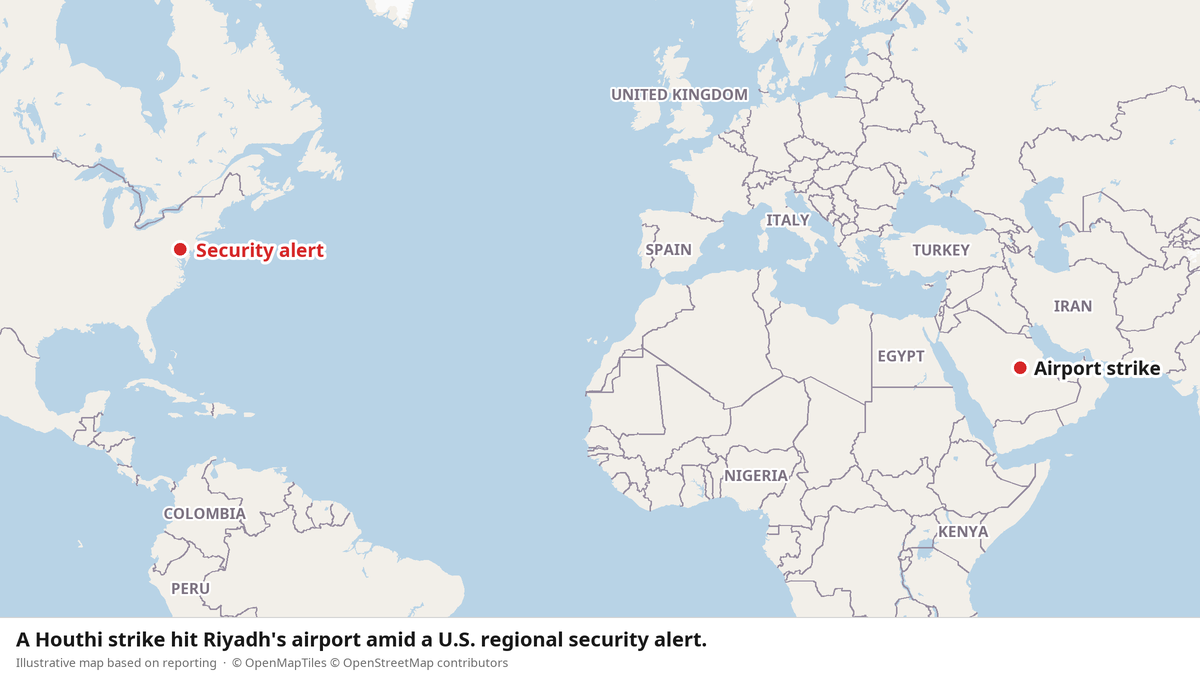
A Houthi missile strike on Saudi Arabia's Riyadh airport killed three people Thursday. The United States responded with a regional security alert, urging Americans to "exercise heightened vigilance" as Iranian proxy operations escalate across the Middle East.
Non-state militias armed and financed by Tehran are striking civilian and economic infrastructure across borders with near impunity, posing a central security challenge for the region. Yemen's Houthi rebels, backed by Iran, claimed responsibility for the Riyadh strike. They have intensified missile attacks on Saudi Arabia while trying to shut down the kingdom's airspace. The attack damaged civilian sites in the capital, and debris from an intercepted ballistic missile struck populated areas.
This wasn't an isolated incident. During the week, the Houthis carried out deadly attacks on airports in Saudi Arabia's southern region, demonstrating sustained operational capability despite years of Saudi-led military operations. Attacks on commercial shipping in the Strait of Hormuz—a vital route for global crude shipments—have also increased, threatening one of the world's most critical energy chokepoints.
The Iranian Strategy
The pattern points to a deliberate Iranian strategy: proxy forces strike civilian and economic targets, destabilizing the region and disrupting global markets while preserving plausible deniability. Treasury Secretary Scott Bessent put it directly: "Treasury is starving the tyrannical regime in Tehran of the money it uses to wage war in the region." The U.S. announced fresh sanctions on 17 vessels transporting millions of barrels of Iranian crude oil and petroleum products to markets in southern and eastern Asia, targeting revenue streams that fuel Iran's regional proxy network.
President Donald Trump said Thursday that the U.S. was holding "productive discussions" with Iran and that the blockade on Iranian shipments through the Strait of Hormuz would remain in "full force." Trump said he had no intention of ordering attacks on Iran before next month's midterm elections, briefly easing concerns about oil supplies. He called Iran economically and militarily in a "very bad condition"—a reflection of the economic pressure campaign, but also an acknowledgment that containment remains a challenge.
Oil Markets and Broader Disruption
Brent crude oil, the benchmark for two-thirds of the world's oil supply, rose 4.1 percent to $104.20 per barrel Thursday as Middle East tensions coincided with massive disruptions to U.S. Gulf of Mexico production. Hurricane Isaias shut in approximately 63 percent of U.S. Gulf oil production, threatening refining infrastructure and export terminals. About 500,000 barrels per day of capacity faced disruption as the hurricane moved toward the coast, with landfall expected late Friday or early Saturday.
Geopolitical pressure and a natural disaster combined to create a supply shock. Nick Stadtmiller, chief economist at Emirates NBD, said that "prices came off their intraday highs after President Donald Trump said the US was holding productive discussions with Iran." By Friday, oil prices had eased slightly: Brent crude dropped 1.38 percent to $102.8 a barrel, and West Texas Intermediate fell 1.37 percent to $90.24 a barrel. Both remained elevated by historical standards.
Analysts at MUFG stressed the structural risk: "Ongoing fighting between Saudi Arabia and its allies against the Houthis are keeping the geopolitical risk in oil markets elevated while shipping in the Gulf and Strait of Hormuz continues to be threatened." Even localized proxy conflicts can have global economic consequences when they target energy infrastructure and chokepoints.
The Sanctions Strategy
The U.S. response relies on financial and diplomatic pressure rather than direct military intervention. Bessent said the government would "continue exposing those who enable the regime's oil sales," targeting the financial networks that let Iran monetize its crude exports despite international sanctions. The approach reflects both the difficulty of interdicting Iranian oil shipments and political constraints on military escalation ahead of midterm elections.
The sanctions target specific vessels and routes, aiming to disrupt Iran's ability to sell crude to Asian markets. Alongside the existing blockade on Iranian shipments, they aim to restrict Tehran's access to hard currency—the money it uses to arm, train, and finance the Houthis, Hezbollah, and other proxy forces throughout the region.
Why This Matters:
The Houthi attack on Riyadh demonstrates the reach of Iranian proxy forces and the vulnerability of civilian infrastructure to non-state actors who reject international norms. When militias armed by a hostile state can strike airports and damage populated areas, deterrence becomes difficult and diplomatic solutions elusive. Elevated oil prices, threatened energy exports, and global supply chain impacts show how regional instability radiates outward.
If Iran's proxy network continues to expand and upgrade its capabilities unopposed, the cost to global energy markets and regional stability will only increase. Direct military confrontation, at the same time, risks escalation without clear pathways to resolution. The U.S. strategy of sanctions and containment assumes economic pressure and time will eventually constrain Iranian ambitions. That assumption faces a test in every Houthi strike and every ship targeted in contested waters.