
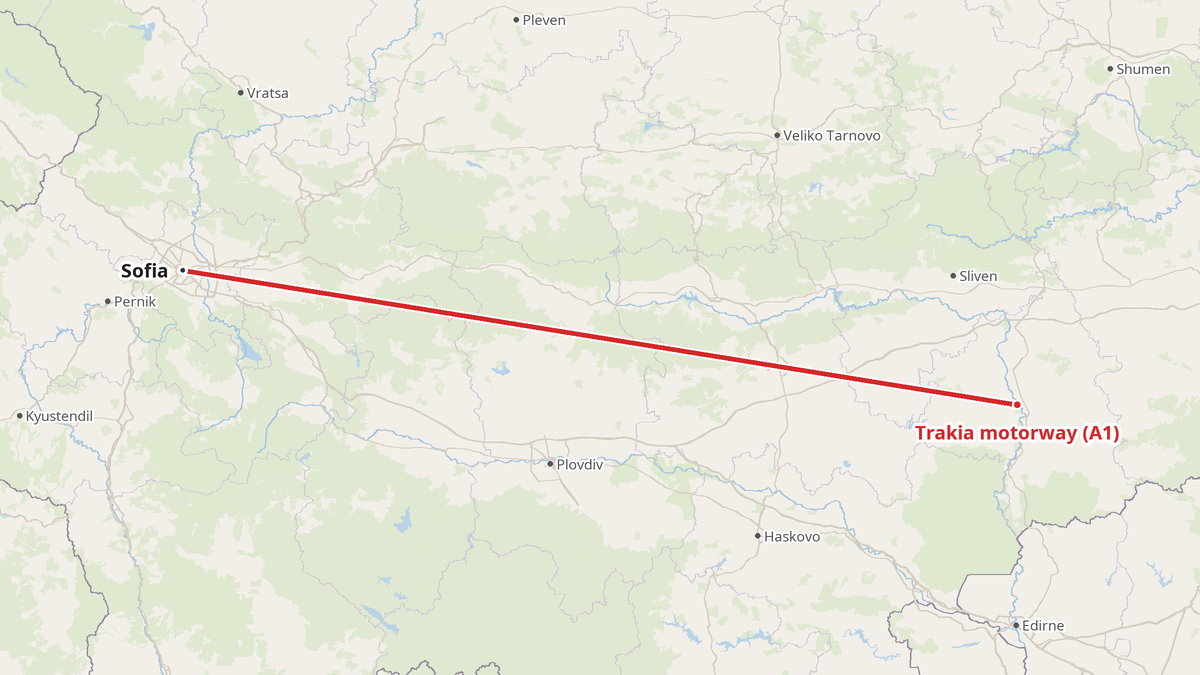
Twelve people died and dozens more were injured on Tuesday when thick fog triggered a mass pile-up on the Trakia motorway in southeastern Bulgaria, a country whose roads are the most dangerous in the European Union. Prime Minister Rumen Radev said the dead were caught in two pile-ups involving dozens of cars and lorries near the city of Yambol.
The Toll and the Rescue
The exact figures differed between accounts. Health Minister Katya Ivkova said 11 people died at the scene, near the town of Zimnitsa, and another later in hospital. In a separate account she said 10 died on the spot and two more while being transported. A health ministry statement said 51 people were admitted to hospitals in nearby cities, 13 of them critically injured.
The scale of the wreckage was just as hard to pin down. Yambol regional governor Georgi Chalakov told the BTA state news agency that around 50 cars and trucks heading in both directions were caught up. Sliven regional governor Mihail Kasherov said more than 70 vehicles were involved. Another report put it near 86. Images showed overturned, mangled and burnt-out vehicles.
Rescuers faced brutal conditions. Chalakov said teams had to remove sections of the crash barrier to reach people, and the fog grounded helicopters. Chief Inspector Todor Mishinev of the Yambol regional police directorate told Nova TV that people were still trapped in their cars. "Right now, the priority is rescue operations," he said. A witness who pulled a man from a burning vehicle told Reuters: "I got out of the car, I ran forward and pulled that man out." Another said "many, many people died."
The government dispatched two aircraft equipped with stretchers and medical teams, and air transport was also organised with Spartan military planes. Radev declared Wednesday a day of national mourning. The identities of the dead had not been announced. Romanian Foreign Minister Dan Neculaescu said one Romanian was among the injured.
Questions Over Preparedness
The Interior Ministry blamed reduced visibility. Interior Minister Ivan Demerdzhiev said a sudden change in weather was the main reason, with visibility around 70-80 metres falling to about 10 metres within a short period. "We are actively working on equipping the toll system gantries with display screens to warn drivers," he said. Road administration director Galin Kostov said speeds were unsuitable for the conditions, which included wet road surfaces.
Civil society was blunter. Bogdan Milchev, chairman of the Road Safety Institute NGO, told public radio BNR that the motorway section should have been closed early Tuesday, and he blamed the government.
The highway links Sofia to the Black Sea city of Burgas. Reports first came in at 07:10 local time. One crash occurred at kilometre 289 towards Burgas, the other at kilometre 294 towards Sofia, where drivers were also likely distracted by the first collision, according to an official cited by BTA.
A Chronic Problem
Bulgaria recorded 71 road fatalities per million inhabitants in 2025, the highest rate in the EU, against an EU average of 43, according to European Commission figures. A total of 456 people died on Bulgarian roads that year, down five percent on 2024 and 27 percent below 2019. The EU set a target in 2019 of halving road deaths and serious injuries by 2030, but a Commission report in October found just five of the 27 member states, Bulgaria among them, on track to meet it.
Victims blame reckless driving, poorly maintained roads and an inefficient justice system. Parliament adopted stricter penalties for drug-driving in 2023, and cars of accused drivers are now impounded until trial. Experts also point to Bulgaria's busy traffic as a gateway to the EU and to its status as the poorest member state, with around half of registered cars more than 20 years old.
EU Reaction
Radev cut short a news conference while hosting European Commission President Ursula von der Leyen and went to the scene; she said she would shorten her visit. European Council chief Antonio Costa said he was "deeply saddened." European Parliament President Roberta Metsola offered condolences to families and thanked rescue services and medical teams "working tirelessly at the scene." Radev cancelled his engagements in Varna, and the Council of Ministers meeting was called off.
Why This Matters:
The fog was the trigger, but the figures point to something deeper. Bulgaria has the EU's worst road-death rate, the poorest economy in the bloc, and an ageing car fleet, and it sits among the countries failing to hit the EU's 2030 safety target. Whether warning gantries, earlier road closures and tougher enforcement arrive in time will test the gap between European ambitions and delivery on the ground. Safer roads cost money, and the poorest member states are the ones that can least afford to wait. That makes road safety a question for shared European investment as much as for national governments, and for the families of today's victims, it is not an abstract one.
- trakia motorway
- bulgaria
- pile-up
- fog
- yambol
- road accident
- road safety
- rumen radev