
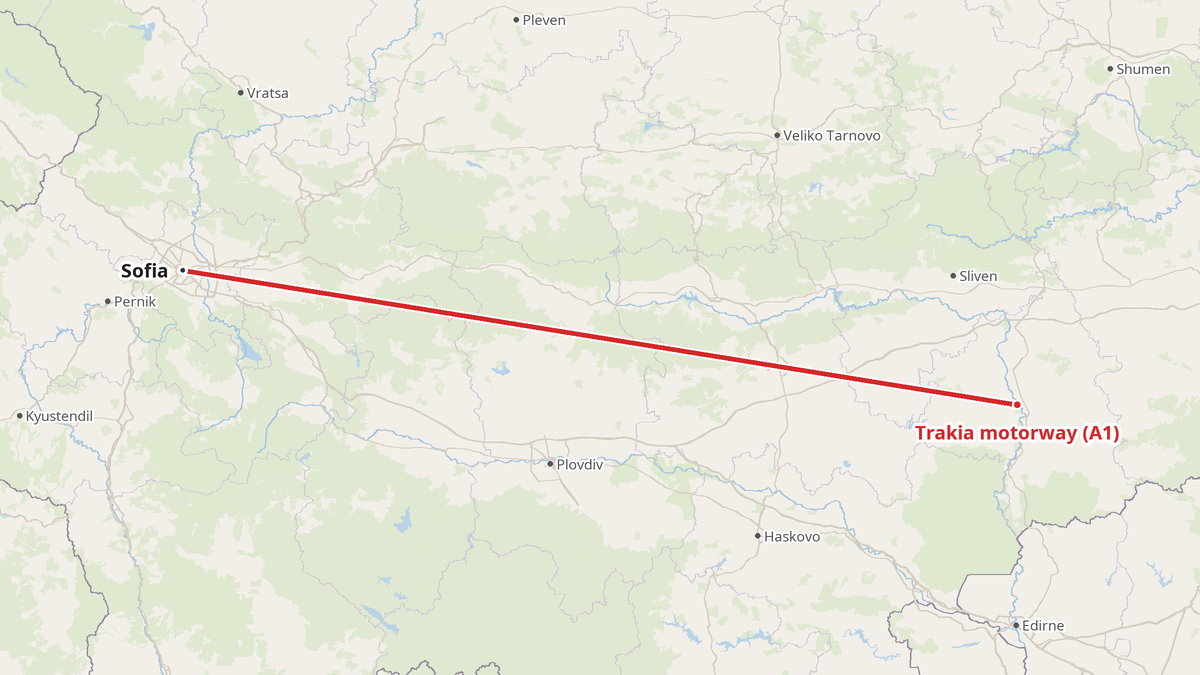
Twelve people died and dozens were injured on Tuesday when a mass pile-up in thick fog engulfed the Trakia motorway in southeastern Bulgaria, a country whose roads are the most dangerous in the European Union. Prime Minister Rumen Radev confirmed the toll after dozens of cars and lorries were caught up in two crashes near the city of Yambol.
The disaster landed at an awkward moment for Sofia. Radev had been hosting European Commission President Ursula von der Leyen when word of the crash arrived. He cut short a news conference and drove to the scene. Von der Leyen said she would shorten her visit.
The Toll and the Confusion
The casualty figures shifted through the day. Health Minister Katya Ivkova said 11 people died at the scene, near the town of Zimnitsa, and another died later in hospital. A health ministry statement said 51 people in total were admitted to hospitals in nearby cities, 13 of them critically injured. Ivkova also put the number of injured transported to medical facilities at 46; elsewhere the figure was about 50.
The number of vehicles involved was equally unclear. Yambol regional governor Georgi Chalakov told the BTA state news agency that around 50 cars and trucks heading in both directions were involved. Sliven regional governor Mihail Kasherov said more than 70. Another report put it at around 86. Images showed overturned cars, trucks mangled together and burnt-out vehicles.
Chalakov said reports first came in at 07:10 local time. Rescue teams had to cut away sections of the crash barrier to reach victims, and the fog grounded helicopters. Chief Inspector Todor Mishinev of the Yambol police told Nova TV that people were still trapped in their cars as he spoke.
Who Knew What, and When
The Interior Ministry blamed reduced visibility. Interior Minister Ivan Demerdzhiev pointed to a sudden change in weather: visibility was around 70-80 metres immediately before the incident and fell to roughly 10 metres within a short period. He said the ministry is working on equipping toll-system gantries with display screens to warn drivers. Road administration director Galin Kostov said speeds were unsuitable for the conditions, which included wet road surfaces.
The government's account faced a direct challenge. Bogdan Milchev, chairman of the Road Safety Institute NGO, told public radio BNR that the motorway section should have been closed early Tuesday, and he blamed the government.
The state's emergency response was substantial. Two aircraft equipped with stretchers and medical teams were dispatched, a government plane flew to Burgas to move the injured to Sofia hospitals, and Spartan military transport planes were used. Radev declared Wednesday a day of national mourning. The Council of Ministers meeting was cancelled.
A Record That Predates the Fog
The numbers behind the headline are stark. Bulgaria recorded 71 road fatalities per million inhabitants in 2025, the highest rate in the EU, according to European Commission figures. The EU average is 43. A total of 456 people were killed on Bulgarian roads in 2025, down five percent from the previous year and 27 percent lower than in 2019.
The EU set a target in 2019 to halve road deaths and serious injuries by 2030. A European Commission report in October found only five of the 27 member states, Bulgaria among them, were on track to meet it. Victims blame reckless driving, poorly maintained roads and an inefficient justice system. In 2023 parliament adopted stricter penalties for driving under the influence of drugs, and cars of accused drivers are now impounded until trial. Experts note that Bulgaria is the EU's poorest member state, with around half of registered cars more than 20 years old, and that its busy road traffic serves as a gateway to the EU.
Condolences came from European Council chief Antonio Costa and European Parliament President Roberta Metsola. Romanian Foreign Minister Dan Neculaescu said one Romanian was among the injured. The identities of the dead had not been announced.
Why This Matters:
The crash puts a hard number on a policy question: Brussels sets road-safety targets, but delivery rests with national governments, their budgets and their courts. Bulgaria's record, the worst rate in the EU, shows what happens when ambitious EU goals meet an ageing vehicle fleet, uneven road maintenance and a slow justice system. The gap between target and capacity is a question of democratic accountability: citizens judge their own government on whether a motorway is closed in dangerous fog, not the Commission. Sofia's pledge to install warning screens will be measured against the NGO's charge that the section should simply have been shut. For a country that serves as an EU gateway, the cost of that gap is paid in lives and, ultimately, in public trust.
- trakia motorway
- bulgaria
- pile-up
- fog
- yambol
- road accident
- road safety
- rumen radev