
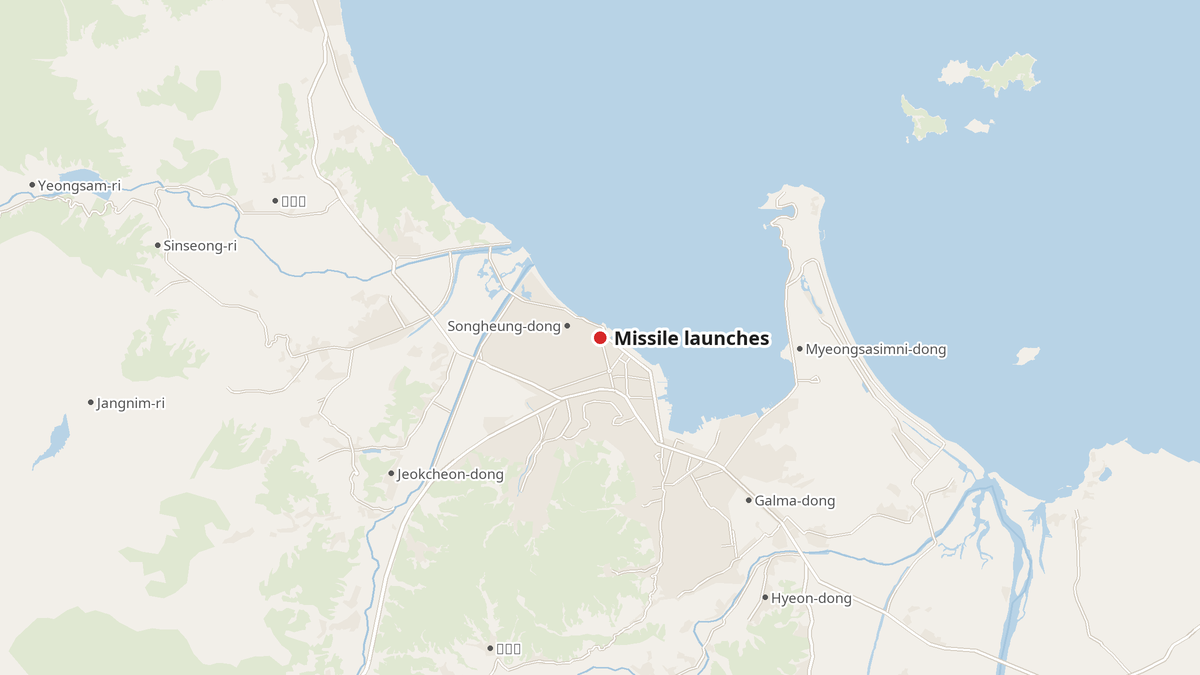
North Korea fired about 10 short-range ballistic missiles toward the sea from Wonsan on Thursday, South Korea’s Joint Chiefs of Staff said, putting the rival states’ military apparatus back on display. A Kyodo News breaking-news item described the barrage as a dozen missiles. South Korea’s military bolstered surveillance and exchanged information about the launches with the United States and Japan.
Military Power, on Both Sides
The launches came after North Korea threatened to resume front-line propaganda loudspeaker broadcasts and deploy new weapons along the border. They also followed recent tests involving submarine-launched cruise missiles and hypersonic missiles. Experts said North Korea likely aimed to pressure the United States into making bigger concessions as U.S. President Donald Trump expressed interest in restoring diplomacy with Kim Jong Un.
The immediate costs of the border confrontation have already reached military personnel. Land mine blasts on Sept. 21 injured three South Korean soldiers. Seoul accused North Korea of planting the mines south of the military demarcation line; Pyongyang denied responsibility and warned of retaliation if provoked.
Last week, North Korea said it would restart propaganda broadcasts and deploy new weapons systems along the border. Pyongyang said it was protesting what it called repeated warning shots by South Korean troops in border areas. South Korea later proposed talks to clarify the border and prevent accidental clashes. North Korea had not responded.
That is the available picture of diplomacy: one side proposed talks, the other had not answered, while both governments continued to issue warnings and prepare military measures. The report describes no grassroots effort or mutual-aid response to the border tensions; the choices it records belong to governments and armed forces.
A Diplomatic Opening, Filtered Through Officials
A separate assessment by South Korea’s National Intelligence Service suggested Kim may have conveyed Pyongyang’s position on potential talks with the United States during his China visit. The agency gave the assessment to lawmakers during a closed-door parliamentary intelligence committee audit Thursday, according to Rep. Youn Kun-young of the ruling Democratic Party and Rep. Yoo Yeong-ha of the main opposition People Power Party.
The NIS said Kim may have had a purpose beyond commemorating China’s participation in the Korean War. It noted that senior diplomats, including Foreign Minister Choe Son-hui, accompanied him rather than military officials. The assessment remains an agency judgment, not a confirmed account of what Kim conveyed.
Kim traveled to Dandong on Saturday, Oct. 24, and met Wang Huning, a top Chinese Communist Party official. He also visited a memorial to China’s support for North Korea during the 1950-53 Korean War. At the memorial, Kim said North Korea would firmly carry forward “the invincible” friendship with China. He reaffirmed his resolve to develop bilateral cooperation with Wang.
Kim’s trip came ahead of next month’s Asia-Pacific Economic Cooperation summit in Shenzhen, China, which Trump is expected to attend. Trump has expressed interest in resuming dialogue with Kim. No agreement or meeting was announced in the report; the possibility of talks remains in the hands of national leaders and their officials.
The Alliances Behind the Threats
China is North Korea’s main ally and economic pipeline. Kim’s visit followed a recent effort to strengthen ties with China after years of prioritizing relations with Russia, including by sending troops and ammunition to support Russia’s war against Ukraine. Kim crossed a newly inaugurated bridge to Dandong and paid respect at the war memorial. It was his sixth visit to China since taking office in late 2011.
Thursday’s launches, the competing border accusations and the unanswered proposal for talks leave ordinary people outside the decisions described here, while governments manage the danger through weapons, surveillance and closed-door assessments. The military postures are public. The intelligence committee’s audit was not.
- north korea
- ballistic missiles
- kim jong un
- south korea
- united states
- china
- missile launches
- us-north korea talks