
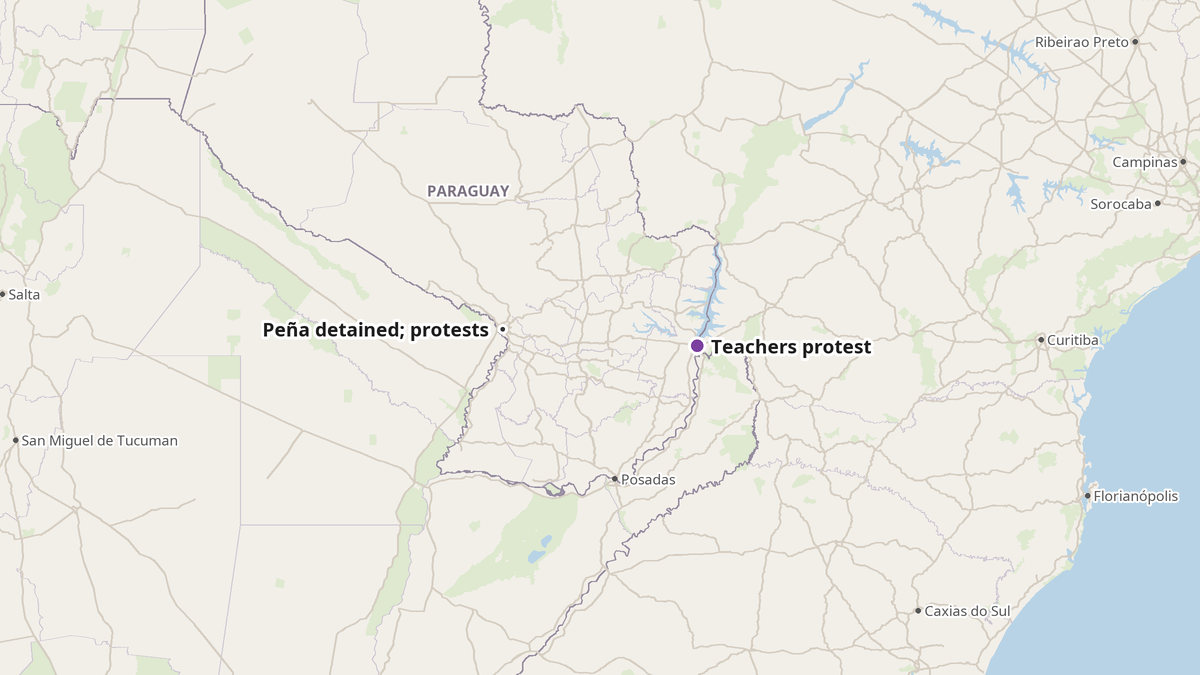
Public schoolteachers walked out across Paraguay on Monday and took to the streets of several cities, demanding to know what happened to their pensions. Around 60 million dollars of it sits inside Ueno Bank, the private digital lender the Central Bank seized on November 3, six days ago. "We want the return of that money to be a priority," Silvio Piris, president of the Federation of Paraguayan Educators, told Paraguay's Channel 9.
They're not alone. More than three million people were locked out of their accounts when the government intervened. Cinthia Vargas, an account holder quoted by Democracy Now, put it plainly: "I had my entire life savings in Ueno Bank. I'd been saving there for five years, and overnight I lost everything." Protests by account holders have followed, some ending in clashes with police.
Who Has the Power
While savers scrambled, prosecutors were busy with a hidden room. They raided the summer mansion of ousted President Santiago Peña in San Bernardino and found an armored vault behind a false wall. They couldn't open it. Prosecutor Benítez said investigators got through only the first door. ABC Color reports the security system is "level 7" and demands at least four mechanisms: facial or iris recognition, fingerprint, numeric code and multilock-style keys.
Now the apparatus is weighing options. A controlled detonation is one, though Benítez conceded it could damage the contents and the structure, with a swimming pool sitting above the vault. Another is hauling in Peña's wife, Leticia Ocampos, to see whether her iris opens it. Prosecutors say relatives aren't obligated to cooperate. Peña's defense made no comment.
The house is the center of the case. According to the charging document, on May 13, 2024, while he was president, Peña took two simultaneous loans from Ueno Bank totaling 3,548 million guaraníes, about 567,254 dollars, to build it. The monthly installments of 239 million guaraníes were equivalent to six times his presidential salary. Construction cost roughly 1.2 to 1.3 million dollars, according to ABC Color. In January 2025, facing criticism over the property, Peña said he had "worked since he was 18."
Who Gets Crushed
The numbers at the bottom are brutal. Pension funds from the Instituto de Previsión Social, which manages retirement for private-sector workers, had deposited about 355 million dollars at Ueno. Al Jazeera, citing the indictment and reports, says the bank held approximately 850 million dollars in public funds by June. The bank had made 146 million dollars in questionable loans to companies linked to its owner, and its capital had fallen below half the legal minimum.
The guaraní has lost about 8 percent of its value against the U.S. dollar since the intervention. The Central Bank says it has partially or fully refunded more than 1.2 million customers, and Vice President Pedro Alliana said Sunday that about 158 million dollars had been paid out. Deposits are insured up to around 37,000 dollars. For a worker whose whole life fit in one account, that's a ceiling, not a rescue.
What They're Calling Justice
The Senate removed Peña on Friday, rejecting the resignation he tried to file a day earlier. Alliana was sworn in and is expected to serve until August 2028. A judge ordered Peña held in preventive detention at the Presidential Escort Regiment military base, and prosecutors charged him with breach of trust and administration for personal gain. They calculate damage of about 809 million dollars, which they note is the sum of state deposits in the bank, not a proven loss. Peña denies the charges.
Legislators accuse him of steering public money into Ueno while regulators overlooked risky insider lending. The impeachment charges allege he held a stake in Ueno's holding company and appointed a former Ueno executive to run the central bank that regulated it. Al Jazeera identifies the former central bank head as Carlos Carvallo, who previously headed Ueno and now faces charges and pretrial detention.
Andrew Nickson, a Paraguay expert at the University of Birmingham, told Al Jazeera: "The judicial system is so corrupt and politicised in favour of the [ruling] Colorado Party that only scapegoats are likely to suffer long-term sentences." He noted that two previous attempts since the 1990s to prosecute former presidents ended with charges dropped on appeal.
Peña's lawyer, Ricardo Preda, had the last word, and it was a lecture: "What sets a serious country apart is not that its banks don't fail, but how it responds." The teachers are still on the street.
- santiago peña
- ueno bank
- paraguay
- central bank
- money laundering
- san bernardino
- presidential mansion
- corruption