
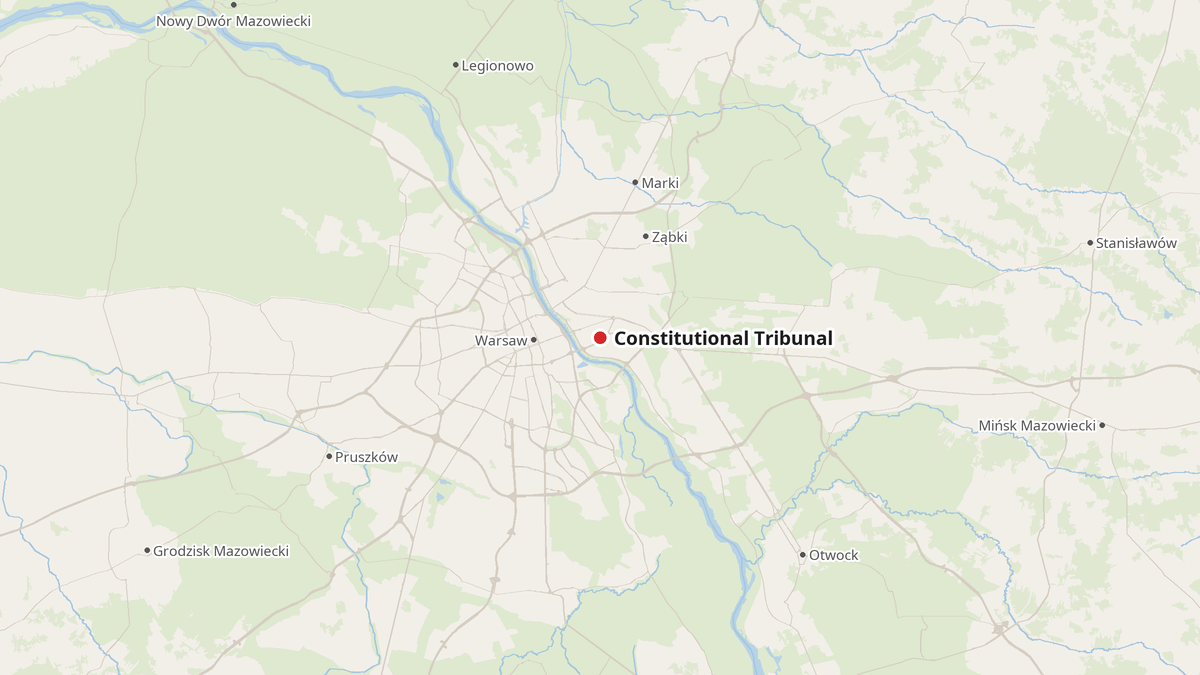
Riot police ringed Poland's Constitutional Tribunal in Warsaw on Friday evening after a judge ordered the suspension of the court's president, Bogdan Święczkowski, and his deputy for a month. The order set off a stand-off between Prime Minister Donald Tusk's government and the nationalist right, and it has handed Poland's opposition a ready-made grievance a year before voters go to the polls.
Anna Korwin-Piotrowska, a judge on the court, ordered Święczkowski and his deputy, Bartłomiej Sochański, suspended and announced she was taking charge. Święczkowski rejected her authority and accused those involved of a "coup d'état." Sochański was turned away at the building's gates. Korwin-Piotrowska is one of five judges elected by parliament since March whom President Karol Nawrocki has refused to swear in, citing alleged flaws in their selection procedure. She said the move was needed to restore the rule of law. "In modern Europe, a democratic state cannot function without a constitutional court (...) that acts as a guarantor of citizens' rights and freedoms," she said.
The Government's Role
The police deployment followed an announcement by Justice Minister Waldemar Żurek, who also serves as prosecutor general. He said he had submitted five requests to lift the immunity of Święczkowski and Sochański, backed by 50 volumes of case files, so that criminal charges could be brought against them for not allowing judges to adjudicate. Żurek accused Święczkowski of turning the institution into his "private fiefdom." "This court has become private property; we must restore its proper functioning," he told journalists. He insisted the government had nothing to do with Korwin-Piotrowska's decision, calling it the act of a legally appointed judge.
The court itself saw it differently. In a social media post it said the two judges the government wants to prosecute remain its legally appointed senior justices. "All persons participating in these actions are committing the crime of a coup d'etat," it said. It added that Korwin-Piotrowska could not become interim chief because the president had not sworn her in. The court's official website was not accessible on Friday evening.
Street Confrontation
Outside the tribunal, protesters clashed with police. Police said objects were thrown at officers and three people were detained after climbing the court's fence. Police said they deployed following warnings of threats to judges and staff, and had not entered the building, though other reporting describes officers entering the premises. Dozens guarded the entrance as supporters of the opposition Law and Justice party (PiS) protested. Some chanted "Tusk traitor." Demonstrator Tomasz Zaleski told AFP that Tusk was "trampling on our constitutional rights."
PiS leader Jarosław Kaczyński joined the protest and tried to force his way into the building. He accused Tusk of staging a "coup" against the court and turning Poland into a "police state," and demanded presidential intervention. Nawrocki, a PiS ally and Tusk's rival, cut short an official trip to Senegal, saying: "At a moment like this, the president must be in Poland." He later entered the court, according to his chief of staff, and met Święczkowski and the court's first chief justice, Zbigniew Kapinski, at the presidential palace. No details of any action were given.
Tusk defended the move on X. "Restoring the rule of law is our duty," he wrote. "After years of Law and Justice's lawlessness, this is a difficult, sometimes painful process that requires decisive action. There is no other way."
The Brussels Backdrop
PiS governed from 2015 to 2023 and filled the tribunal with its appointees, including Święczkowski and his deputy. That put the court at the heart of Poland's confrontation with Brussels over the rule of law. The European Court of Human Rights and the Court of Justice of the European Union ruled that the PiS majority had improperly elected three judges and that the tribunal was no longer an "independent and impartial tribunal." Tusk's government has used those rulings as a basis to stop publishing the tribunal's rulings. The Venice Commission said earlier this month that Nawrocki should swear in the five judges so they can sit on the bench.
Tusk, a strongly pro-EU figure, vowed to end the dispute with Brussels after winning the 2023 election. He has failed to undo the PiS-era changes, partly because Nawrocki and his predecessor Andrzej Duda used presidential vetoes to block him. Some of his own supporters accuse him of not acting decisively. Parliamentary elections are scheduled for next year, and some see the move as an attempt to boost his standing. Critics include allies of the cause: lawyer Marcin Matczak, a critic of the PiS-era reforms who calls Święczkowski the court's worst president, said the suspension had no legal basis "for a million reasons." He wrote that the action "buries this body and the issue of the rule of law for two decades," and that images of armed police and a reading under which the justice minister can remove the court's president by decree "will have a powerful, anti-rule of law backlash for years to come."
Why This Matters:
The dispute shows how hard it is to repair a politicised institution by methods that critics say sit outside the law. Even a government with European court rulings behind it is being accused, by a prominent reformist lawyer, of damaging the very principle it invokes. For Brussels, the episode is a warning that enforcement from above cannot substitute for settled rules at home, and that member-state constitutional disputes are resolved or worsened in national politics. With elections due next year, and a president and a prime minister in open conflict, the question of who controls Poland's top court now carries consequences for democratic accountability, investor confidence and the credibility of the rule-of-law agenda across the Union.
- constitutional tribunal
- poland
- donald tusk
- bogdan święczkowski
- karol nawrocki
- law and justice
- judicial overhaul
- rule of law