
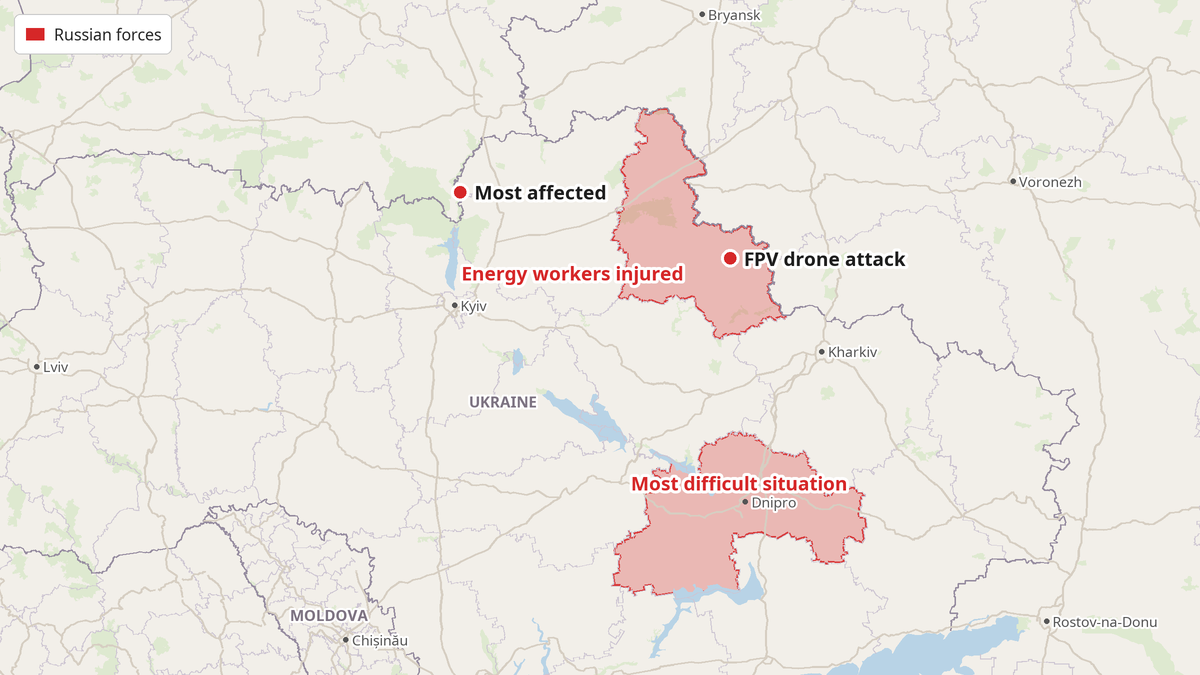
A Russian FPV drone struck a vehicle carrying Ukrainian energy workers in Sumy Oblast on Nov. 9 and injured three of them. All three were taken to hospital, and one is in critical condition. According to state-owned operator Ukrenergo, Russian forces deliberately targeted the people whose job is to maintain and repair damaged energy infrastructure. "Today's attack is yet another testament to the price paid for this work," the company said.
That's the sharpest edge of a week-long campaign. Artem Nekrasov, First Deputy Minister of Energy, told a briefing that Russia deliberately attacked Ukraine's energy and oil and gas sectors 128 times between 2 and 8 November. The ministry recorded 219 incidents that damaged or destroyed energy and oil and gas infrastructure. As of Monday 9 November, the situation remained most difficult in Dnipropetrovsk and Kyiv oblasts.
Who Gets Crushed
By morning on 9 November, consumers in 12 oblasts had no electricity: Vinnytsia, Dnipropetrovsk, Donetsk, Zhytomyr, Zaporizhzhia, Kyiv, Odesa, Poltava, Rivne, Kharkiv, Khmelnytskyi and Chernihiv. Emergency power cuts hit Sumy, Poltava and Kharkiv oblasts, and Ukrenergo suspended the outage schedules it had already announced there. Schedules, in other words, couldn't keep up with the strikes.
For most oblasts, power cuts of 1.5 to 4 queues stay in effect through 9 November. That means up to 16 hours a day without electricity. Ukrenergo defines a "queue" as a group of consumers and businesses using a specific amount of megawatts, and the Dispatch Centre decides how many queues each oblast must shed to cover the deficit. Supply can change several times an hour. The Ministry of Energy's advice to the public: keep watching announcements from the oblenergos, the regional power distribution companies.
The Grid's Pecking Order
Not everyone sits in the dark equally. A Cabinet resolution says critical infrastructure, and eligible industrial companies that import at least 60% of their energy, cannot be disconnected. Households absorb the cuts; the carve-outs are written into state paperwork. The base facts don't say who counts as "eligible" beyond that threshold, and that gap is worth asking about.
Who Pays for the Repairs
"Power engineers are working flat out to restore stable power supply to consumers as quickly as possible," Nekrasov said. He added: "Despite the constant attacks and danger, power engineers work daily to restore the electricity supply. Repair work is underway in all affected regions where the security situation allows." Ukrenergo said emergency repairs continue wherever security conditions allow, with the situation particularly critical in Kyiv and Dnipropetrovsk oblasts.
The officials speak of power engineers as a resource. In Sumy Oblast they were three people in a vehicle, hit by a drone, one now critical in hospital. Overnight on Nov. 9, power lines were also hit in the village of Zolochiv, Kharkiv Oblast, and in the city of Kharkiv, according to Oleh Syniehubov. In Odesa Oblast, local authorities reported massive attacks on the grid, and in Rivne Oblast an energy infrastructure facility was hit.
Winter as a Weapon
The 3 November mass strike was the largest attack on Ukraine's energy facilities this year. It caused widespread outages and cut water supplies across Kyiv for more than 24 hours. Six days later the pattern holds. On 4 November, because of large-scale and systematic attacks, Ukrainian nuclear power plants were forced to reduce their generation capacity. Russia has increasingly targeted power lines as temperatures drop, and repeated strikes have forced authorities to bring in rolling blackouts and emergency cuts.
The ones holding this together are the line workers and the people watching oblenergo announcements to learn when the lights go out. A war between states, fought over who keeps the heat on, lands hardest on those with no say in either government's strategy.
- russia
- ukraine
- power outages
- energy infrastructure
- ukrenergo
- kyiv
- military attacks
- rolling blackouts