
Russia attacked Ukraine's energy and oil and gas sectors 128 times between 2 and 8 November, according to Artem Nekrasov, First Deputy Minister of Energy. The ministry logged 219 incidents that damaged or destroyed energy infrastructure. As of Monday 9 November, consumers in 12 oblasts had no electricity: Vinnytsia, Dnipropetrovsk, Donetsk, Zhytomyr, Zaporizhzhia, Kyiv, Odesa, Poltava, Rivne, Kharkiv, Khmelnytskyi and Chernihiv.
The cold is coming. Russia has increasingly targeted power lines as temperatures drop, and repeated strikes have forced authorities to introduce rolling blackouts and emergency power cuts. People who lose heat, light and water in winter face a stark choice: stay, or move.
The Human Cost
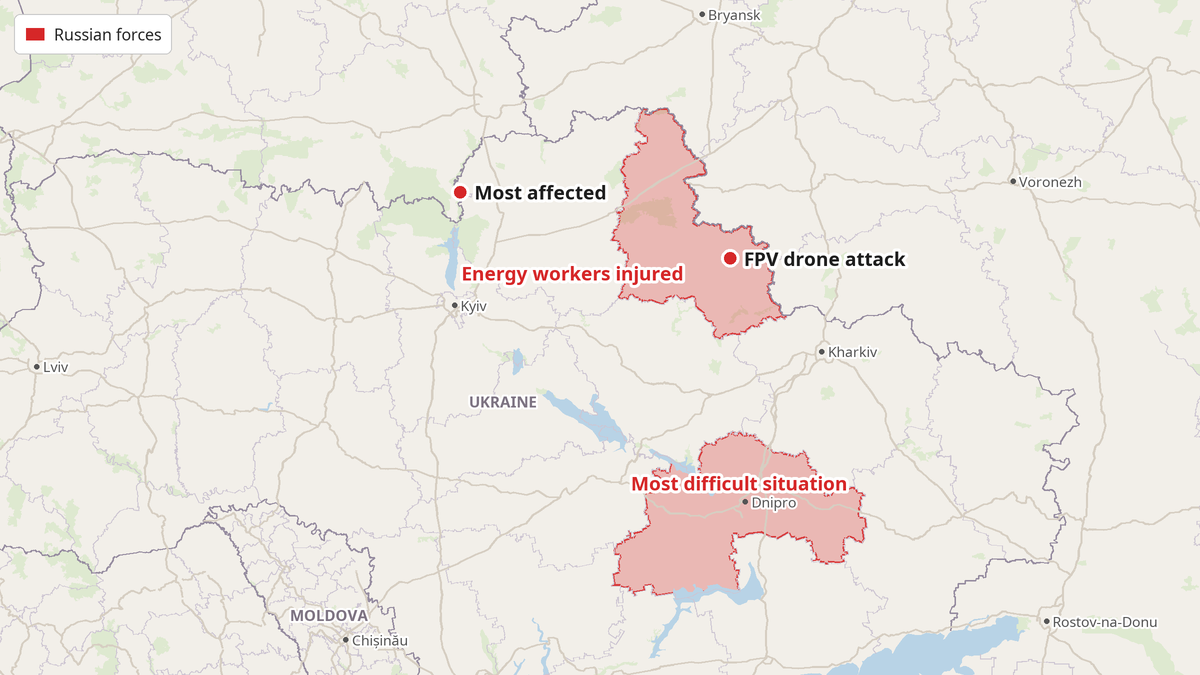
Three energy workers were injured on 9 November when a Russian FPV drone struck their vehicle in Sumy Oblast, according to state-owned operator Ukrenergo. All three were taken to hospital. One is in critical condition. Ukrenergo said Russian forces deliberately targeted the workers who maintain and repair damaged infrastructure. "Today's attack is yet another testament to the price paid for this work," the company said.
Nekrasov described the repair effort in plain terms. "Power engineers are working flat out to restore stable power supply to consumers as quickly as possible," he said. "Despite the constant attacks and danger, power engineers work daily to restore the electricity supply. Repair work is underway in all affected regions where the security situation allows."
On 4 November, because of large-scale and systematic Russian attacks, Ukrainian nuclear power plants were forced to reduce their generation capacity. A Russian mass strike on 3 November was the largest attack on Ukraine's energy facilities this year. It caused widespread outages and cut water supplies across Kyiv for more than 24 hours.
Living on a Schedule
Power cuts of 1.5 to 4 queues will apply in most oblasts throughout 9 November. That means up to 16 hours a day without electricity. Ukrenergo defines a queue as a group of consumers and businesses using a set amount of megawatts. The Dispatch Centre decides how many queues each oblast needs to cover energy deficits.
Emergency cuts hit Sumy, Poltava and Kharkiv oblasts on Monday morning. Ukrenergo suspended the outage schedules it had announced for those regions. Supply can change several times an hour, and the Ministry of Energy urges the public to watch announcements from oblenergos, the regional distribution companies.
A Cabinet resolution shields some users. Critical infrastructure, and eligible industrial companies that import at least 60% of their energy, cannot be disconnected. Households carry the rest of the load, in the dark.
Overnight on 9 November, power lines were hit in the village of Zolochiv, Kharkiv Oblast, and in Kharkiv city, according to Oleh Syniehubov. In Odesa Oblast, local authorities reported massive attacks on the grid. In Rivne Oblast, an energy facility was hit.
Winter and the Border
The base reporting says nothing about who is leaving or where they are headed. What it records is the pressure that pushes people out: sixteen-hour blackouts, interrupted water, repair crews under drone fire. Europe's response to those displaced by this kind of destruction has not been uniform. Ukrainians received temporary protection immediately. Syrians, Afghans and Eritreans fleeing comparable wrecked infrastructure and war have met pushbacks.
Ukrenergo says the situation is most critical in Kyiv and Dnipropetrovsk oblasts, where emergency repairs continue wherever security conditions permit. The cold season has barely started.
- russia
- ukraine
- power outages
- energy infrastructure
- ukrenergo
- kyiv
- military attacks
- rolling blackouts