
Russia attacked Ukraine's energy and oil and gas sectors 128 times between 2 and 8 November, First Deputy Minister of Energy Artem Nekrasov told a briefing on the operational situation in the power grid. The ministry logged 219 incidents that damaged or destroyed energy and oil and gas facilities within the past week.
The numbers describe a country whose power supply is now a daily battlefield. And they put one question to every European capital: who controls the energy that keeps a nation running?
The Grid Under Fire
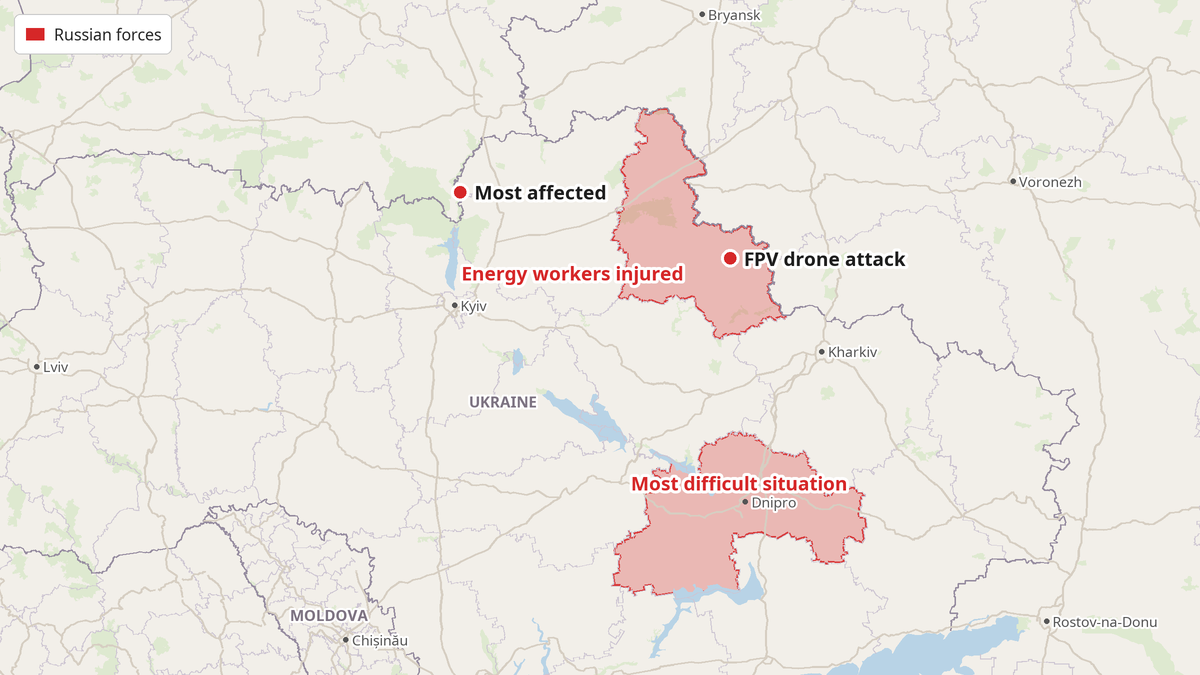
Consumers in 12 oblasts had no electricity as of the morning of 9 November: Vinnytsia, Dnipropetrovsk, Donetsk, Zhytomyr, Zaporizhzhia, Kyiv, Odesa, Poltava, Rivne, Kharkiv, Khmelnytskyi and Chernihiv. The situation remained most difficult in Dnipropetrovsk and Kyiv oblasts.
On 4 November, five days ago, Ukrainian nuclear power plants were forced to reduce their generation capacity because of what the ministry called large-scale and systematic Russian attacks. A mass strike on 3 November, six days ago, was the largest attack on Ukraine's energy facilities this year. It caused widespread outages and disrupted water supplies across Kyiv for more than 24 hours.
Emergency power cuts hit Sumy, Poltava and Kharkiv oblasts on Monday morning, and Ukrenergo suspended previously announced outage schedules there. Cuts of 1.5 to 4 queues will run through most oblasts throughout 9 November. For households, that can mean no electricity for up to 16 hours a day.
Critical infrastructure and eligible industrial companies that import at least 60% of their energy cannot be disconnected, under a Ukrainian Cabinet resolution. Supply can change several times an hour, and the Ministry of Energy urges the public to follow announcements from the regional oblenergos.
Workers in the Line of Fire
A Russian FPV drone struck a vehicle carrying Ukrainian energy workers in Sumy Oblast on 9 November. Three were injured, according to state-owned operator Ukrenergo. All three went to hospital. One is in critical condition.
Ukrenergo said Russian forces deliberately targeted the workers who maintain and repair damaged infrastructure. "Today's attack is yet another testament to the price paid for this work," the company said. Nekrasov said repair crews are working in every affected region where the security situation allows. "Power engineers are working flat out to restore stable power supply to consumers as quickly as possible," he said.
Overnight, power lines were hit in the village of Zolochiv, Kharkiv Oblast, and in Kharkiv city, according to Oleh Syniehubov. Odesa Oblast authorities reported massive attacks on the grid, and an energy facility in Rivne Oblast was hit. Russia has increasingly targeted power lines as temperatures drop. Repeated strikes have forced authorities to impose rolling blackouts and emergency cuts.
What It Means for Europe's Borders
The base reporting contains no refugee or displacement figures. But the pattern it describes, a power grid pushed to rationing and a population facing up to 16 hours a day without electricity as temperatures fall, is the kind of pressure that raises hard questions about border sovereignty. Governments across the continent will have to decide who they admit, on what terms, and with what consent from their own citizens, before any winter movement begins rather than after.
The lesson on energy is just as direct. A state that can't secure its own generation and transmission can't guarantee heat, water or light to its people. Ukraine's nuclear plants, forced to cut output, show how quickly national capacity can be throttled from outside. Nations that produce their own power and hold their own borders decide their own fate. Those that depend on others, or on open systems they can't police, wait for someone else's decision.
- russia
- ukraine
- power outages
- energy infrastructure
- ukrenergo
- kyiv
- military attacks
- rolling blackouts