
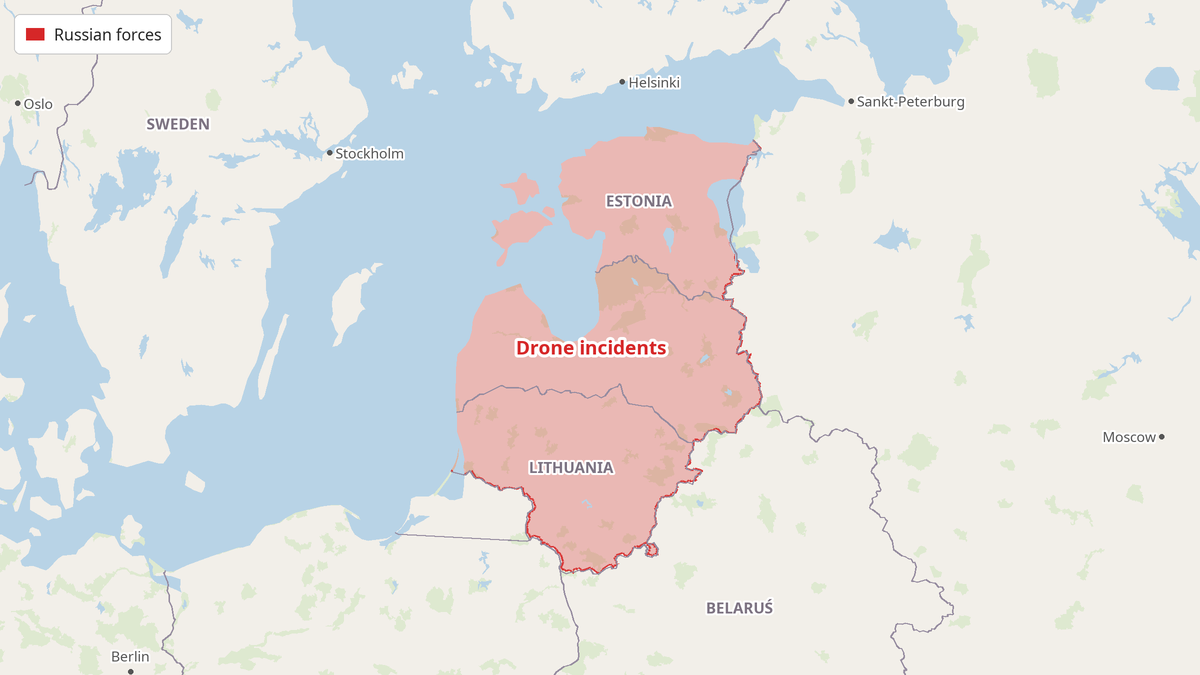
European officials say Russian fighter planes entered Polish, Lithuanian and Estonian airspace, while suspected Russian drones have been downed over Poland, Finland and the Baltic states. As governments warn of escalation and discuss stronger deterrence, the borderlands are also where people seeking asylum have allegedly been forced across a line by armed men.
Borders as a battleground
Latvia's ambassador to Greece, Ieva Cesniece, told Al Jazeera that masked and likely armed individuals on the Belarus side of the border escorted groups of migrants and attempted to push them into Latvia. She said they threatened Latvian soldiers and border guards. In a separate incident the same day, masked people crossed into Latvian territory and damaged border infrastructure, removing surveillance equipment, she said.
Latvian media reported that asylum seekers and undocumented migrants who tried to run back from the Latvian border were rounded up by Belarusian authorities and pushed toward Latvia again. The report presents migrants as caught in an alleged state operation: moved across a border, then forced back toward it. The people subjected to that coercion have little place in the official language of resilience and deterrence, except as the bodies being pushed around.
Cesniece linked Russia's war in Ukraine to what she called its shadow war in Europe. “The weaker Russia appears in Ukraine, the more it tests our resilience, trying to weaken NATO and EU resolve and support for Ukraine,” she said.
Ukraine also accused Russia of using aerial and surface drones in two operations in October to sink four cargo ships just outside Bulgaria's territorial waters. Bulgaria is a European Union and NATO member. The alleged attacks appeared to warn that Ukraine's grain exports through NATO territorial waters might not be safe for long.
Deterrence, with no end in sight
European governments warned of an imminent escalation, while experts called for stronger defence and deterrence. Olena Tregub, cofounder and head of Ukraine's Independent Anti-Corruption Commission, said protecting infrastructure and strengthening intelligence services were essential. But deterrence, she argued, also meant making continued operations too costly. “I'm not sure Russia currently sees those costs as sufficiently high,” she said.
Tregub said European governments had not done enough to identify networks behind operations, expose command structures, disrupt financing and logistics, and impose consequences. The European response discussed in the report is to harden infrastructure and consider retaliation; it doesn't describe a way out of the escalating contest between states and their security apparatuses.
In August, an operation to blow up cargo planes at Germany's Leipzig/Halle Airport failed. The European Commission later verified it as a Russian operation. In September, Czech spy chief Michal Koudelka warned that Russia might attempt a military attack on a NATO member in “months, not years.” Days later, Russian Ministry of Foreign Affairs spokesperson Maria Zakharova said European defence industries supplying Ukraine were legitimate targets for Moscow.
The machinery keeps expanding
Representatives of five EU intelligence agencies told the Financial Times that Russia was seeking to “kill” European defence bosses and target their supply chains. The report followed a story in the German newspaper Frankfurter Allgemeine Zeitung about incendiary devices allegedly planted in the Munich offices of Rohde & Schwarz and Helsing, and a Politico report quoting EU security officials who said Russia planned to move beyond messaging and claim lives on European soil.
European officials have discussed strengthening data centres, telecommunications and other vulnerable networks and industries, but haven't spoken of retaliation. Ukraine's perspective, as reported, is that Europe has been slow to recognise sabotage, military operations, cyberattacks and information warfare as early stages of a multidimensional war.
On October 16, Ukrainian President Volodymyr Zelenskyy asked journalists: “Where will he stop if he is currently testing all these drones against European countries, even NATO countries?” He warned that people would speak loudly when ballistic and cruise missiles and thousands of drones arrived. The proposed answers elsewhere in the report include more forward troops in the Baltic states, stronger support for Ukraine, visa restrictions, cyberattacks and sanctions. The border, the military alliance and the security apparatus remain the terrain on which states answer one another—while people at the edges are left to absorb the consequences.
- russia
- nato
- europe
- sabotage
- hybrid warfare
- ukraine
- baltic states
- cyberattacks