
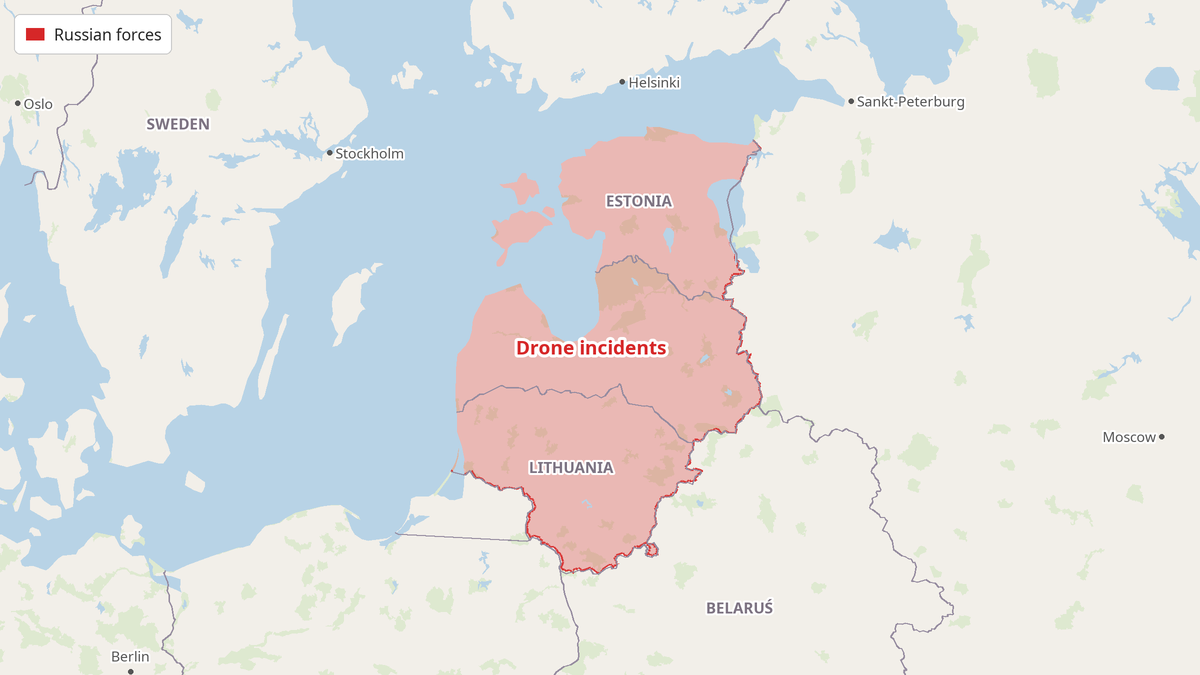
Masked men, some of them probably armed, escorted groups of illegal migrants toward Latvia's frontier with Belarus and threatened Latvian soldiers and border guards. That's the account Latvia's ambassador to Greece, Ieva Cesniece, gave Al Jazeera, and it sits at the centre of a widening picture: a Russian campaign against Europe that runs from the sky to the sea to the border fence.
Cesniece said that on a separate occasion the same day, masked people crossed into Latvian territory and deliberately sabotaged the line. "Border infrastructure was damaged, and surveillance equipment was removed," she said. Latvian media reported that asylum seekers and undocumented migrants who tried to run back from the Latvian border were rounded up by Belarusian authorities and pushed toward Latvia again. Russia and Belarus stand accused of trying to destabilise the Baltic states by making their borders appear fluid.
Borders as a Weapon
The Baltic episode matters beyond Latvia. A border that can't be held isn't just a migration problem; it's a security problem, and Moscow and Minsk appear to understand that. Cesniece tied the pressure directly to the war in Ukraine. "The weaker Russia appears in Ukraine, the more it tests our resilience, trying to weaken NATO and EU resolve and support for Ukraine," she said.
The pressure isn't confined to the ground. European officials allege that Russian fighter planes entered Polish, Lithuanian and Estonian airspace, testing response times. Suspected Russian drones have been downed over Poland, Finland and the Baltic states. Ukraine also accused Russia of using aerial and surface drones in two October operations to sink four cargo ships just outside Bulgaria's territorial waters. Bulgaria belongs to both the EU and NATO, and the attacks appeared to warn that Ukraine's grain exports through NATO waters might not be safe for long.
Industry in the Crosshairs
The sharper warnings concern European industry. In August, an operation to blow up cargo planes at Germany's Leipzig/Halle Airport failed; the European Commission later verified it as a Russian operation. Czech spy chief Michal Koudelka warned in September that Russia might attempt a military attack on a NATO member in "months, not years." Days later, Russian foreign ministry spokesperson Maria Zakharova said European defence industries supplying Ukraine were legitimate targets.
Representatives of five EU intelligence agencies told the Financial Times that Russia was seeking to "kill" European defence bosses and target their supply chains. The Frankfurter Allgemeine Zeitung reported that Russia had planted incendiary devices in the Munich offices of defence companies Rohde & Schwarz and Helsing. Politico quoted EU security officials saying Moscow planned to move beyond messaging and claim lives on European soil.
Olena Tregub, cofounder and head of Ukraine's Independent Anti-Corruption Commission, said Moscow doesn't separate battlefield capability from the industry behind it. "From Moscow's perspective, a factory producing military equipment for Ukraine, a logistics hub transporting that equipment or a company providing critical technology can all become potential targets of disruption," she said.
The Deterrence Gap
European officials have discussed hardening data centres, telecommunications and other vulnerable networks. They haven't spoken of retaliation. Tregub said governments hadn't done enough to identify the networks behind operations, expose command structures, disrupt financing and logistics, and impose consequences. "I'm not sure Russia currently sees those costs as sufficiently high," she said.
Oleksandr Danylyuk of the Royal United Services Institute was blunter. "Russians are limited right now only by their capabilities because they do whatever they want. There is no reaction," he said. He urged NATO to station more forward troops in the Baltic states to create "deterrence by denial." Minna Alander of the Center for European Policy Analysis listed immediate options: denying Russians travel visas, retaliatory cyberattacks, further interdiction of the Russian oil fleet, and sanctions on Chinese suppliers of defence goods to Russia.
The Bill Arrives
Money is the other front. Danylyuk proposed raising combined support for Ukraine by "10 percent, 20 percent" each time Russian intelligence operations are detected in Europe, and said allies were signalling the opposite. The report said the United States withdrew its military and financial support in January 2025 and had recently cast doubt on the dependability of its satellite services. In France and Germany, governments trailed opposition leaders who wanted to stop aid to Ukraine.
On October 16, Volodymyr Zelenskyy told the European Council: "Next year, the war will cost 155 billion euros, and we need at least 70 billion euros more from you." He said Ukraine could double or even triple drone production with the funding. Ukraine has built its own weapons since 2023 and has struck Russian oil installations and weapons factories deep inside Russia.
Why This Matters:
The sabotage reports point to a problem member states can't outsource to Brussels: defending their own territory, borders and industrial base. Latvia's experience shows how a poorly held frontier doubles as a security vulnerability. The funding request puts a concrete figure, 70 billion euros, before governments already facing political pressure at home, with Berlin and Paris trailing opposition voices who want aid cut. With Washington's support withdrawn since January 2025, Europe carries more of the burden itself. The open question for taxpayers and parliaments is whether national capitals will pay for deterrence now, or face higher costs if the warnings from intelligence chiefs prove right.
- russia
- nato
- europe
- sabotage
- hybrid warfare
- ukraine
- baltic states
- cyberattacks