
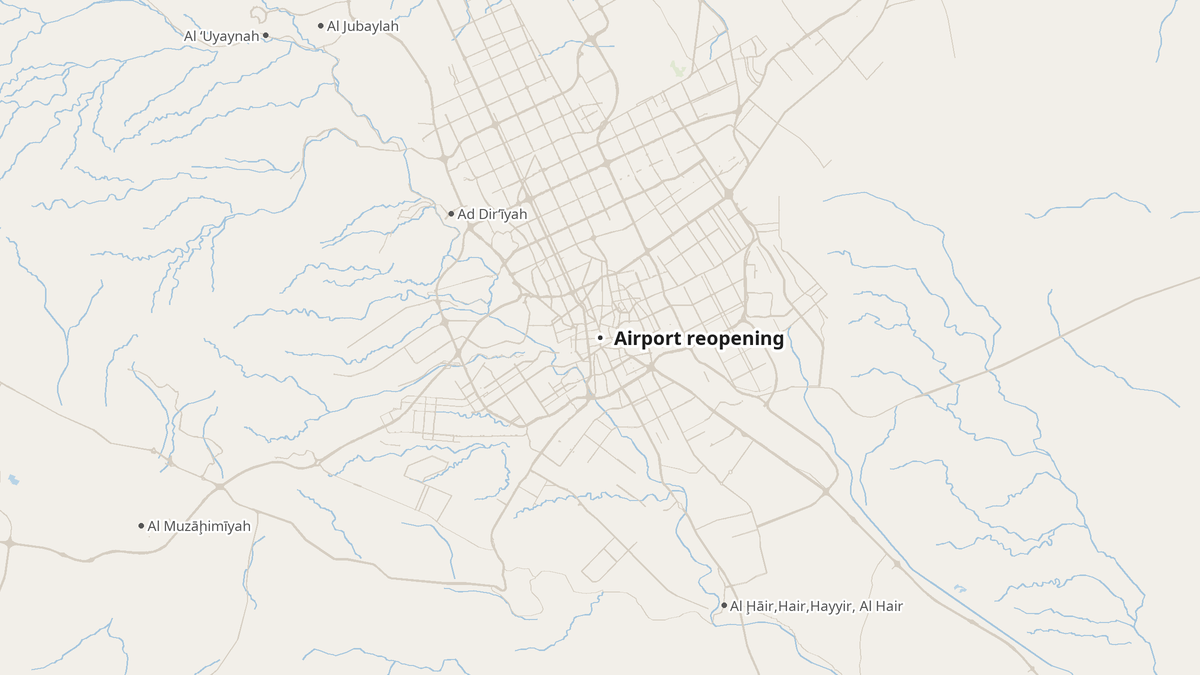
Riyadh’s King Khalid International Airport reopened terminals 1 and 2 on Sunday as Yemen’s Houthi movement continued firing missiles and drones toward Saudi Arabia. Saudi military spokesman Maj. Gen. Turki al-Maliki said the kingdom intercepted and destroyed a ballistic missile and a drone fired by the Houthis early Sunday. Flights resumed; the armed confrontation did not.
The airport had reopened to limited domestic flights the previous week. Early October’s Houthi strikes hit a complex housing two other terminals, killing 17 people and wounding more than 330, the Associated Press reported. The airport’s return to service places an ordinary piece of civilian infrastructure back in operation while missiles and military interceptions remain part of the day’s account.
The National’s live updates reported that a Saudi-led coalition intercepted a Houthi missile launched toward Riyadh as the capital’s airport prepared to resume operations. The AP report said the airport announcement specified terminals 1 and 2 and confirmed the Sunday interception. The accounts describe rival armed forces and a city whose airport operates under the shadow of their actions. The people killed and wounded in the earlier strikes bear the costs in bodies, not communiqués.
Security and civilian life
The same AP report described an Israeli military operation in the occupied West Bank after an attack in Hebron on Friday killed two Israeli soldiers and wounded three. The operation displaced hundreds of Palestinians over the weekend and imposed major movement restrictions. Here, too, military decisions reached beyond the fighters involved: people were displaced, and movement across the territory was restricted.
Israel’s military said most Palestinian workers with permits would be barred from entering Israeli communities for work on Sunday and Monday. Several crossings would remain closed until after Israel’s election on Tuesday. The restrictions tie access to work and movement to decisions made by the military, while the election proceeds on its own timetable. The AP described the vote as widely viewed as a referendum on Prime Minister Benjamin Netanyahu’s handling of the wars and Israel’s domestic and international direction.
The ballot and the apparatus
The AID Coalition, a U.S.-based nonprofit focused on strengthening Israeli democracy, expected tens of thousands of Israelis living abroad to fly to Israel to vote. Israeli law generally requires citizens to vote in person in the country, with narrow exceptions for diplomats and certain official emissaries abroad. The report offered no estimate of what returning voters would mean for the result; it said the effect was unclear.
Israel had more than 7.3 million registered voters, and polls suggested a tight race. Many liberal Israelis who opposed Netanyahu had left the country in recent years, the AP reported. A ballot can measure political choices, but the report also records who controls crossings and who can enter Israeli communities for work: Israel’s military. Those restrictions remain in place until after the election.
Across the two reports, Saudi and Houthi forces confront one another around Riyadh, while Israeli military power shapes movement in the occupied West Bank. The accounts don’t describe a grassroots organization or a civilian body deciding these security measures. They record the armed actors’ statements, the airport’s reopening, the dead and wounded, and the people displaced or barred from movement. For civilians, the machinery of security arrives as interrupted travel, closed crossings, lost access to work and the aftermath of deadly strikes.
- king khalid international airport
- riyadh
- houthi movement
- saudi arabia
- missile attacks
- drone attacks
- airport reopening