
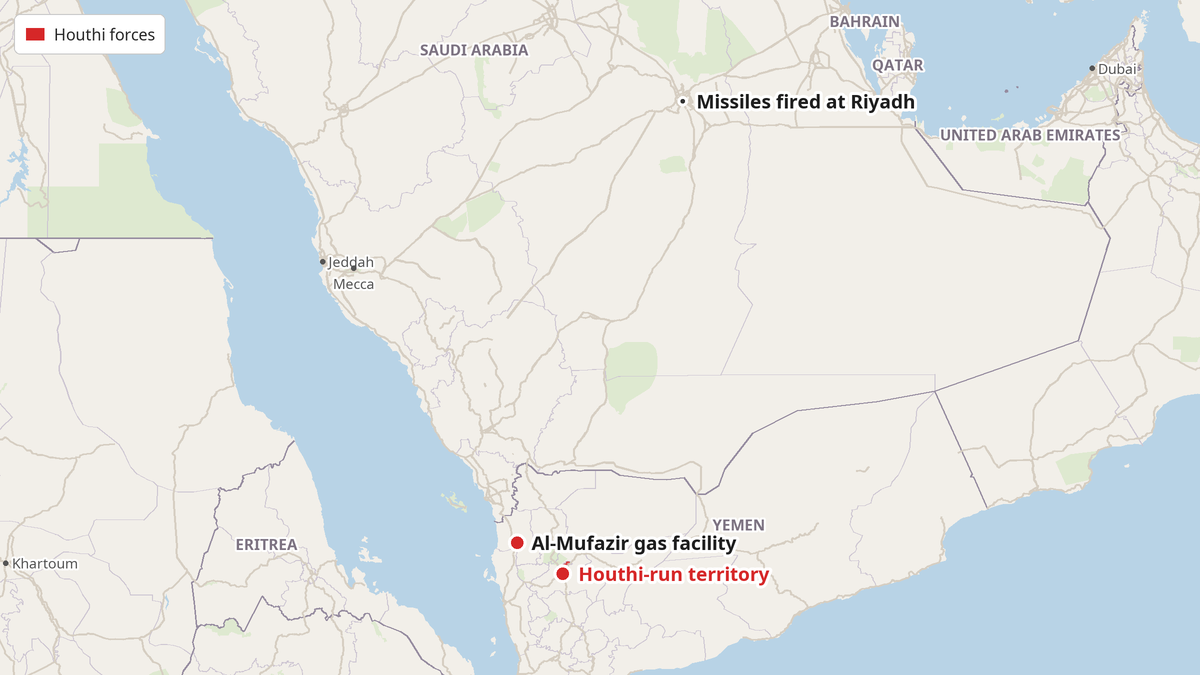
Residents of Riyadh got text messages Tuesday telling them to take shelter from an "aerial threat." Explosions rang out across the Saudi capital. Minutes later, a second alert from the civil defence agency said the danger had passed.
The Saudi Arabia-led coalition fighting Yemen's Houthis said it intercepted two missiles fired toward the capital and a third aimed at the kingdom's southern region. Major-General Turki al-Maliki, a coalition spokesperson, blamed the Iran-backed Houthis. In a series of posts on X, he said a ballistic missile and a cruise missile were destroyed over Riyadh, while a second ballistic missile was downed over the southern part of the country. The AFP news agency reported multiple explosions in the city. The Houthis offered no immediate comment.
Strikes on Sanaa
The fire flowed in both directions. The Houthi-run Saba news agency reported coalition air strikes on Sanaa, the Yemeni capital, which the Houthis control. Saba said the strikes hit the al-Mufazir gas facility in the Jadar district, north of the city, along with a building belonging to the state oil company in southern Sanaa. Civil defence teams were working to put out a fire in gas trailers at the al-Mufazir station, according to the agency. The coalition did not immediately confirm the strikes.
The base reporting offers no casualty figures from either side of Tuesday's exchange, and that gap matters. Gas stations and fuel depots in a densely populated capital are not abstract targets, and fires at such sites put the people who live and work nearby at risk. Until independent confirmation arrives, the human toll in Sanaa stays unknown.
An Attack on a Lifeline
The latest escalation began a day earlier. On Monday, the East-West oil pipeline in Saudi Arabia's Medina region was attacked again. A Saudi Ministry of Energy official told the state-run SPA news agency the strike caused a "limited fire" that was extinguished and that "pipeline operations were unaffected." No injuries or deaths were reported.
The pipeline carries outsized weight. It is a vital route for Saudi oil exports because of Tehran's restrictions in the Strait of Hormuz following the US-Israel war against Iran, and it has come under attack several times. On Sunday, the Houthis said they attacked Riyadh's business district. Saudi officials said falling debris from an "attempted attack" caused minor damage to the Aramco Tower, and SPA images showed the deputy governor of the Riyadh region and other officials inspecting damage visible on several floors.
A War Inside a War
The cross-border strikes unfold against a ground war in Yemen. Fighting is raging between the Houthis and the internationally recognised government, which Riyadh backs. The coalition has supported a government offensive to retake territory with air strikes, while the Houthis have repeatedly hit Saudi oil infrastructure, including refineries and storage facilities, with drones and missiles.
Against that backdrop, The National's live blog noted the Saudi and Omani foreign ministers calling for diplomacy. The call is the only sign of restraint in a day otherwise defined by interceptions, shelter alerts and burning fuel trailers.
Why This Matters: Tuesday's exchange shows how a regional conflict reaches ordinary people far from any front line: families in Riyadh told to seek cover, and residents of Sanaa living beside gas facilities that coalition strikes reportedly set ablaze. The Hormuz restrictions have made the East-West pipeline a strategic target, so civilian infrastructure and energy supplies now sit squarely in the line of fire. Each volley makes the diplomacy urged by Saudi and Omani officials harder to achieve, and the ground offensive in Yemen suggests no one is close to a settlement. The cost of that gap falls on civilians, whose fate rarely appears in the military statements.
- saudi arabia
- houthis
- yemen
- missile attack
- riyadh
- east-west pipeline
- aramco tower
- turki al-maliki