
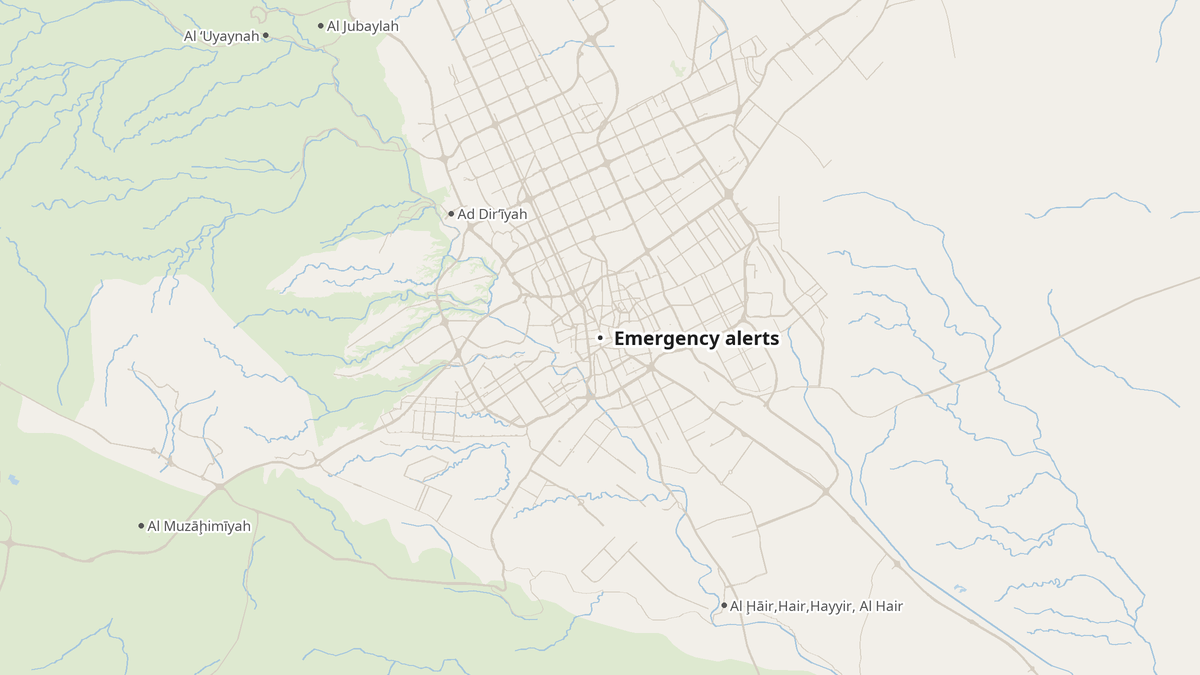
Saudi Arabia’s civil defence agency issued eight public emergency alerts in a 24-hour period as missiles and drones crossed into the kingdom and coalition aircraft struck Yemen. The alerts sounded over Riyadh early Saturday, when the Saudi-led coalition said it intercepted three ballistic missiles fired by Yemen’s Houthi rebels. People were left to navigate a war conducted by rival armed authorities, each describing its violence as security or military necessity.
The State’s Monopoly
The interception came two days after a Houthi strike damaged the Public Investment Fund tower, headquarters of Saudi Arabia’s sovereign wealth fund and Riyadh’s tallest skyscraper. The coalition said it was the third day in a row that Saudi Arabia issued and quickly lifted alerts for the capital. The warning system made the confrontation immediate for residents, even as the armed parties traded claims and threats at a distance.
Hours after the interception, the coalition said it destroyed another Houthi drone fired towards the kingdom’s south. It didn’t identify the targeted province. That omission leaves the public with the scale of the response but not the location it was meant to protect.
On Friday, the previous day, the coalition said it carried out a “special operation” against the Houthi-held Red Sea port of Hodeidah and “military targets” in the capital, Sanaa. Coalition spokesperson Turki al-Malki said the strikes hit “operational capabilities at Hodeidah port that were used in smuggling operations and the transport of weapons and ballistic missiles,” the AFP news agency reported. The official vocabulary is familiar: targets and capabilities. The danger reaches people who depend on the port and the supply routes around it.
Yemen’s internationally recognised government defended the strikes on Hodeidah, accusing the Houthis of using the port’s facilities to receive smuggled Iranian weapons and conduct military operations. Its defence frames the bombardment as a security measure; the coalition’s account supplies the same justification in military language. Neither statement describes the consequences for civilians who rely on vital supply routes.
Threats and Supply Routes
The Houthis threatened to attack Jeddah and other Saudi Red Sea ports. They also warned airlines that Saudi Arabia’s airspace was “unsafe” and threatened Riyadh’s financial centre and a power station in Al-Shuqaiq, in the southwest. The threats extend the reach of the confrontation well beyond the claimed military targets, putting ports, aviation, financial infrastructure and electricity in the same exchange of warnings.
The missile fire and airstrikes aren’t equivalent in scale or consequence simply because each side invokes security. But both authorities wield organized force over civilian populations, while the people exposed to alerts, bombardment and threatened infrastructure have little say in the decisions made in their name. In this account, no grassroots organizers, mutual-aid networks or civilian defenders appear; the public enters mainly as people under alerts or dependent on supply routes.
The UN’s Warning
The United Nations said it was following the escalation “with concern” and warned that continued fighting could threaten vital supply routes for humanitarian aid in Yemen. The warning identifies the cost without describing any means to stop the strikes or threats. Aid routes become another pressure point in a conflict managed by armed authorities and observed by an institution whose statement offers concern, not protection.
The coalition calls its attack a “special operation.” Yemen’s internationally recognised government says Hodeidah served military purposes. The Houthis call Saudi airspace unsafe and name further targets. Meanwhile, emergency alerts reach Riyadh, another drone is reported destroyed, and the UN warns that aid may be caught in the escalation. Those are the terms of this round: authorities announce what they struck, what they intercepted and what they may hit next; civilians inherit the risk.
- houthi rebels
- saudi arabia
- riyadh
- ballistic missiles
- saudi-led coalition
- hodeidah
- yemen conflict
- humanitarian aid