
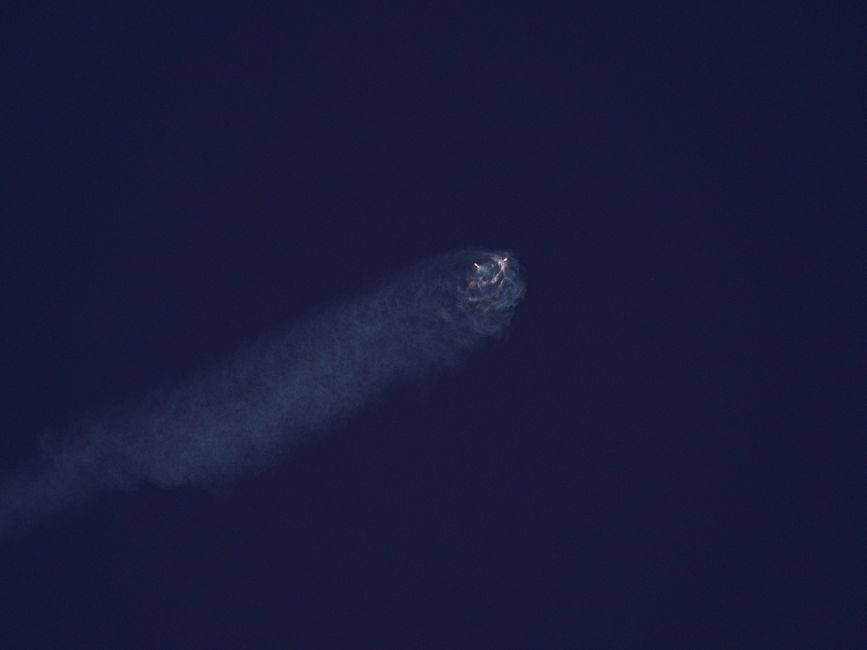
A floating piece of a SpaceX rocket crashed into the Moon at 8,690 kilometres an hour after drifting off course for the past year. The school-bus-sized second stage, weighing 4,000 kilograms, hit near Einstein Crater on the Moon's western limb about 4:35pm AEST yesterday, leaving astronomers to watch the wreckage of private space hardware do what it does best: fail loudly and leave a mess somewhere else.
At the Paranal Observatory in Chile, the European Southern Observatory's Very Large Telescope detected glimmers of light associated with the impact. An ESO spokesperson said, "We can confirm that the telescope detected spectral lines of sodium and lithium gas in the impact plume lasting for 5 to 10 minutes after impact." NASA's Lunar Reconnaissance Orbiter probe and South Korea's Pathfinder Lunar Orbiter were planning to take images of the site after impact, but it could take days to receive that information.
Who Pays for the Wreckage
The object was the second stage of a SpaceX Falcon 9 rocket that had launched a lunar lander from Firefly Aerospace toward the Moon in January 2025. It drifted for the past year before the collision, which occurred near the Moon's terminator line, the boundary of its shadow between the sunlit side and its far side. The impact site is often difficult to see from Earth. That makes the Moon a convenient dumping ground for the leftovers of a space industry that keeps moving fast and cleaning up later, if at all.
Carl Schmidt, the lead astronomer conducting the impact observations, said, "This observation did not go perfectly, and this is a very crude analysis, but I wanted to share something quickly, and we can say more about these results in time." He said the sodium gas evidenced in the spectra is believed to have originated from the lunar soil, while the traces of lithium may have come from the rocket stage itself. The science may be crude, but the hierarchy is not. A private rocket stage went off course for a year, then smashed into a celestial body, and everyone else gets to sort through the debris.
What They Call an Accident
SpaceX's Julianna Scheiman said this week that the company was working with NASA to track future wrecks, stressing that this projected crash was not deliberate. She said a combination of solar activity and gravity accidentally put it on a collision course with the Moon. The language is neat. The hardware still hit the Moon.
Bill Gray, creator of widely used astronomy software Project Pluto, said, "This may be of some, probably minor, scientific interest, and we may learn some things from it." He said, "By January, I was pretty sure it would hit, though with only a vague idea as to where it would do so. By April, I was confident enough to post an announcement." Gray said the impact presented no danger to anyone, "though it does highlight a certain carelessness about how leftover space hardware [space junk] is disposed of."
That carelessness has a long record. A Chinese rocket stage crashed into the Moon in March 2022 after completing a lunar test mission. In 2009, NASA intentionally crashed a rocket stage into the Moon to study the plume of lunar material kicked up by the impact, leading to a key discovery that lunar dirt contains traces of water ice. NASA intentionally crashed stages from its Saturn V Moon rocket into the Moon in the 1970s to study the seismic effects of the impacts. The pattern is hard to miss. Powerful institutions launch, crash, study, and move on.
The Moon as a Dumping Ground
Several spacecraft trying to land softly on the Moon in recent years have crashed instead. Russia's nuclear-powered Luna-25 mission spun out of control and crashed in 2023. Its small power source of plutonium-238 likely remains harmlessly on the lunar surface. India's Chandrayaan-2 lander mission crashed in 2019. Israel's Beresheet lander crashed that same year. Among the Israeli lander's payloads were tiny tardigrades, microscopic animals known for surviving radiation and other harsh environments and which may still be on the surface.
The US space agency plans to build a lunar base and send routine astronaut missions to the lunar surface beginning later this decade under its multi-billion-dollar Artemis program. It would not want errant pieces of space junk impacting those assets. That concern sits at the center of the whole arrangement: the same institutions that treat the Moon as a proving ground for prestige projects also worry about protecting their future installations from the debris they create.
NASA's Lunar Reconnaissance Orbiter probe and South Korea's Pathfinder Lunar Orbiter were planning to take images of the site after impact, but it could take days to receive that information. For now, the evidence comes from a telescope in Chile, a plume of sodium and lithium gas, and another reminder that the people and institutions with the power to launch hardware into space are rarely the ones left dealing with the wreckage on the ground, or on the Moon.