
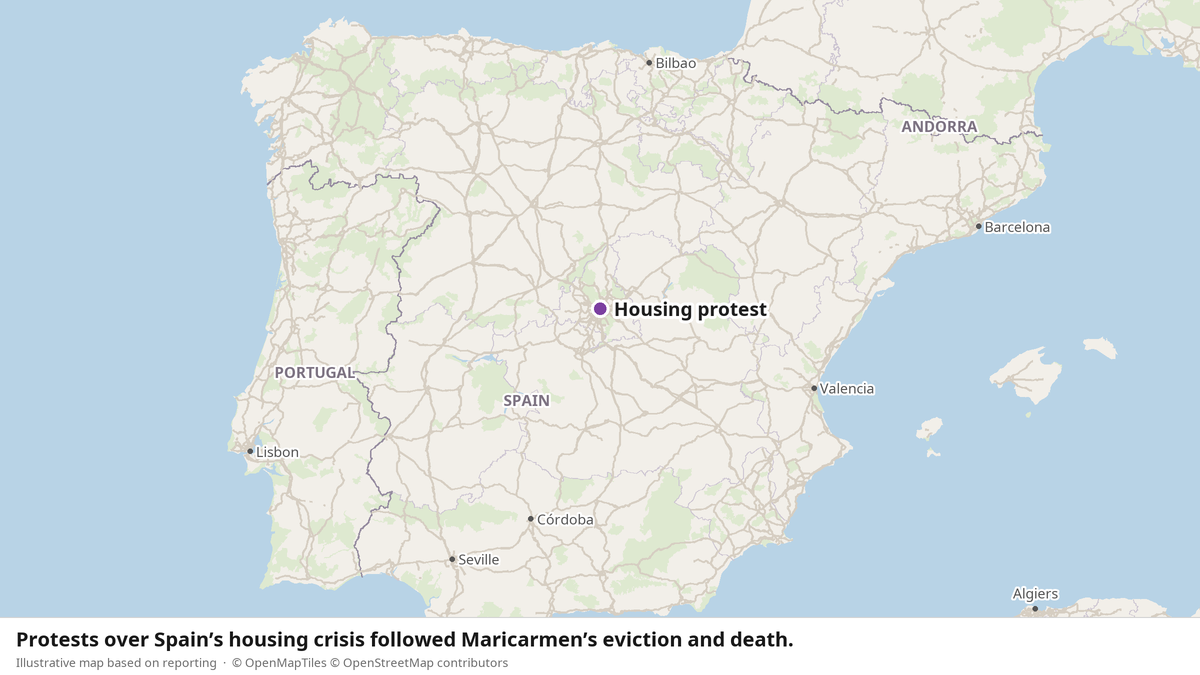
Spain is short roughly 750,000 homes, and the gap could reach one million by 2028. That is the Bank of Spain's estimate. It underlies the grief that filled central Madrid on Thursday, when thousands marched to mark the death of María del Carmen Abascal, the 87-year-old known as Maricarmen, whose eviction on Sept. 23 sparked protests across the country.
She died in hospital on Wednesday. Reuters reported she had been hospitalised for severe anxiety and exhaustion since the eviction; officials haven't announced a cause of death. Her lawyer, Beatriz Duro, didn't disclose one when she confirmed the death to Cadena Ser radio. Maricarmen, a wheelchair user, had lived in the same Madrid apartment for seven decades. Police cordoned off the street and removed protesters as they carried her out on a stretcher. Televised images of that scene spread anger far beyond the capital.
A Political Fight Weeks Before an Election
The protests came amid a political crisis. Socialist Prime Minister Pedro Sánchez called a snap general election for Nov. 29 after Congress rejected his emergency housing measures. Sánchez said he was legislating "against those who consider housing just another object on the market with which to speculate."
The opposition says the government has had its chance. Right-wing critics argue the central government failed to tackle the crisis after eight years in power. Alberto Núñez Feijóo, leader of the conservative People's Party, accused Sánchez and the Socialists of exploiting the issue for political gain. "We will not allow this attempt to manipulate the emotions of the Spanish people; all of this has happened during their eight years in government. It won't fly," he said. Madrid regional leader Isabel Díaz Ayuso also blamed Sánchez, saying his government evicted Maricarmen. Left-leaning parties blamed conservatives for rejecting legislation meant to curb soaring rents.
What the Numbers Say About Supply
Protesters pointed to "vulture funds," landlords and short-term tourist rentals. The data gives a more complicated picture. Jorge Galindo, director at the Esade centre for economic policy, said available figures make it hard to establish how many properties so-called vulture funds hold and use for speculation. Bank of Spain figures from 2024 showed companies owned 8% of rental properties, and Galindo said the data doesn't show a notable concentration among a small number of owners. "When it comes to explaining the rise in rentals, that is not the big cause," he said. "What explains it is the shortage of supply compared to demand over recent years."
The numbers are stark. Spain formed about 1.2 million new households between 2021 and 2025, driven in great part by migrants who contributed to recent economic growth. Builders completed fewer than half a million homes. Construction shrank after the Eurozone crisis, materials grew substantially more expensive after Covid, and a lack of political consensus created legal obstacles to building. "It was not a priority for us to build new houses," Galindo said. "But, once the demographic boom came, we realised how costly it was for us." He added that short-term tourist accommodation probably raises prices in particular urban areas rather than having an overall impact.
The INE counted 3.8 million empty properties, many in depopulated rural areas, others awaiting renovation or caught in inheritance disputes. Idealista reported average rental costs up 84% over the previous 10 years, 113% in central Málaga and just under 150% in Marbella. The government says 26% of Spanish renters spend an average of 40% of their income on rent and utilities, against 18% across the EU. An El País study found the average Spaniard has 5% less spending power in real terms than a decade ago. The average monthly salary in the Madrid region is €1,550.
Public Mood and Policy Pressure
Public opinion favors intervention. A Centre for Sociological Research (CIS) survey published Thursday found 76.3% support market intervention to guarantee access to housing, and 79% believe the right to housing should outrank treating homes as a commodity. Another CIS study found 72% back higher taxes on people with 10 or more properties, 76% want limits on short-term tourist accommodation, and 40% support expropriating empty homes.
Ombudsman Ángel Gabilondo said tackling the crisis requires greater commitment from all levels of government. He reiterated proposals to expand public housing, restrict tourist rentals, increase rent assistance and strengthen eviction protections for vulnerable households.
The voices in the streets were personal. Francisco Pardo, an 81-year-old retired taxi driver, said: "No worker should have to spend 75% or 80% of their salary on rent, because what are they supposed to eat?" Carmen Pérez, a retired widow originally from Ecuador who has lived in Spain for 17 years, has moved in with her daughter and son-in-law while seeking affordable rent. "When a property is listed to rent, there's always a long waiting list," she said.
Maricarmen's case carried a bitter detail. While in hospital, she reached an agreement that would have let her return home, after public pressure moved the real estate company. She died before she could. The Madrid Tenants' Union called it "an entirely avoidable situation following a harrowing ordeal." Several people who had received eviction orders have died by suicide in Spain in recent months.
Why This Matters: Spain's housing crisis is a supply failure, and the economist quoted here says so plainly: demand outran construction. Roughly 1.2 million new households against fewer than half a million new homes can't be fixed by rent controls or by blaming investors alone. The political risk is real. With an election set for Nov. 29, and polls showing broad support for heavy market intervention, voters face competing explanations for the same shortage. Any lasting answer depends on getting homes built, which means clearing the legal obstacles and the lack of political consensus that Galindo identified. It also means being honest about how population growth, including migration, feeds housing demand. A country that can't house its residents, old or new, will keep losing public trust in the institutions meant to serve them. That's a national responsibility, and it's one Madrid, not Brussels, must answer for.