
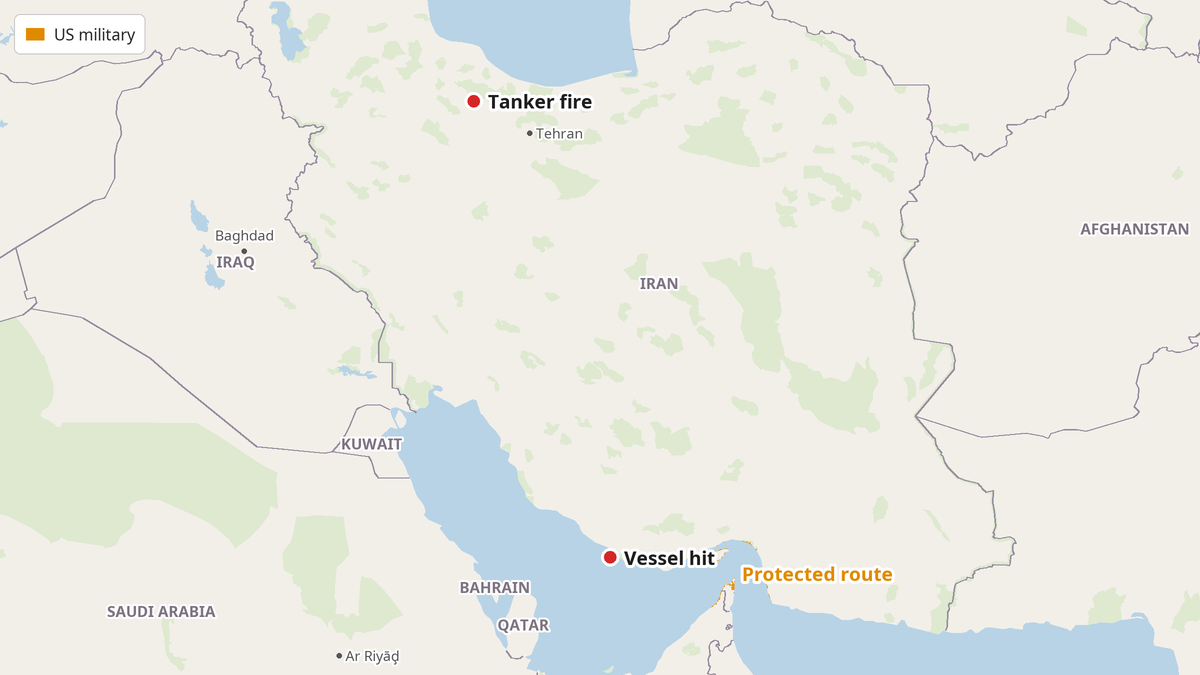
A vessel took an unidentified projectile on its port side roughly 40 nautical miles (74 kilometers) south of Iran's Lavan Island on Friday, and a fire broke out on board. That's the UK Maritime Trade Operations agency's account. The crew was reported safe. The ship's identity and the party responsible stayed unknown. In a separate report, UKMTO said an oil tanker was struck by an unidentified projectile while leaving the Strait of Hormuz. Again, no name attached to the attacker.
The people doing the actual work of moving oil, the crews, ended up on the receiving end of everyone's claims.
The State's Monopoly, Both Banks
Iran's Revolutionary Guard Corps says four oil tankers caught fire after striking naval mines, and that the ships ignored Iranian navigation warnings. The IRGC Navy says the fourth tanker carried more than two million barrels of crude when it hit a mine and exploded. Iranian officials say the ships tried to cross on routes Tehran hadn't authorized, and Iranian state media says some vessels switched off their tracking systems before entering dangerous areas. None of it could be independently verified. It also remained unclear whether the ships in the British warnings were among the four the IRGC cited.
Note the phrase "not authorized by Tehran." Since the war began in late February, about eight months ago, Iran has intensified its efforts to control shipping through the strait, repeatedly warning that vessels crossing without its permission risk attack. One-fifth of global oil supplies normally moves through this narrow water, and a single government is demanding a permit slip for it.
Oman, meanwhile, said it rescued 25 sailors from a Panama-flagged tanker that was attacked and set ablaze near the coast of Musandam governorate. Twenty-five workers pulled from a burning ship. Authorities didn't immediately say whether it was among the vessels Iran mentioned. Iran separately reported that three more oil tankers were halted while transiting.
The Other Navy
The American side tells a tidier story. According to a Wall Street Journal report, the US military flies nightly missions over the strait to enforce a blockade on Iranian ports and to protect commercial vessels. Rear Adm. Jeffrey Heames, who commands the USS George Washington Carrier Strike Group, told the Journal that if a threat is launched at those vessels, "whether it's an anti-ship cruise missile or a drone, those aircraft will go in and intercept it and shoot it down in a very short amount of time." The airspace is about 20 miles wide and crowded with aerial objects, leaving pilots a small window to react.
CENTCOM chief Adm. Brad Cooper, in a video posted to X on Friday, said Iran hasn't been able to export any oil since the blockade began. "Iran's Navy is all at the bottom of the sea," he said, adding, "I didn't see the IRGC out there, at all." CENTCOM says the Navy's protection has let Gulf partners export over 1.5 billion barrels of crude since the summer, and that more than 3,000 commercial vessels transited the strait without incident over six months. Arab News reported that oil shipments have climbed back to pre-war levels despite the ongoing attacks.
Hold those claims up against Friday's burning ships. Two states, each insisting it alone controls who passes and who doesn't, each handing out safety certificates, while hulls burn between the press releases.
Who Pays the Bill
The machinery itself is wearing out. US officials familiar with the missions told the Journal that the nightly operations have strained aircraft, crews and the mechanics who keep the fighter jets flying. Ensign Addie Schaefer, an officer in the carrier's maintenance department, said the more the aircraft fly, the more prone they are to damage and wear. Adm. Daryl Caudle, the chief of naval operations, said a ship maintenance hub has been set up on Diego Garcia, and that more port calls are planned after sailors aboard the USS Abraham Lincoln completed a record-breaking 286 days at sea.
US military leaders say they can hold the blockade as long as needed. Some officials worry the effort could limit the ability to respond to crises elsewhere. The Journal puts the current deployment at 50,000 troops and 20 ships in the Middle East, costing between $2 billion and $3 billion a month in munitions, fuel and supplies.
That's the bill for keeping a waterway open to the oil trade: tens of thousands of conscripted bodies, billions a month, and a Panama-flagged crew pulled from the sea by a third government's rescuers. Nobody in the base reporting asks the crews what they think of the arrangement. The generals and the Guard each get a microphone. The twenty-five sailors get a headcount.
- strait of hormuz
- tanker attacks
- iran
- us-iran war
- naval mines
- persian gulf
- uk maritime trade operations
- us central command