
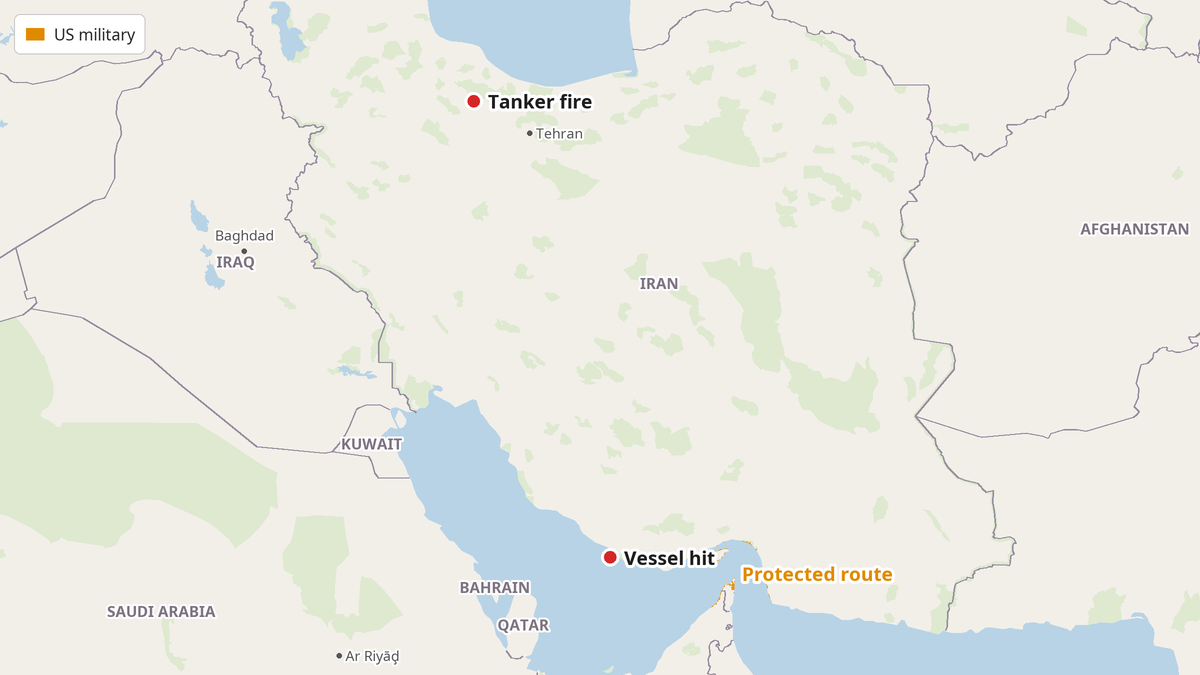
A vessel was struck on its port side by an unidentified projectile roughly 40 nautical miles (74 kilometers) south of Iran's Lavan Island in the Persian Gulf on Friday, the United Kingdom Maritime Trade Operations agency (UKMTO) said. The impact started a fire on board. The crew was reported safe, and no environmental damage had been reported. Neither the vessel's identity nor the party responsible was established.
It wasn't the only incident. In a separate report, UKMTO said an oil tanker was hit by an unidentified projectile as it left the Strait of Hormuz. The agency again named no culprit.
The Security Picture
Iran's Islamic Revolutionary Guard Corps (IRGC) offered its own account. It said four oil tankers caught fire after explosions in the waterway, and it claimed the ships had struck naval mines after ignoring Iranian navigation warnings. According to the IRGC Navy, the fourth tanker carried more than two million barrels of crude when it hit a mine, setting off a powerful explosion and fire. Iranian officials said the tankers tried to cross on routes Tehran hadn't authorized, and that some ignored repeated warnings from Iranian forces. Iranian state media added that some vessels switched off their navigation and tracking systems before entering dangerous areas.
None of that could be independently verified. It also remained unclear whether the ships in the British maritime warnings were among the four the IRGC cited.
Oman said on Friday it rescued 25 sailors from a merchant ship that was targeted and set ablaze in the waterway. The crew was evacuated from a Panama-flagged tanker attacked and burning near the coast of Musandam governorate, close to the strait. Authorities didn't immediately establish whether it was among the vessels Iran mentioned. Separately, Iran reported that three oil tankers were halted while transiting.
The stakes are global. Under normal conditions, roughly one-fifth of the world's oil supply passes through the narrow channel linking the Persian Gulf with the Gulf of Oman. Since the war began in late February, now about eight months into the war, Iran has intensified its efforts to control shipping there, repeatedly warning that vessels crossing without its authorization risk attack. The US-Iran war has narrowed to a fight over the shipping lanes, where Tehran tried to choke off the region's energy exports in response to the initial US-Israeli attacks.
The American Response
The US military is flying nightly missions over the strait as American forces enforce a blockade on Iranian ports and shield commercial vessels from Iranian projectiles, according to a Wall Street Journal report on Thursday. Pilots and aircrew aboard the USS George Washington, deployed in the region since August and roughly three months on station as of October 31, described around-the-clock defense of the waterway. The airspace over the strait is only about 20 miles wide but crowded with aerial objects, service members told the Journal, leaving fighter pilots a narrow window to react to anything launched from Iran's coast.
Rear Adm. Jeffrey Heames, who commands the USS George Washington Carrier Strike Group, said US forces have reliably struck down threats to commercial shipping. "If there's a threat that's launched against those vessels, whether it's an anti-ship cruise missile or a drone, those aircraft will go in and intercept it and shoot it down in a very short amount of time," Heames said.
US Central Command (CENTCOM) puts numbers on the effort. Its protection has allowed Gulf partners to export over 1.5 billion barrels of crude since the summer, and more than 3,000 commercial vessels have transited the strait without incident over the past six months. In a video statement on X/Twitter on Friday, CENTCOM chief Adm. Brad Cooper said Iran hasn't been able to export any oil since the blockade began. On a recent flight over the strait he saw no Iranian military presence, he said, because "Iran's Navy is all at the bottom of the sea." He added: "I didn't see the IRGC out there, at all." Cooper said US forces are keeping the shipping lanes clear of Iranian sea mines after a major operation to remove them.
Arab News reported that Washington has created a protected route that has let oil shipments climb back to pre-war levels despite continued Iranian attacks.
The Strain
The tempo carries a cost. Nightly operations have strained aircraft, crews and the mechanics who maintain the fighter jets, US officials told the Journal. Adm. Daryl Caudle, chief of naval operations, said the Navy is accounting for it. A ship maintenance hub has been set up on Diego Garcia, he said, and more port calls are planned after personnel aboard the USS Abraham Lincoln completed a record-breaking 286-day deployment at sea. Ensign Addie Schaefer, an officer in the carrier's maintenance department, said the more the aircraft fly, the more they're prone to damage and wear.
Military leaders say they can hold the blockade and protect the strait for as long as needed. Some officials worry the resource-heavy mission could limit America's ability to respond to crises elsewhere. The US now has 50,000 troops and 20 ships in the Middle East, costing between $2 billion and $3 billion a month in munitions, fuel and supplies, the Journal reported.
Why This Matters: Iran's strategy rests on one idea: that it can hold a fifth of the world's oil hostage and make the price of resistance too high for others to pay. The record so far, per CENTCOM, shows that approach meeting a sustained counter-effort, with thousands of safe transits and Iranian oil exports reportedly cut to zero. But the strain on American aircraft, crews and budgets is real, and officials themselves worry about readiness for other theaters. For Israel and Gulf states, the outcome shapes whether a regime that fires on shipping and answers for it only with claims of mines and ignored warnings can be deterred. A withdrawal of protection before Iran's capacity to threaten the strait is settled would hand Tehran the leverage it has spent eight months trying to seize.
- strait of hormuz
- tanker attacks
- iran
- us-iran war
- naval mines
- persian gulf
- uk maritime trade operations
- us central command