
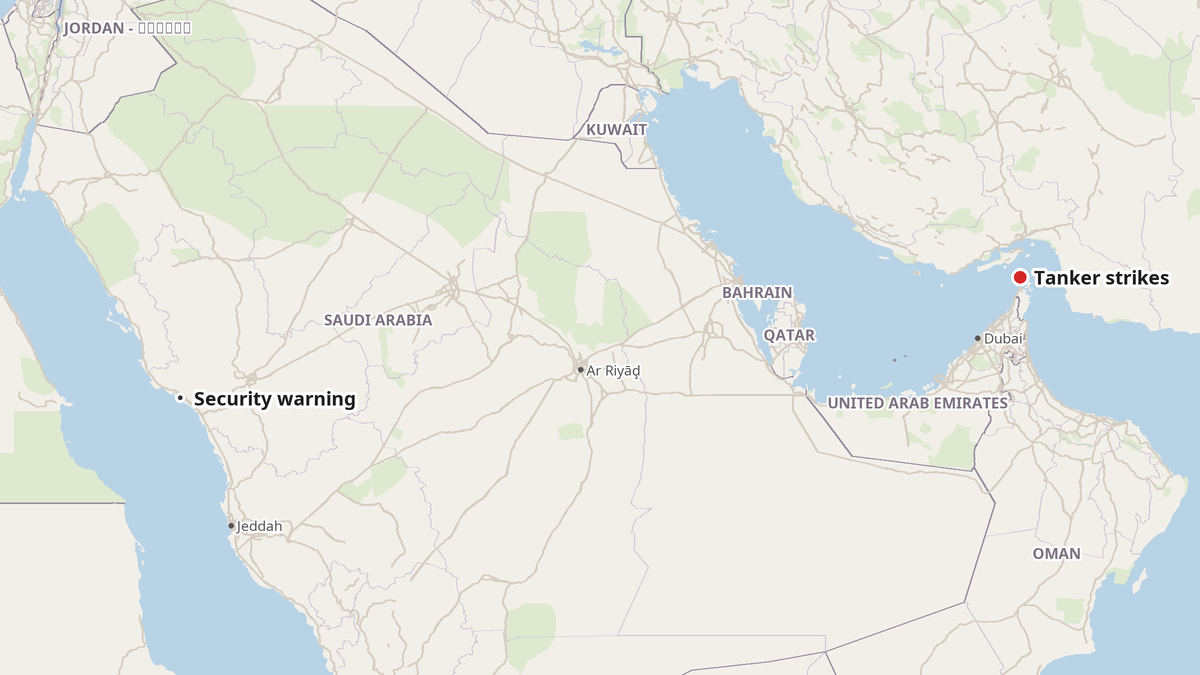
Iranian forces said Thursday that at least five tankers were damaged in the Strait of Hormuz, while the British military separately reported that a tanker was hit by two projectiles off Qatar's coast. The incidents come in the ninth month of a war that began with US-Israeli strikes on Feb. 28, and as Iran keeps its grip on a waterway that normally carries about one-fifth of global oil consumption.
The Islamic Revolutionary Guard Corps told the Fars news agency that a large oil tanker trying to pass through what it called an "illegal passageway" south of the strait caught fire after striking a mine the previous night. Another supertanker caught fire while leaving the eastern strait, the IRGC said, and a tugboat that approached to fight the blaze burned too. Iran's army later claimed three more tankers hit naval mines. None of this has been independently confirmed. The IRGC blamed Washington for encouraging vessels to use the route and said the incidents would raise insurance costs for US taxpayers and regional allies.
The Maritime Threat
The United Kingdom Maritime Trade Operations said a tanker was struck by two projectiles about 50 nautical miles north of Qatar's Madinat ash-Shamal at 23:20 GMT on Wednesday. It named no ship, no flag and no culprit. Last week, the Qatari LNG carrier Al Mayeda was hit by "unidentified objects" in the Gulf, according to Nakilat. No crew were hurt.
The true scale may be worse than the numbers suggest. UKMTO said last month it was "struggling to accurately report" the number of attacks because most ships now refuse to report them. Iran has severely restricted Hormuz traffic since the war began, Al Jazeera reported. Tehran also ties any reopening of the strait to its demands: an end to the US naval blockade, eased sanctions and the release of frozen funds.
The threat reaches beyond the strait. Saudi-led coalition forces said their air defences destroyed a ballistic missile launched by Yemen's Houthis toward the Medina region on Thursday. The Houthis denied targeting Medina and said their operations were aimed at oil facilities and military bases.
The Nuclear Question
Qatar has stepped up mediation. Its Foreign Ministry spokesperson said Tuesday that both sides were reviewing mediator proposals. No date has been set for direct talks, and neither side has accepted a final settlement.
The New York Times, as cited by The Jerusalem Post, reported that Iran is reviewing "concrete proposals" on the future of its nuclear program. The same reporting said a growing number of Iranian clerics and officials were pressing their leaders to reverse the pledge not to pursue nuclear weapons. Former supreme leader Ayatollah Ali Khamenei issued a fatwa forbidding nuclear arms. US and Israeli intelligence agencies, meanwhile, have reported signs Iran is enriching uranium beyond peaceful levels.
The military campaign badly damaged Iran's capabilities but produced no decisive outcome, Daily Sabah reported, leaving the nuclear program unresolved. Supreme Leader Mojtaba Khamenei warned against "even the slightest inclination toward submission," a signal that Tehran isn't softening its Hormuz demands.
Washington's Options
Thousands of US air and naval forces, aboard more than a dozen ships and at bases in the region and the United States, are poised to resume major combat operations on President Donald Trump's orders, unnamed Pentagon officials told The New York Times. Gulf News, citing Axios, said preparations didn't mean Trump had ordered new attacks. Trump said he was in no rush. Vice President JD Vance was reported to favor a negotiated settlement, while CIA Director John Ratcliffe and Treasury Secretary Scott Bessent favored maintaining economic pressure.
Republicans lost both chambers of Congress in the November 3 midterms. Trump acknowledged the war contributed, mainly through higher fuel prices, but said he would do it again to prevent Iran from developing a nuclear weapon.
Gulf voices read the moment differently. Ebtesam al-Ketbi of the Emirates Policy Center said the results make a settlement "more urgent" for Trump "but no easier for Iran." She warned that if Tehran read the vote as proof American resolve had weakened, "it could instead encourage him to launch a new military escalation." Any deal that let Iran impose tolls or political conditions on shipping, she said, would be temporary and lay groundwork for another crisis. Abdulaziz Sager of the Gulf Research Center argued Trump might see confrontation as a chance to "finish the job." A Hezbollah official said the chances of escalation and de-escalation "may be equal." Two senior Iranian sources said they feared Trump might answer his defeat with a strike, even as Tehran's leaders welcomed it.
In a separate thread, court documents unsealed Thursday showed the administration held secret talks with Iran about deporting Iranians while the war continued. Judge Ana Reyes ordered 24-hour notice of finalized plans. The Department of Homeland Security has denied sharing asylum records with Iran.
Why This Matters: Hormuz is the chokepoint where Iran's leverage is most direct. Whoever controls access to a strait carrying a fifth of the world's oil can tax, threaten or close it, and Gulf analysts say any deal that legitimizes tolls or political conditions would only postpone the next crisis. Iran's proxies, from the Houthis to Hezbollah, extend that pressure across the region. Meanwhile an unresolved nuclear program, reports of clerics pushing to abandon the pledge against weapons, and a US political system sending mixed signals leave Tehran reading for weakness. From a security standpoint, a settlement that doesn't guarantee freedom of navigation and verifiable limits on enrichment risks rewarding the behavior it's meant to end.
- strait of hormuz
- iran
- tanker attacks
- qatar
- nuclear talks
- united states
- maritime security
- iran nuclear program